Doomreader

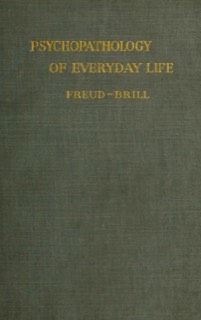
Psychopathology of Everyday Life

by Sigmund Freud

Length: 73,465 words, about 294 pages, about 5 hours to read

Psychology and mind

Read Psychopathology of Everyday Life free, starting with its best pages and lines below. Listen to it free too, read aloud by your phone's own voice.

The best passages

Pages from the book itself, chosen to make you want to read on. Each opens in the reader at that exact spot.

FORGETTING OF FOREIGN WORDS

Last summer, while journeying on my vacation, I renewed the acquaintance of a young man of academic education, who, as I soon noticed, was conversant with some of my works. In our conversation we drifted—I no longer remember how—to the social position of the race to which we both belonged. He, being ambitious, bemoaned the fact that his generation, as he expressed it, was destined to grow crippled, that it was prevented from developing its talents and from gratifying its desires. He concluded his passionately felt speech with the familiar verse from Virgil: Exoriare ... in which the unhappy Dido leaves her vengeance upon Æneas to posterity. Instead of “concluded,” I should have said “wished to conclude,” for he could not bring the quotation to an end, and attempted to conceal the open gap in his memory by transposing the words:—

“Exoriar(e) ex nostris ossibus ultor!”

He finally became piqued and said: “Please don’t make such a mocking face, as if you were gloating over my embarrassment, but help me. There is something missing in this verse. How does it read in its complete form?”

“With pleasure,” I answered, and cited it correctly:—

“Exoriar(e) aliquis nostris ex ossibus ultor!”

“It is too stupid to forget such a word,” he said. “By the way, I understand you claim that forgetting is not without its reasons; I should be very curious to find out how I came to forget this indefinite pronoun ‘aliquis.’”
Keep reading from here

Ode to Apollo

Let us assume that I was so reckless as to take a walk at night in an uninhabited neighbourhood of a big city, and was attacked and robbed of my watch and purse. At the nearest police-station I report the matter in the following words: “I was in this or that street, and was there robbed of my watch and purse by lonesomeness and darkness.” Although these words would not express anything that is incorrect, I would, nevertheless, run the danger of being considered—judging from the wording of this report—as not quite right in the head. To be correct, the state of affairs could only be described by saying that, favoured by the lonesomeness of the place and under cover of darkness, I was robbed of my valuables by unknown malefactors.

Now, then, the state of affairs in forgetting names need not be different. Favoured by exhaustion, circulatory disturbances, and intoxication, I am robbed by an unknown psychic force of the disposal over the proper names belonging to my memory; it is the same force which in other cases may bring about the same failure of memory during perfect health and mental capacity.

Keep reading from here

CHILDHOOD AND CONCEALING MEMORIES

I would like to show by one more example the sense that may be gained by a childhood reminiscence through analytic work, although it may seem to contain no sense before. In my forty-third year, when I began to interest myself in what remained in my memory of my own childhood, a scene struck me which for a long time, as I afterwards believed, had repeatedly come to consciousness, and which through reliable identification could be traced to a period before the completion of my third year. I saw myself in front of a chest, the door of which was held open by my half-brother, twenty years my senior. I stood there demanding something and screaming; my mother, pretty and slender, then suddenly entered the room, as if returning from the street.

In these words I formulated this scene so vividly seen, which, however, furnished no other clue. Whether my brother wished to open or lock the chest (in the first explanation it was a “cupboard”), why I cried, and what bearing the arrival of my mother had, all these questions were dim to me; I was tempted to explain to myself that it dealt with the memory of a hoax by my older brother, which was interrupted by my mother. Such misunderstandings of childhood scenes retained in memory are not uncommon; we recall a situation, but it is not centralized; we do not know on which of the elements to place the psychic accent.

Keep reading from here

ERRONEOUSLY CARRIED-OUT ACTIONS

of my works, in which the reproach was made that I “always went too far,” which I replaced by the less respectful expression “climbed too high.”

(c) For many years a reflex hammer and a tuning-fork lay side by side on my desk. One day I hurried off at the close of my office hours, as I wished to catch a certain train, and, despite broad daylight, put the tuning-fork in my coat pocket in place of the reflex hammer. My attention was called to the mistake through the weight of the object drawing down my pocket. Any one unaccustomed to reflect on such slight occurrences would without hesitation explain the faulty action by the hurry of the moment, and excuse it. In spite of that, I preferred to ask myself why I took the tuning-fork instead of the hammer. The haste could just as well have been a motive for carrying out the action properly in order not to waste time over the correction.

“Who last grasped the tuning-fork?” was the question which immediately flashed through my mind. It happened that only a few days ago an idiotic child, whose attention to sensory impressions I was testing, had been so fascinated by the tuning-fork that I found it difficult to tear it away from him. Could it mean, therefore, that I was an idiot? To be sure, so it would seem, as the next thought which associated itself with the hammer was chamer (Hebrew for “ass”).

Keep reading from here

SYMPTOMATIC AND CHANCE ACTIONS

It must be said that just such symptomatic actions often give us access to the understanding of the intimate psychic life of the person.

Of the many isolated chance-actions, I will relate one example which showed a deeper meaning even without analysis. This example clearly explains the conditions under which such symptoms may be produced most casually, and also shows that an observation of practical importance may be attached to it. During a summer tour it happened that I had to wait several days at a certain place for the arrival of my travelling companions. In the meantime I made the acquaintance of a young man, who also seemed lonely and was quite willing to join me. As we lived at the same hotel it was quite natural that we should take all our meals and our walks together.

On the afternoon of the third day he suddenly informed me that he expected his wife to arrive on that evening’s express train. My psychologic interest was now aroused, as it had already struck me that morning that my companion rejected my proposal to make a long excursion, and in our short walk he objected to a certain path as too steep and dangerous. During our afternoon walk he suddenly thought that I must be hungry and insisted that I should not delay my evening meal on his account, that he would not sup before his wife’s arrival. I understood the hint and seated myself at the table while he went to the station.

The next morning we met in the foyer of the hotel. He presented me to his wife, and added, “Of course, you will breakfast with us?”

Keep reading from here

10 of the best lines

To be sure, I have enough to do with nerves.

Ode to ApolloKeep reading from here

Thus I extend my conscious memory by invoking my larger unconscious memory.

FORGETTING OF IMPRESSIONS AND RESOLUTIONSKeep reading from here

The tendency to forget the disagreeable seems to me to be quite general; the capacity for it is naturally differently developed in different persons.

A. Forgetting of Impressions and Knowledge.Keep reading from here

A year ago you would not have forgotten. Evidently you no longer care for me.

B. Forgetting of Intentions.Keep reading from here

There is a proverb which indicates the popular knowledge that the forgetting of intentions is not accidental. It says: “What one forgets once he will often forget again.”

B. Forgetting of Intentions.Keep reading from here

I cannot maintain that one always makes friends of those to whom he tells the meaning of their symptomatic actions.

SYMPTOMATIC AND CHANCE ACTIONSKeep reading from here

As a matter of fact it can be generally affirmed that every one is continually practising psychoanalysis on his neighbours, and consequently learns to know them better than each individual knows himself.

SYMPTOMATIC AND CHANCE ACTIONSKeep reading from here

It may cause general astonishment to learn how much stronger is the impulse to tell the truth than is usually supposed.

ERRORSKeep reading from here

I do not believe that an occurrence in which my mental life takes no part can teach me anything hidden concerning the future shaping of reality; but I do believe that an unintentional manifestation of my own mental activity surely contains something concealed which belongs only to my mental life

Points of View.Keep reading from here

Allowing these faulty and chance actions to continue corresponds in great part to a comfortable toleration of the unmoral.

Points of View.Keep reading from here

All 26 Psychopathology of Everyday Life quotes, with the words around each

Reviews

No reviews yet. Be the first, in the app.

Write a review in Doomreader

Contents

All 32 parts
  1. INTRODUCTION
  2. Chapter I
  3. FORGETTING OF PROPER NAMES
  4. Chapter II
  5. FORGETTING OF FOREIGN WORDS
  6. Chapter III
  7. FORGETTING OF NAMES AND ORDER OF WORDS
  8. Ode to Apollo
  9. Chapter IV
  10. CHILDHOOD AND CONCEALING MEMORIES
  11. Chapter V
  12. MISTAKES IN SPEECH
  13. Chapter VI
  14. MISTAKES IN READING AND WRITING
  15. A. Lapses in Reading.
  16. B. Lapses in Writing.
  17. Chapter VII
  18. FORGETTING OF IMPRESSIONS AND RESOLUTIONS
  19. A. Forgetting of Impressions and Knowledge.
  20. B. Forgetting of Intentions.
  21. Chapter VIII
  22. ERRONEOUSLY CARRIED-OUT ACTIONS
  23. Chapter IX
  24. SYMPTOMATIC AND CHANCE ACTIONS
  25. Chapter X
  26. ERRORS
  27. Chapter XI
  28. COMBINED FAULTY ACTS
  29. Chapter XII
  30. DETERMINISM—CHANCE—AND SUPERSTITIOUS BELIEFS
  31. Points of View.
  32. FOOTNOTES:

Listen to Psychopathology of Everyday Life free

Psychopathology of Everyday Life as a free audiobook: Doomreader reads any book aloud, free, in your phone's or computer's own voice. Open the book and tap listen, at the speed you like, hands free.

Want a more natural voice? The AI voices read with AI credits.

Listen free in Doomreader

Download Psychopathology of Everyday Life free

The whole book as an EPUB file, free and legal, from Project Gutenberg. It opens in any ebook app, or read it here in Doomreader with nothing to install.

Download the EPUB (0.5 MB)

More by Sigmund Freud

More like Psychopathology of Everyday Life

About this edition

Text from Project Gutenberg. In the public domain in the USA. The Project Gutenberg License is kept inside the file. Every passage and line on this page is the book's own words, checked against the text.