Doomreader

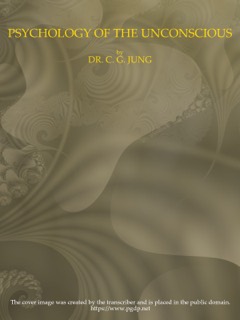
Psychology of the Unconscious

by C. G. Jung

Length: 177,654 words, about 711 pages, about 12 hours to read

Psychology and mind

Read Psychology of the Unconscious free, starting with its best pages and lines below. Listen to it free too, read aloud by your phone's own voice.

The best passages

Pages from the book itself, chosen to make you want to read on. Each opens in the reader at that exact spot.

CHAPTER I CONCERNING THE TWO KINDS OF THINKING

It is a well-known fact that one of the principles of analytic psychology is that the dream images are to be understood symbolically; that is to say, that they are not to be taken literally just as they are presented in sleep, but that behind them a hidden meaning has to be surmised. It is this ancient idea of a dream symbolism which has challenged not only criticism, but, in addition to that, the strongest opposition. That dreams may be full of import, and, therefore, something to be interpreted, is certainly neither a strange nor an extraordinary idea. This has been familiar to mankind for thousands of years, and, therefore, seems much like a banal truth. The dream interpretations of the Egyptians and Chaldeans, and the story of Joseph who interpreted Pharaoh’s dreams, are known to every one, and the dream book of Artemidorus is also familiar. From countless inscribed monuments of all times and peoples we learn of foreboding dreams, of significant, of prophetic and also of curative dreams which the Deity sent to the sick, sleeping in the temple. We know the dream of the mother of Augustus, who dreamt she was to be with child by the Deity transformed into a snake. We will not heap up references and examples to bear witness to the existence of a belief in the symbolism of dreams.
Keep reading from here

CHAPTER I CONCERNING THE TWO KINDS OF THINKING

This problem deserves to be more thoroughly discussed. As a concrete example, let us take the history of the pious Abbé Oegger which Anatole France has communicated to us.[52] This priest was a hypercritical man, and much given to phantasies, especially in regard to one question, viz., the fate of Judas; whether he was really damned, as the teaching of the church asserts, to everlasting punishment, or whether God had pardoned him after all. Oegger sided with the intelligent point of view that God, in his all-wisdom, had chosen Judas as an instrument, in order to bring about the highest point of the work of redemption by Christ.[53] This necessary instrument, without the help of which the human race would not have been a sharer in salvation, could not possibly be damned by the all-good God. In order to put an end to his doubts, Oegger went one night to the church, and made supplication for a sign that Judas was saved. Then he felt a heavenly touch upon his shoulder. Following this, Oegger told the Archbishop of his resolution to go out into the world to preach God’s unending mercy.

Keep reading from here

CHAPTER III THE HYMN OF CREATION

“From Naples to Livorno, the ship travelled for a night, during which I slept more or less well,—my sleep, however, is seldom deep or dreamless. It seemed to me as if my mother’s voice wakened me, just at the end of the following dream. At first I had a vague conception of the words, ‘When the morning stars sang together,’ which were the praeludium of a certain confused representation of creation and of the mighty chorals resounding through the universe. In spite of the strange, contradictory and confused character which is peculiar to the dream, there was mingled in it the chorus of an oratorio which has been given by one of the foremost musical societies of New York, and with that were also memories of Milton’s ‘Paradise Lost.’ Then from out of this whirl, there slowly emerged certain words, which arranged themselves into three strophes and, indeed, they seemed to be in my own handwriting on ordinary blue-lined writing paper on a page of my old poetry book which I always carried around with me; in short, they appeared to me exactly as some minutes later they were in reality in my book.”

Miss Miller now wrote down the following poem, which she rearranged somewhat a few months later, to make it more nearly, in her opinion, like the dream original.

“When the Eternal first made Sound

A myriad ears sprang out to hear,

And throughout all the Universe

There rolled an echo deep and clear:

All glory to the God of Sound!

“When the Eternal first made Light

Keep reading from here

CHAPTER IV THE SONG OF THE MOTH

A little later Miss Miller travelled from Geneva to Paris. She says:

“My weariness on the railway was so great that I could hardly sleep an hour. It was terrifically hot in the ladies’ carriage.”

At four o’clock in the morning she noticed a moth that flew against the light in her compartment. She then tried to go to sleep again. Suddenly the following poem took possession of her mind.

The Moth to the Sun

“I longed for thee when first I crawled to consciousness.

My dreams were all of thee when in the chrysalis I lay.

Oft myriads of my kind beat out their lives

Against some feeble spark once caught from thee.

And one hour more—and my poor life is gone;

Yet my last effort, as my first desire, shall be

But to approach thy glory; then, having gained

One raptured glance, I’ll die content.

For I, the source of beauty, warmth and life

Have in his perfect splendor once beheld.”

Keep reading from here

CHAPTER VII THE DUAL MOTHER RÔLE

“And verily, what I saw was like nothing I ever saw before. I saw a young shepherd, writhing, choking, twitching with a convulsed face, from whose mouth hung a black, heavy serpent.

“Did I ever see so much disgust and pallid fear upon a countenance?[761] Might he have been sleeping, and the snake crept into his mouth—there it bit him fast?

“My hand tore at the serpent and tore—in vain!—I failed to tear the serpent out of his mouth. Then there cried out of me: ‘Bite! Bite! Its head off! Bite!’ I exclaimed; all my horror, my hate, my disgust, my compassion, all the good and bad cried out from me in one voice.

“Ye intrepid ones around me! solve for me the riddle which I saw, make clear to me the vision of the lonesomest one.

“For it was a vision and a prophecy; what did then I behold in parable? And who is it who is still to come?

“Who is the shepherd into whose mouth crept the snake? Who is the man into whose throat all the heaviness and the blackest would creep?[762]

“But the shepherd bit, as my cry had told him; he bit with a huge bite! Far away did he spit the head of the serpent—and sprang up.

Keep reading from here

10 of the best lines

Here, as in no other relation in life, an absolute truth and an absolute honesty are the only basis of action, since deception of any kind deceives no one but the individual himself and acts as a boomerang, defeating his own aims.

AN INTRODUCTION TO PSYCHOANALYSIS AND ANALYTIC PSYCHOLOGYKeep reading from here

The secret of the development of culture lies in the mobility of the libido, and in its capacity for transference.

CHAPTER I CONCERNING THE TWO KINDS OF THINKINGKeep reading from here

Thus the poem is properly only a dream become audible.

CHAPTER III THE HYMN OF CREATIONKeep reading from here

Whoever renounces the chance to experience must stifle in himself the wish for it, and, therefore, commits a sort of self-murder.

CHAPTER IV THE SONG OF THE MOTHKeep reading from here

Man is, indeed, mortal, but there are some who are immortal, or there is something in us which is immortal.

CHAPTER IV THE UNCONSCIOUS ORIGIN OF THE HEROKeep reading from here

To-day there are countless neurotics who are so simply because they do not know how to seek happiness in their own manner.

CHAPTER V SYMBOLISM OF THE MOTHER AND OF REBIRTHKeep reading from here

The wish of young girls to die is only an indirect expression, which remains a pose, even in case of real death, for death itself can be a pose.

CHAPTER VI THE BATTLE FOR DELIVERANCE FROM THE MOTHERKeep reading from here

If he is to live he must fight and sacrifice his longing for the past, in order to rise to his own heights.

CHAPTER VII THE DUAL MOTHER RÔLEKeep reading from here

Work, however, is salvation only when it is a free act, and has in itself nothing of infantile compulsion.

CHAPTER VIII THE SACRIFICEKeep reading from here

The old thoughts come from below in new force in the history of religion. The revolution from below creates a new life of religion in primitive indestructible forms.

CHAPTER VKeep reading from here

All 85 Psychology of the Unconscious quotes, with the words around each

Reviews

No reviews yet. Be the first, in the app.

Write a review in Doomreader

Contents

All 35 parts
  1. PSYCHOLOGY OF THE UNCONSCIOUS A Study of the Transformations and Symbolisms of the Libido A Contribution to the History of the Evolution of Thought
  2. TRANSLATOR’S NOTE
  3. AN INTRODUCTION TO PSYCHOANALYSIS AND ANALYTIC PSYCHOLOGY
  4. The Oedipus Problem
  5. AUTHOR’S NOTE
  6. PART I
  7. INTRODUCTION
  8. CHAPTER I CONCERNING THE TWO KINDS OF THINKING
  9. CHAPTER II THE MILLER PHANTASIES
  10. CHAPTER III THE HYMN OF CREATION
  11. CHAPTER IV THE SONG OF THE MOTH
  12. PART II
  13. CHAPTER I ASPECTS OF THE LIBIDO
  14. CHAPTER II THE CONCEPTION AND THE GENETIC THEORY OF LIBIDO
  15. CHAPTER III THE TRANSFORMATION OF THE LIBIDO. A POSSIBLE SOURCE OF PRIMITIVE HUMAN DISCOVERIES
  16. CHAPTER IV THE UNCONSCIOUS ORIGIN OF THE HERO
  17. CHAPTER V SYMBOLISM OF THE MOTHER AND OF REBIRTH
  18. CHAPTER VI THE BATTLE FOR DELIVERANCE FROM THE MOTHER
  19. CHAPTER VII THE DUAL MOTHER RÔLE
  20. CHAPTER VIII THE SACRIFICE
  21. PART I
  22. INTRODUCTION
  23. CHAPTER I
  24. CHAPTER II
  25. CHAPTER III
  26. CHAPTER IV
  27. PART II
  28. CHAPTER I
  29. CHAPTER II
  30. CHAPTER III
  31. CHAPTER IV
  32. CHAPTER V
  33. CHAPTER VI
  34. CHAPTER VII
  35. CHAPTER VIII

Listen to Psychology of the Unconscious free

Psychology of the Unconscious as a free audiobook: Doomreader reads any book aloud, free, in your phone's or computer's own voice. Open the book and tap listen, at the speed you like, hands free.

Want a more natural voice? The AI voices read with AI credits.

Listen free in Doomreader

Download Psychology of the Unconscious free

The whole book as an EPUB file, free and legal, from Project Gutenberg. It opens in any ebook app, or read it here in Doomreader with nothing to install.

Download the EPUB (2.4 MB)

More by C. G. Jung

More like Psychology of the Unconscious

About this edition

Text from Project Gutenberg. In the public domain in the USA. The Project Gutenberg License is kept inside the file. Every passage and line on this page is the book's own words, checked against the text.