Doomreader

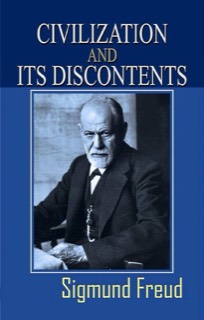
Civilization and Its Discontents

by Sigmund Freud

Length: 34,182 words, about 137 pages, about 2 hours to read

Psychology and mind

Read Civilization and Its Discontents free, starting with its best pages and lines below. Listen to it free too, read aloud by your phone's own voice.

The best passages

Pages from the book itself, chosen to make you want to read on. Each opens in the reader at that exact spot.

Chapter I

The impression forces itself upon one that men measure by false standards, that everyone seeks power, success, riches for himself and admires others who attain them, while undervaluing the truly precious things in life. And yet, in making any general judgement of this kind one is in danger of forgetting the manifold variety of humanity and its mental life. There are certain men from whom their contemporaries do not withhold veneration, although their greatness rests on attributes and achievements which are completely foreign to the aims and ideals of the multitude. One might well be inclined to suppose that after all it is only a minority who appreciate these great men, while the majority cares nothing for them. But the discrepancy between men’s opinions and their behaviour is so wide and their desires so many-sided that things are probably not so simple.

One of these exceptional men calls himself my friend in his letters to me. I had sent him my little book which treats of religion as an illusion and he answered that he agreed entirely with my views on religion, but that he was sorry I had not properly appreciated the ultimate source of religious sentiments. This consists in a peculiar feeling, which never leaves him personally, which he finds shared by many others, and which he may suppose millions more also experience. It is a feeling which he would like to call a sensation of ‘eternity’, a feeling as of something limitless, unbounded, something ‘oceanic’.

Keep reading from here

Chapter I

This brings us very close to the more general problem of conservation in the mind, which has so far hardly been discussed, but is so interesting and important that we may take the opportunity to pay it some attention, even though its relevance is not immediate. Since the time when we recognized the error of supposing that ordinary forgetting signified destruction or annihilation of the memory-trace, we have been inclined to the opposite view that nothing once formed in the mind could ever perish, that everything survives in some way or other, and is capable under certain conditions of being brought to light again, as, for instance, when regression extends back far enough. One might try to picture to oneself what this assumption signifies by a comparison taken from another field. Let us choose the history of the Eternal City as an example.⁠[3] Historians tell us that the oldest Rome of all was the Roma quadrata, a fenced settlement on the Palatine. Then followed the phase of the Septimontium, when the colonies on the different hills united together; then the town which was bounded by the Servian wall; and later still, after all the transformations in the periods of the republic and the early Caesars, the city which the Emperor Aurelian enclosed by his walls.

Keep reading from here

Chapter II

The question, ‘What is the purpose of human life?’ has been asked times without number; it has never received a satisfactory answer; perhaps it does not admit of such an answer. Many a questioner has added that if it should appear that life has no purpose, then it would lose all value for him. But these threats alter nothing. It looks, on the contrary, as though one had a right to dismiss this question, for it seems to presuppose that belief in the superiority of the human race with which we are already so familiar in its other expressions. Nobody asks what is the purpose of the lives of animals, unless peradventure they are designed to be of service to man. But this, too, will not hold, for with many animals man can do nothing—except describe, classify and study them; and countless species have declined to be put even to this use, by living and dying and becoming extinct before men had set eyes upon them. So again, only religion is able to answer the question of the purpose of life. One can hardly go wrong in concluding that the idea of a purpose in life stands and falls with the religious system.

We will turn, therefore, to the less ambitious problem, what the behaviour of men themselves reveals as the purpose and object of their lives, what they demand of life and wish to attain in it. The answer to this can hardly be in doubt: they seek happiness, they want to become happy and to remain so.

Keep reading from here

Chapter II

I do not suppose that I have enumerated all the methods by which men strive to win happiness and keep suffering at bay, and I know, too, that the material might have been arranged differently. One of these methods I have not yet mentioned at all—not because I had forgotten it, but because it will interest us in another connection. How would it be possible to forget this way of all others of practising the art of life! It is conspicuous for its remarkable capacity to combine characteristic features. Needless to say, it, too, strives to bring about independence of fate—as we may best call it—and with this object it looks for satisfaction within the mind, and uses the capacity for displacing libido which we mentioned before, but it does not turn away from the outer world; on the contrary, it takes a firm hold of its objects and obtains happiness from an emotional relation to them. Nor is it content to strive for avoidance of pain—that goal of weary resignation; rather it passes that by heedlessly and holds fast to the deep-rooted, passionate striving for a positive fulfilment of happiness. Perhaps it really comes nearer to this goal than any other method. I am speaking, of course, of that way of life which makes love the centre of all things and anticipates all happiness from loving and being loved. This attitude is familiar enough to all of us; one of the forms in which love manifests itself, sexual love, gives us our most intense experience of an overwhelming pleasurable sensation and so furnishes a prototype for our strivings after happiness. What is more natural than that we should persist in seeking happiness along the path by which we first encountered it?

Keep reading from here

Chapter V

When I look more closely I find still further difficulties. Not merely is this stranger on the whole not worthy of love, but, to be honest, I must confess he has more claim to my hostility, even to my hatred. He does not seem to have the least trace of love for me, does not show me the slightest consideration. If it will do him any good, he has no hesitation in injuring me, never even asking himself whether the amount of advantage he gains by it bears any proportion to the amount of wrong done to me. What is more, he does not even need to get an advantage from it; if he can merely get a little pleasure out of it, he thinks nothing of jeering at me, insulting me, slandering me, showing his power over me; and the more secure he feels himself, or the more helpless I am, with so much more certainty can I expect this behaviour from him towards me. If he behaved differently, if he showed me consideration and did not molest me, I should in any case, without the aforesaid commandment, be willing to treat him similarly. If the high-sounding ordinance had run: ‘Love thy neighbour as thy neighbour loves thee’, I should not take objection to it. And there is a second commandment that seems to me even more incomprehensible, and arouses still stronger opposition in me. It is: ‘Love thine enemies’. When I think it over, however, I am wrong in treating it as a greater imposition. It is at bottom the same thing.⁠[16]

Keep reading from here

10 of the best lines

Life as we find it is too hard for us; it entails too much pain, too many disappointments, impossible tasks.

Chapter IIKeep reading from here

Needless to say, no one who shares a delusion recognizes it as such.

Chapter IIKeep reading from here

There is no very evident use in beauty; the necessity of it for cultural purposes is not apparent, and yet civilization could not do without it.

Chapter IIKeep reading from here

Man has become a god by means of artificial limbs, so to speak, quite magnificent when equipped with all his accessory organs; but they do not grow on him and they still give him trouble at times.

Chapter IIIKeep reading from here

Eros and Ananke were the parents of human culture, too.

Chapter IVKeep reading from here

One is irresistibly reminded here of an incident in the French Chamber when capital punishment was being discussed; the speech of a member who had passionately supported its abolition was being applauded with loud acclamation, when suddenly a voice was heard calling out from the back of the room, ‘Que messieurs les assassins commencent!’

Chapter VKeep reading from here

One only wonders, with some concern, however, how the Soviets will manage when they have exterminated their bourgeois entirely.

Chapter VKeep reading from here

And it is this battle of the Titans that our nurses and governesses try to compose with their lullaby-song of Heaven!

Chapter VIKeep reading from here

What an overwhelming obstacle to civilization aggression must be if the defence against it can cause as much misery as aggression itself!

Chapter VIIIKeep reading from here

Sending the young out into life with such a false psychological orientation is as if one were to equip people going on a Polar expedition with summer clothing and maps of the Italian lakes.

FOOTNOTES:Keep reading from here

All 21 Civilization and Its Discontents quotes, with the words around each

Reviews

No reviews yet. Be the first, in the app.

Write a review in Doomreader

Contents

  1. TRANSLATOR’S NOTE
  2. Chapter I
  3. FOOTNOTES:
  4. Chapter II
  5. FOOTNOTES:
  6. Chapter III
  7. FOOTNOTES:
  8. Chapter IV
  9. FOOTNOTES:
  10. Chapter V
  11. FOOTNOTES:
  12. Chapter VI
  13. FOOTNOTES:
  14. Chapter VII
  15. FOOTNOTES:
  16. Chapter VIII
  17. FOOTNOTES:

Listen to Civilization and Its Discontents free

Civilization and Its Discontents as a free audiobook: Doomreader reads any book aloud, free, in your phone's or computer's own voice. Open the book and tap listen, at the speed you like, hands free.

Want a more natural voice? The AI voices read with AI credits.

Listen free in Doomreader

Download Civilization and Its Discontents free

The whole book as an EPUB file, free and legal, from Project Gutenberg. It opens in any ebook app, or read it here in Doomreader with nothing to install.

Download the EPUB (0.3 MB)

More by Sigmund Freud

More like Civilization and Its Discontents

About this edition

Text from Project Gutenberg. In the public domain in the USA. The Project Gutenberg License is kept inside the file. Every passage and line on this page is the book's own words, checked against the text.