Doomreader

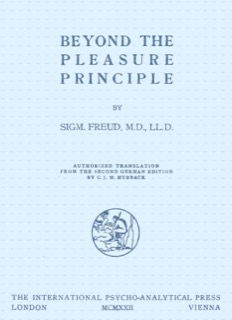
Beyond the Pleasure Principle

by Sigmund Freud

Length: 22,491 words, about 90 pages, about 2 hours to read

Psychology and mind

Read Beyond the Pleasure Principle free, starting with its best pages and lines below. Listen to it free too, read aloud by your phone's own voice.

The best passages

Pages from the book itself, chosen to make you want to read on. Each opens in the reader at that exact spot.

Chapter I

In the psycho-analytical theory of the mind we take it for granted that the course of mental processes is automatically regulated by ‘the pleasure-principle’: that is to say, we believe that any given process originates in an unpleasant state of tension and thereupon determines for itself such a path that its ultimate issue coincides with a relaxation of this tension, i. e. with avoidance of ‘pain’ or with production of pleasure. When we consider the psychic processes under observation in reference to such a sequence we are introducing into our work the economic point of view. In our opinion a presentation which seeks to estimate, not only the topographical and dynamic, but also the economic element is the most complete that we can at present imagine, and deserves to be distinguished by the term metapsychological.

Keep reading from here

Chapter II

After severe shock of a mechanical nature, railway collision or other accident in which danger to life is involved, a condition may arise which has long been recognised and to which the name ‘traumatic neurosis’ is attached. The terrible war that is just over has been responsible for an immense number of such maladies and at least has put an end to the inclination to explain them on the basis of organic injury to the nervous system due to the operation of mechanical force.[2] The clinical picture of traumatic neurosis approaches that of hysteria in its wealth of similar motor symptoms, but usually surpasses it in its strongly marked signs of subjective suffering—in this resembling rather hypochondria or melancholia—and in the evidences of a far more comprehensive general weakening and shattering of the mental functions. Neither the war neuroses nor the traumatic neuroses of peace are as yet fully understood. With the war neuroses some light was contributed, but also on the other hand a certain confusion introduced, by the fact that the same type of malady could occasionally occur without the interposition of gross mechanical force. In the traumatic neuroses there are two outstanding features which might serve as clues for further reflection: first that the chief causal factor seemed to lie in the element of surprise, in the fright; and secondly that an injury or wound sustained at the same time generally tended to prevent the occurrence of the neurosis.

Keep reading from here

Chapter II

I propose now to leave the obscure and gloomy theme of the traumatic neuroses and to study the way in which the psychic apparatus works in one of its earliest normal activities. I refer to the play of children.

The different theories of child-play have recently been collated by S. Pfeifer in Imago[3] and their analytical value estimated; I may here refer the reader to this work. These theories endeavour to conjecture the motives of children’s play, though without placing any special stress on the ‘economic’ point of view, i. e. consideration of the attainment of pleasure. Without the intention of making a comprehensive study of these phenomena I availed myself of an opportunity which offered of elucidating the first game invented by himself of a boy eighteen months old. It was more than a casual observation, for I lived for some weeks under the same roof as the child and his parents, and it was a considerable time before the meaning of his puzzling and continually repeated performance became clear to me.

Keep reading from here

Chapter II

The child was in no respect forward in his intellectual development; at eighteen months he spoke only a few intelligible words, making besides sundry significant sounds which were understood by those about him. But he made himself understood by his parents and the maid-servant, and had a good reputation for behaving ‘properly’. He did not disturb his parents at night; he scrupulously obeyed orders about not touching various objects and not going into certain rooms; and above all he never cried when his mother went out and left him for hours together, although the tie to his mother was a very close one: she had not only nourished him herself, but had cared for him and brought him up without any outside help. Occasionally, however, this well-behaved child evinced the troublesome habit of flinging into the corner of the room or under the bed all the little things he could lay his hands on, so that to gather up his toys was often no light task. He accompanied this by an expression of interest and gratification, emitting a loud long-drawn-out ‘o-o-o-oh’ which in the judgement of the mother (one that coincided with my own) was not an interjection but meant ‘go away’ (fort). I saw at last that this was a game, and that the child used all his toys only to play ‘being gone’ (fortsein) with them. One day I made an observation that confirmed my view. The child had a wooden reel with a piece of string wound round it.

Keep reading from here

Chapter IV

What follows now is speculation, speculation often far-fetched, which each will according to his particular attitude acknowledge or neglect. Or one may call it the exploitation of an idea out of curiosity to see whither it will lead.

Psycho-analytic speculation starts from the impression gained on investigating unconscious processes that consciousness cannot be the most general characteristic of psychic processes, but merely a special function of them. Metapsychologically expressed, it asserts that consciousness is the functioning of a particular system which may be called Bw. Since consciousness essentially yields perceptions of excitations coming from without and feelings (Empfindungen) of pleasure and ‘pain’ which can only be derived from within the psychic apparatus, we may allot the system W-Bw.[10] (= perceptual consciousness) a position in space. It must lie on the boundary between outer and inner, must face towards the outer world, and must envelop the other psychic systems. We then note that in this assumption we have ventured nothing new, but are in agreement with the localising tendencies of cerebral anatomy, which places the ‘seat’ of consciousness in the cortical layer, the outermost enveloping layer of the central organ. Cerebral anatomy does not need to wonder why—anatomically speaking—consciousness should be accomodated on the surface of the brain, instead of being safely lodged somewhere in the deepest recesses of it. Perhaps we may carry matters a little further than this in our deduction of such a position for our system W-Bw.

Consciousness is not the only peculiar feature that we ascribe to the processes in this system.

Keep reading from here

10 of the best lines

Fright, fear, apprehension are incorrectly used as synonymous expressions: in their relation to danger they admit of quite clear distinction.

Chapter IIKeep reading from here

We see that children repeat in their play everything that has made a great impression on them in actual life, that they thereby abreact the strength of the impression and so to speak make themselves masters of the situation.

Chapter IIKeep reading from here

Or one may call it the exploitation of an idea out of curiosity to see whither it will lead.

Chapter IVKeep reading from here

Novelty is always the necessary condition of enjoyment.

Chapter VKeep reading from here

The rudimentary creature would from its very beginning not have wanted to change, would, if circumstances had remained the same, have always merely repeated the same course of existence.

Chapter VKeep reading from here

Everyone posited as many instincts or ‘fundamental instincts’ as he pleased, and contrived with them just as the ancient Greek philosophers did with their four elements: earth, air, fire and water.

Chapter VIKeep reading from here

But we must admit that we are working here at an equation with two unknown quantities.

Chapter VIKeep reading from here

One may inexorably reject theories that are contradicted by the very first steps in the analysis of observation and yet at the same time be aware that those one holds oneself have only a tentative validity.

Chapter VIKeep reading from here

One may surely give oneself up to a line of thought, and follow it up as far as it leads, simply out of scientific curiosity, or—if you prefer—as advocatus diaboli, without, however, making a pact with the devil about it.

Chapter VIKeep reading from here

Whither we cannot fly, we must go limping.

Chapter VIIKeep reading from here

All 15 Beyond the Pleasure Principle quotes, with the words around each

Reviews

No reviews yet. Be the first, in the app.

Write a review in Doomreader

Contents

  1. EDITORIAL PREFACE
  2. Chapter I
  3. Chapter II
  4. Chapter III
  5. Chapter IV
  6. Chapter V
  7. Chapter VI
  8. Chapter VII

Listen to Beyond the Pleasure Principle free

Beyond the Pleasure Principle as a free audiobook: Doomreader reads any book aloud, free, in your phone's or computer's own voice. Open the book and tap listen, at the speed you like, hands free.

Want a more natural voice? The AI voices read with AI credits.

Listen free in Doomreader

Download Beyond the Pleasure Principle free

The whole book as an EPUB file, free and legal, from Project Gutenberg. It opens in any ebook app, or read it here in Doomreader with nothing to install.

Download the EPUB (0.4 MB)

More by Sigmund Freud

More like Beyond the Pleasure Principle

About this edition

Text from Project Gutenberg. In the public domain in the USA. The Project Gutenberg License is kept inside the file. Every passage and line on this page is the book's own words, checked against the text.