Doomreader

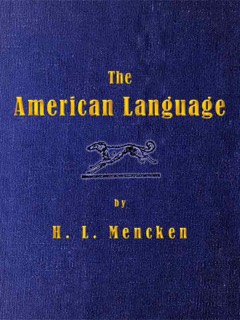
The American Language

by H. L. Mencken

Length: 141,547 words, about 566 pages, about 10 hours to read

Essays and ideas

Read The American Language free, starting with its best pages and lines below. Listen to it free too, read aloud by your phone's own voice.

The best passages

Pages from the book itself, chosen to make you want to read on. Each opens in the reader at that exact spot.

The Diverging Streams

—Thomas Jefferson, with his usual prevision, saw clearly more than a century ago that the American people, as they increased in numbers and in the diversity of their national interests and racial strains, would make changes in their mother tongue, as they had already made changes in the political institutions of their inheritance. "The new circumstances under which we are placed," he wrote to John Waldo from Monticello on August 16, 1813, "call for new words, new phrases, and for the transfer of old words to new objects. An American dialect will therefore be formed."

Nearly a quarter of a century before this, another great American, and one with an expertness in the matter that the too versatile Jefferson could not muster, had ventured upon a prophecy even more bold and specific. He was Noah Webster, then at the beginning of his stormy career as a lexicographer. In his little volume of "Dissertations on the English Language," printed in 1789 and dedicated to "His Excellency, Benjamin Franklin, Esq., LL.D., F.R.S., late President of the Commonwealth of Pennsylvania," Webster argued that the time for regarding English usage and submitting to English authority had already passed, and that "a future separation of the American tongue from the English" was "necessary and unavoidable." "Numerous local causes," he continued, "such as a new country, new associations of people, new combinations of ideas in arts and sciences, and some intercourse with tribes wholly unknown in Europe, will introduce new words into the American tongue.
Keep reading from here

The Characters of American

Of the intrinsic differences that separate American from English the chief have their roots in the obvious disparity between the environment and traditions of the American people since the seventeenth century and those of the English. The latter have lived under a stable social order, and it has impressed upon their souls their characteristic respect for what is customary and of [Pg022] good report. Until the war brought chaos to their institutions, their whole lives were regulated, perhaps more than those of any other people save the Spaniards, by a regard for precedent. The Americans, though largely of the same blood, have felt no such restraint, and acquired no such habit of conformity. On the contrary, they have plunged to the other extreme, for the conditions of life in their new country have put a high value upon the precisely opposite qualities of curiosity and daring, and so they have acquired that character of restlessness, that impatience of forms, that disdain of the dead hand, which now broadly marks them. From the first, says a recent literary historian, they have been "less phlegmatic, less conservative than the English. There were climatic influences, it may be; there was surely a spirit of intensity everywhere that made for short effort."[43] Thus, in the arts, and thus in business, in politics, in daily intercourse, in habits of mind and speech.

Keep reading from here

In Colonial Days

—William Gifford, the first editor of the Quarterly Review, is authority for the tale that some of the Puritan clergy of New England, during the Revolution, proposed that English be formally abandoned as the national language of America, and Hebrew adopted in its place. An American chronicler, Charles Astor Bristed, makes the proposed tongue Greek, and reports that the change was rejected on the ground that "it would be more convenient for us to keep the language as it is, and make the English speak Greek."[1] The story, though it has the support of the editors of the Cambridge History of American Literature,[2] has an apocryphal smack; one suspects that the savagely anti-American Gifford invented it. But, true or false, it well indicates the temper of those times. The passion for complete political independence of England bred a general hostility to all English authority, whatever its character, and that hostility, in the direction of present concern to us, culminated in the revolutionary attitude of Noah Webster's "Dissertations on the English Language," printed in 1789. Webster harbored no fantastic notion of abandoning English altogether, but he was eager to set up American as a distinct and independent dialect. "Let us," he said, "seize the present moment, and establish a national language as well as a national government.... As an independent nation our honor requires [Pg037] us to have a system of our own, in language as well as government."

Keep reading from here

The Expanding Vocabulary

Of these coinages, perhaps those of the second class are most numerous and characteristic. In them American exhibits one of its most marked tendencies: a habit of achieving short cuts in speech by a process of agglutination. Why explain laboriously, as an Englishman might, that the notes of a new bank (in a day of innumerable new banks) are insufficiently secure? Call [Pg081] them wild-cat notes and have done! Why describe a gigantic rain storm with the lame adjectives of everyday? Call it a cloud-burst and immediately a vivid picture of it is conjured up. Rough-neck is a capital word; it is more apposite and savory than the English navvy, and it is overwhelmingly more American.[18] Square-meal is another. Fire-eater is yet another. And the same instinct for the terse, the eloquent and the picturesque is in boiled-shirt, blow-out, big-bug, claim-jumper, spread-eagle, come-down, back-number, claw-hammer (coat), bottom-dollar, poppy-cock, cold-snap, back-talk, back-taxes, calamity-howler, cut-off, fire-bug, grab-bag, grip-sack, grub-stake, pay-dirt, tender-foot, stocking-feet, ticket-scalper, store-clothes, small-potatoes, cake-walk, prairie-schooner, round-up, snake-fence, flat-boat, under-the-weather, on-the-hoof, and jumping-off-place. These compounds (there must be thousands of them) have been largely responsible for giving the language its characteristic tang and color. Such specimens as bell-hop, semi-occasional, chair-warmer and down-and-out are as distinctively American as baseball or the quick-lunch.

The spirit of the language appears scarcely less clearly in some of the coinages of the other classes.

Keep reading from here

Geographical Names

—"There is no part of the world," said Robert Louis Stevenson, "where nomenclature is so rich, poetical, humorous and picturesque as in the United States of America." A glance at the latest United States Official Postal Guide[36] or report of the United States Geographic Board[37] quite bears out this opinion. The map of the country is besprinkled with place names from at least half a hundred languages, living and dead, and among them one finds examples of the most daring and elaborate fancy. There are Spanish, French and Indian names as melodious and charming as running water; there are names out of the histories and mythologies of all the great races of man; there are names grotesque and names almost sublime. No other country can match them for interest and variety. When there arises among us a philologist who will study them as thoroughly and intelligently as the Swiss, Johann Jakob Egli, studied the place names of Central Europe, his work will be an invaluable contribution to the history of the nation, and no less to an understanding of the psychology of its people.

Keep reading from here

10 of the best lines

A new fallacy in politics spreads faster in the United States than anywhere else on earth, and so does a new fashion in hats, or a new revelation of God, or a new means of killing time, or a new metaphor or piece of slang.

The Characters of AmericanKeep reading from here

English has been arrested in its growth by its purists and grammarians.

The Characters of AmericanKeep reading from here

These early Americans were not botanists.

New Words of English MaterialKeep reading from here

Pen in hand, they might still achieve laborious imitations of Johnson and Macaulay, but their mouths began to betray them.

The Language in the MakingKeep reading from here

The pound and the shilling became extinct a century ago, but the penny still binds us to the mother tongue.

International ExchangesKeep reading from here

Speech itself, indeed, would become almost impossible if the grammarians could follow their own rules unfailingly, and were always right.

Grammarians and Their WaysKeep reading from here

Funny connotes the whole range of the unusual; hard indicates every shade of difficulty; nice is everything satisfactory; bully is a superlative of almost limitless scope.

The Noun and AdjectiveKeep reading from here

The map of the country is besprinkled with place names from at least half a hundred languages, living and dead, and among them one finds examples of the most daring and elaborate fancy.

Geographical NamesKeep reading from here

It is constantly forgotten by purists of defective philological equipment that a great many of our most respectable words and phrases originated in the plainest sort of slang.

American SlangKeep reading from here

But that is the way that new dialects always come in—through a drum-fire of cackles.

The Future of the LanguageKeep reading from here

All 50 The American Language quotes, with the words around each

Reviews

No reviews yet. Be the first, in the app.

Write a review in Doomreader

Contents

All 71 parts
  1. PREFACE
  2. I By Way of Introduction
  3. The Diverging Streams
  4. The Academic Attitude
  5. The View of Writing Men
  6. Foreign Observers
  7. The Characters of American
  8. The Materials of American
  9. Footnotes
  10. II The Beginnings of American
  11. In Colonial Days
  12. Sources of Early Americanisms
  13. New Words of English Material
  14. Changed Meanings
  15. Archaic English Words
  16. Colonial Pronunciation
  17. Footnotes
  18. III The Period of Growth
  19. The New Nation
  20. The Language in the Making
  21. The Expanding Vocabulary
  22. Loan-Words
  23. Pronunciation
  24. Footnotes
  25. IV American and English Today
  26. The Two Vocabularies
  27. Differences in Usage
  28. Honorifics
  29. Euphemisms and Forbidden Words
  30. Footnotes
  31. V Tendencies in American
  32. International Exchanges
  33. Points of Difference
  34. Lost Distinctions
  35. Foreign Influences Today
  36. Processes of Word Formation
  37. Pronunciation
  38. Footnotes
  39. VI The Common Speech
  40. Grammarians and Their Ways
  41. Spoken American As It Is
  42. The Verb
  43. The Pronoun
  44. The Adverb
  45. The Noun and Adjective
  46. The Double Negative
  47. Pronunciation
  48. Footnotes
  49. VII Differences in Spelling
  50. Typical Forms
  51. General Tendencies
  52. The Influence of Webster
  53. Exchanges
  54. Simplified Spelling
  55. Minor Differences
  56. Footnotes
  57. VIII Proper Names in America
  58. Surnames
  59. Given Names
  60. Geographical Names
  61. Street Names
  62. Footnotes
  63. IX Miscellanea
  64. Proverb and Platitude
  65. American Slang
  66. The Future of the Language
  67. Footnotes
  68. Bibliography
  69. Footnotes
  70. List of Words and Phrases
  71. General Index

Listen to The American Language free

The American Language as a free audiobook: Doomreader reads any book aloud, free, in your phone's or computer's own voice. Open the book and tap listen, at the speed you like, hands free.

Want a more natural voice? The AI voices read with AI credits.

Listen free in Doomreader

Download The American Language free

The whole book as an EPUB file, free and legal, from Project Gutenberg. It opens in any ebook app, or read it here in Doomreader with nothing to install.

Download the EPUB (0.5 MB)

More by H. L. Mencken

More like The American Language

About this edition

Text from Project Gutenberg. In the public domain in the USA. The Project Gutenberg License is kept inside the file. Every passage and line on this page is the book's own words, checked against the text.