Doomreader

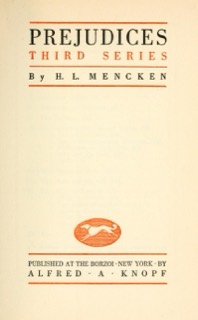
Prejudices, Third Series

by H. L. Mencken

Length: 75,082 words, about 300 pages, about 5 hours to read

Essays and ideas

Read Prejudices, Third Series free, starting with its best pages and lines below. Listen to it free too, read aloud by your phone's own voice.

The best passages

Pages from the book itself, chosen to make you want to read on. Each opens in the reader at that exact spot.

I. ON BEING AN AMERICAN 1

Apparently there are those who begin to find it disagreeable—nay, impossible. Their anguish fills the Liberal weeklies, and every ship that puts out from New York carries a groaning cargo of them, bound for Paris, London, Munich, Rome and way points—anywhere to escape the great curses and atrocities that make life intolerable for them at home. Let me say at once that I find little to cavil at in their basic complaints. In more than one direction, indeed, I probably go a great deal further than even the Young Intellectuals. It is, for example, one of my firmest and most sacred beliefs, reached after an inquiry extending over a score of years and supported by incessant prayer and meditation, that the government of the United States, in both its legislative arm and its executive arm, is ignorant, incompetent, corrupt, and disgusting—and from this judgment I except no more than twenty living lawmakers and no more than twenty executioners of their laws. It is a belief no less piously cherished that the administration of justice in the Republic is stupid, dishonest, and against all reason and equity—and from this judgment I except no more than thirty judges, including two upon the bench of the Supreme Court of the United States. It is another that the foreign policy of the United States—its habitual manner of dealing with other nations, whether friend or foe—is hypocritical, disingenuous, knavish, and dishonorable—and from this judgment I consent to no exceptions whatever, either recent or long past.
Keep reading from here

II. HUNEKER: A MEMORY

There was a stimulating aliveness about him always, an air of living eagerly and a bit recklessly, a sort of defiant resiliency. In his very frame and form something provocative showed itself—an insolent singularity, obvious to even the most careless glance. That Caligulan profile of his was more than simply unusual in a free republic, consecrated to good works; to a respectable American, encountering it in the lobby of the Metropolitan or in the smoke-room of a Doppelschrauben-schnellpostdampfer, it must have suggested inevitably the dark enterprises and illicit metaphysics of a Heliogabalus. More, there was always something rakish and defiant about his hat—it was too white, or it curled in the wrong way, or a feather peeped from the band—, and a hint of antinomianism in his cravat. Yet more, he ran to exotic tastes in eating and drinking, preferring occult goulashes and risi-bisis to honest American steaks, and great floods of Pilsner to the harsh beverages of God-fearing men. Finally, there was his talk, that cataract of sublime trivialities: gossip lifted to the plane of the gods, the unmentionable bedizened with an astounding importance, and even profundity.

Keep reading from here

III. FOOTNOTE ON CRITICISM

Truth, indeed, is something that is believed in completely only by persons who have never tried personally to pursue it to its fastnesses and grab it by the tail. It is the adoration of second-rate men—men who always receive it at second-hand. Pedagogues believe in immutable truths and spend their lives trying to determine them and propagate them; the intellectual progress of man consists largely of a concerted effort to block and destroy their enterprise. Nine times out of ten, in the arts as in life, there is actually no truth to be discovered; there is only error to be exposed. In whole departments of human inquiry it seems to me quite unlikely that the truth ever will be discovered. Nevertheless, the rubber-stamp thinking of the world always makes the assumption that the exposure of an error is identical with the discovery of the truth—that error and truth are simple opposites. They are nothing of the sort. What the world turns to, when it has been cured of one error, is usually simply another error, and maybe one worse than the first one. This is the whole history of the intellect in brief. The average man of to-day does not believe in precisely the same imbecilities that the Greek of the fourth century before Christ believed in, but the things that he does believe in are often quite as idiotic. Perhaps this statement is a bit too sweeping. There is, year by year, a gradual accumulation of what may be called, provisionally, truths—there is a slow accretion of ideas that somehow manage to meet all practicable human tests, and so survive. But even so, it is risky to call them absolute truths. All that one may safely say of them is that no one, as yet, has demonstrated that they are errors. Soon or late, if experience teaches us anything, they are likely to succumb too.

Keep reading from here

V. AD IMAGINEM DEI CREAVIT ILLUM 1 The Life of Man

The old anthropomorphic notion that the life of the whole universe centers in the life of man—that human existence is the supreme expression of the cosmic process—this notion seems to be on its way toward the Sheol of exploded delusions. The fact is that the life of man, as it is more and more studied in the light of general biology, appears to be more and more empty of significance. Once apparently the chief concern and masterpiece of the gods, the human race now begins to bear the aspect of an accidental by-product of their vast, inscrutable and probably nonsensical operations. A blacksmith making a horse-shoe produces something almost as brilliant and mysterious—the shower of sparks. But his eye and thought, as we know, are not on the sparks, but on the horse-shoe. The sparks, indeed, constitute a sort of disease of the horse-shoe; their existence depends upon a wasting of its tissue. In the same way, perhaps, man is a local disease of the cosmos—a kind of pestiferous eczema or urethritis. There are, of course, different grades of eczema, and so are there different grades of men. No doubt a cosmos afflicted with nothing worse than an infection of Beethovens would not think it worth while to send for the doctor. But a cosmos infested by prohibitionists, Socialists, Scotsmen and stockbrokers must suffer damnably. No wonder the sun is so hot and the moon is so diabetically green!

Keep reading from here

XII. MEMORIAL SERVICE

Where is the grave-yard of dead gods? What lingering mourner waters their mounds? There was a day when Jupiter was the king of the gods, and any man who doubted his puissance was ipso facto a barbarian and an ignoramus. But where in all the world is there a man who worships Jupiter to-day? And what of Huitzilopochtli? In one year—and it is no more than five hundred years ago—50,000 youths and maidens were slain in sacrifice to him. To-day, if he is remembered at all, it is only by some vagrant savage in the depths of the Mexican forest. Huitzilopochtli, like many other gods, had no human father; his mother was a virtuous widow; he was born of an apparently innocent flirtation that she carried on with the sun. When he frowned, his father, the sun, stood still. When he roared with rage, earthquakes engulfed whole cities. When he thirsted he was watered with 10,000 gallons of human blood. But to-day Huitzilopochtli is as magnificently forgotten as Allen G. Thurman. Once the peer of Allah, Buddha and Wotan, he is now the peer of General Coxey, Richmond P. Hobson, Nan Patterson, Alton B. Parker, Adelina Patti, General Weyler and Tom Sharkey.

Keep reading from here

10 of the best lines

Yet I remain on the dock, wrapped in the flag, when the Young Intellectuals set sail.

I. ON BEING AN AMERICAN 1Keep reading from here

The mob-man, a savage set amid civilization, cherishes a code of the same draconian kind.

Chapter 2Keep reading from here

It was, in brief, chaos, and chaos cannot be described.

II. HUNEKER: A MEMORYKeep reading from here

Truth, indeed, is something that is believed in completely only by persons who have never tried personally to pursue it to its fastnesses and grab it by the tail.

III. FOOTNOTE ON CRITICISMKeep reading from here

Literature always thrives best, in fact, in an atmosphere of hearty strife.

III. FOOTNOTE ON CRITICISMKeep reading from here

Always he imagines things just over the sky-line.

3 Meditation on Meditation.Keep reading from here

Poetry, then, is a capital medicine.

Chapter IVKeep reading from here

And it consists, secondly, of a deep belief in the interest and importance of the thing taught, a concern about it amounting to a sort of passion.

XIII. EDUCATION IKeep reading from here

The man who boasts that he habitually tells the truth is simply a man with no respect for it.

10 The Truth-SeekerKeep reading from here

A man who has passed through a love affair, even though he may eventually forget the lady’s very name, is never quite the same thereafter.

5 The Disabled VeteranKeep reading from here

All 132 Prejudices, Third Series quotes, with the words around each

Reviews

No reviews yet. Be the first, in the app.

Write a review in Doomreader

Contents

All 56 parts
  1. I. ON BEING AN AMERICAN 1
  2. Chapter 2
  3. Chapter 3
  4. Chapter 4
  5. II. HUNEKER: A MEMORY
  6. III. FOOTNOTE ON CRITICISM
  7. IV. DAS KAPITAL
  8. V. AD IMAGINEM DEI CREAVIT ILLUM 1 The Life of Man
  9. 2 The Anthropomorphic Delusion
  10. 3 Meditation on Meditation.
  11. 4 Man and His Soul
  12. 5 Coda
  13. VI. STAR-SPANGLED MEN
  14. VII. THE POET AND HIS ART I
  15. Chapter II
  16. Chapter III
  17. Chapter IV
  18. VIII. FIVE MEN AT RANDOM 1 Abraham Lincoln
  19. 2 Paul Elmer More
  20. 3 Madison Cawein
  21. 4 Frank Harris
  22. 5 Havelock Ellis
  23. IX. THE NATURE OF LIBERTY
  24. X. THE NOVEL
  25. XI. THE FORWARD-LOOKER
  26. XII. MEMORIAL SERVICE
  27. XIII. EDUCATION I
  28. Chapter II
  29. Chapter III
  30. Chapter IV
  31. XIV. TYPES OF MEN 1 The Romantic
  32. 2 The Skeptic
  33. 3 The Believer
  34. 4 The Worker
  35. 5 The Physician
  36. 6 The Scientist
  37. 7 The Business Man
  38. 8 The King
  39. 9 The Average Man
  40. 10 The Truth-Seeker
  41. 11 The Pacifist
  42. 12 The Relative
  43. 13 The Friend
  44. XV. THE DISMAL SCIENCE
  45. XVI. MATTERS OF STATE 1 Le Contrat Social
  46. 2 On Minorities
  47. XVII. REFLECTIONS ON THE DRAMA
  48. XVIII. ADVICE TO YOUNG MEN 1 To Him that Hath
  49. 2 The Venerable Examined
  50. 3 Duty
  51. Martyrs
  52. 5 The Disabled Veteran
  53. 6 Patriotism
  54. XIX. SUITE AMÉRICANE 1 Aspiration
  55. 2 Virtue
  56. 3 Eminence

Listen to Prejudices, Third Series free

Prejudices, Third Series as a free audiobook: Doomreader reads any book aloud, free, in your phone's or computer's own voice. Open the book and tap listen, at the speed you like, hands free.

Want a more natural voice? The AI voices read with AI credits.

Listen free in Doomreader

Download Prejudices, Third Series free

The whole book as an EPUB file, free and legal, from Project Gutenberg. It opens in any ebook app, or read it here in Doomreader with nothing to install.

Download the EPUB (0.3 MB)

More by H. L. Mencken

More like Prejudices, Third Series

About this edition

Text from Project Gutenberg. In the public domain in the USA. The Project Gutenberg License is kept inside the file. Every passage and line on this page is the book's own words, checked against the text.