
Guide
The best way to read the classics, if they never stuck before
Many people's experience of the classics is a school assignment read too fast, with a test at the end. It is no wonder they did not stick. Read for pleasure, at your own pace, most classics turn out to be what they are: books that stayed popular for a century or more because readers kept enjoying them.
Updated 10 Oct 2026
Here is how to approach them so that they feel like that.
Start with the page-turners
Begin with books that were bestsellers in their day, written to be enjoyed: Pride and Prejudice, Dracula, The Count of Monte Cristo, the Sherlock Holmes stories, Jane Eyre. Save the experiments, Ulysses and The Sound and the Fury, for later. Our list of classic books everyone should read first is chosen on exactly that principle.
Short books are a good way in too. Short classics such as Candide or Heart of Darkness give you the whole experience in an afternoon.
Read the best page first
If you are unsure whether a classic is for you, read a passage before committing. Every free classic in Doomreader has its best opening scenes and lines chosen, and the book pages on this site show them. A book whose best page leaves you cold is probably not your book right now.
Old language gets easier in about twenty pages
Nineteenth-century prose has longer sentences and more commas than you are used to. Give it twenty pages and your ear adjusts, much as it does to an accent. For older English (Shakespeare, Chaucer, Milton) it helps to read a scene summary first and then the scene, or to listen to it read aloud, since much of it was written to be heard.
Long-press a word in the app to use your phone's own dictionary. You do not need every word; the context carries most of them.
Translations matter
For Russian, French and ancient books, the translation is half the experience. Free editions are usually older translations, now in the public domain: Constance Garnett for many of the Russians, for example. They are readable and were loved for decades, though modern translations are often smoother. If an old one fights you, try a modern edition of the same book; if it flows, enjoy it free.
Read in short pieces
Victorian novels were first published in monthly parts and read a chapter at a time, often aloud. They were built for short sessions. Reading them as a feed of short posts on a phone, a few minutes at a time, is closer to how their first readers met them than a weekend marathon with a doorstop paperback.
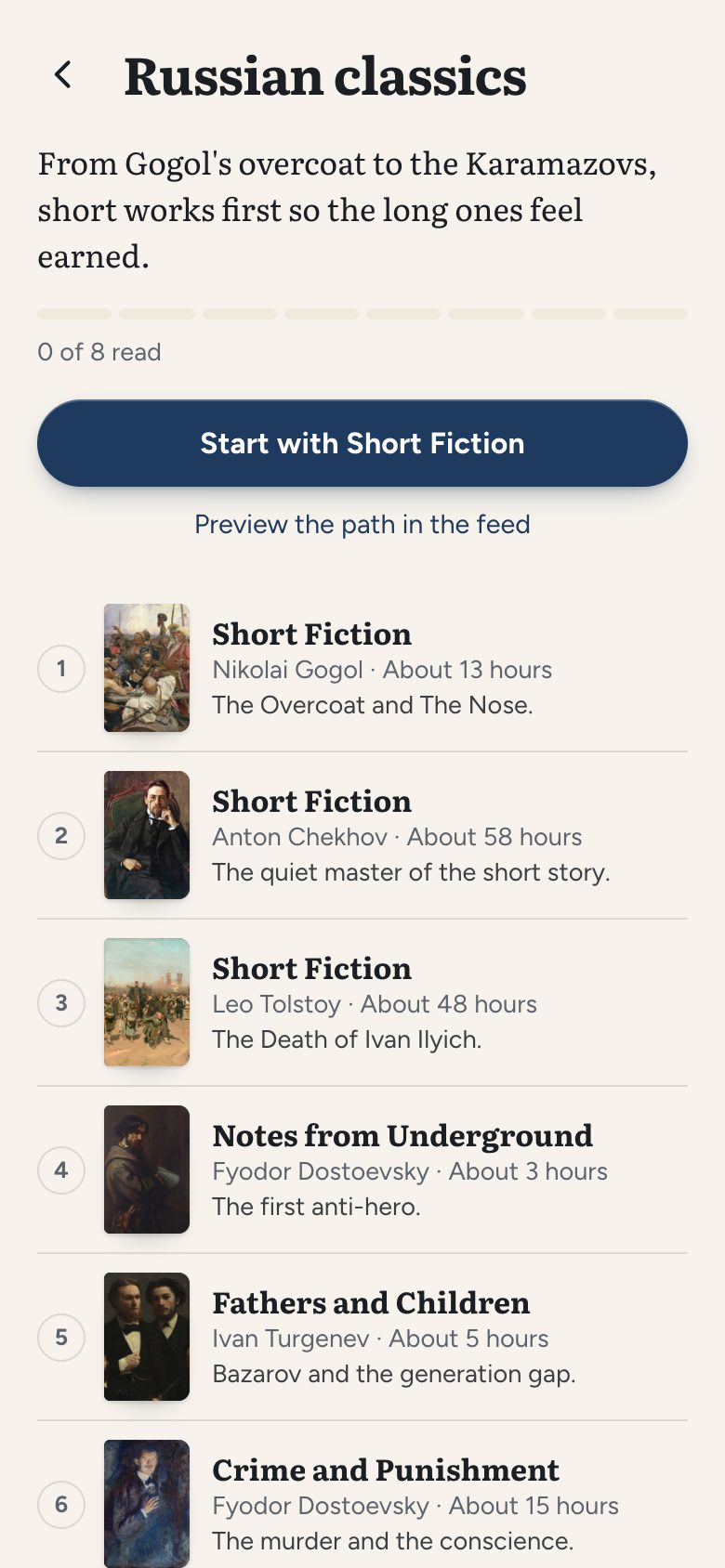
Doomreader's reading paths take this further: short, ordered journeys such as Russian classics, which starts with short stories so the long novels feel earned.
Notes, highlights and remembering
Classics reward a little attention to the lines that strike you. Highlighting a passage in Doomreader keeps it, with its book and chapter, and you can share it as an image or write a note beside it. Going back over the lines you highlighted after finishing a book is a quick way to remember what it was about, and to find the quotes you will want later.
Do not read with a study guide open beside you unless you want to. The experience of not knowing what happens next is the point of a novel, classic or not, and the guide will still be there when you finish.