
Guide
How to read more books: what actually works
Reading more books is mostly arithmetic. An average adult reads around 238 words a minute (a 2019 review of 190 studies by Marc Brysbaert put silent reading of non-fiction at about that). A typical novel is 80,000 to 100,000 words, so it takes six or seven hours. Twenty minutes a day is two hours a week, which is a book every three or four weeks, or about fifteen a year, before you change anything about how you read.
Updated 10 Oct 2026
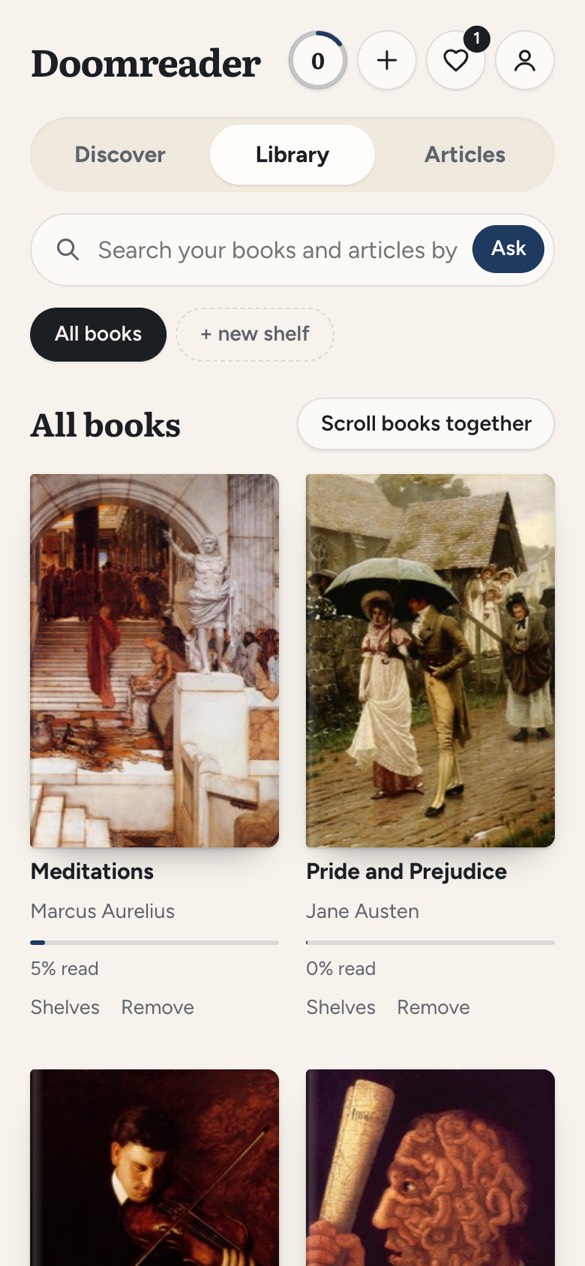
So the question is less about speed and more about where those twenty minutes come from, and whether the book in your hand makes you want to come back.
Find the minutes you already have
Most people do not lack reading time; they lack reading time in blocks. The minutes waiting for a train and the quarter of an hour in bed add up to more than an hour a day for many of us, and they currently go to a feed because a feed asks nothing of you to start.
A book on your phone that opens at the exact sentence you left removes that friction. This is the whole idea behind Doomreader: books as short posts you scroll, so a two-minute gap is two minutes of the book, not two minutes of finding your place.
Choose books you will finish
The fastest way to read more is to stop reading books you do not enjoy. Give a book fifty pages, or about an hour, and if it has not caught you, put it down without guilt. You are not obliged to finish anything, and the next book might be the one you read in a weekend.
Short books are underrated. Short classics such as The Great Gatsby or Heart of Darkness take two or three hours and count as a book as much as War and Peace does. Alternating long and short keeps the momentum going.
If you are not sure what to try, read the best page first. Every free classic in Doomreader has its best opening scenes and lines picked out in the Discover feed, and the book pages here show them, such as Wuthering Heights.
Speed reading is mostly a myth
Courses that promise thousands of words a minute rely on skimming, and comprehension falls as speed rises. You can get a little faster by reading more (familiar words are recognised faster), but the gains are modest. Reading more often beats reading faster by a wide margin.
Listening is different, and genuinely adds hours. Any book in Doomreader can be read aloud free by your device's voice, so a commute, a walk or the washing-up becomes reading time.
Make it a daily thing, not a yearly target
A goal of fifty books a year mostly produces anxiety in November. A daily goal small enough to hit on a bad day works better: twenty cards in Doomreader is about five minutes. The habit guide has more on making that stick.
Keep a record of what you finish, too. Seeing a short list of finished books grow is a better motivator than a target, and it shows you what kind of book you actually finish, which is the most useful thing to know when choosing the next one. Doomreader keeps the books you finish and shows your month in books; a notebook works just as well. If your list lives on Goodreads, the Goodreads import brings its classics across, and how Doomreader compares with Goodreads says what it can and cannot replace.