Doomreader

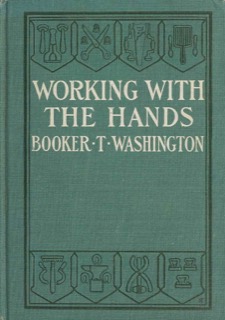
Working with the Hands

by Booker T. Washington

Length: 61,977 words, about 248 pages, about 4 hours to read

Lives and letters, Self-help

Read Working with the Hands free, starting with its best pages and lines below. Listen to it free too, read aloud by your phone's own voice.

The best passages

Pages from the book itself, chosen to make you want to read on. Each opens in the reader at that exact spot.

CHAPTER I Moral Values of Hand Work

The worth of work with the hands as an uplifting power in real education was first brought home to me with striking emphasis when I was a student at the Hampton Normal and Agricultural Institute, which was at that time under the direction of the late General S. C. Armstrong. But I recall with interest an experience, earlier than my Hampton training, along similar lines of enlightenment, which came to me when I was a child. Soon after I was made free by the proclamation of Abraham Lincoln, there came the new opportunity to attend a public school at my home town in West Virginia. When the teacher said that the chief purpose of education was to enable one to speak and write the English language correctly, the statement found lodgment in my mind and stayed there. While at the time I could not put my thoughts into words clearly enough to express instinctive disagreement with my teacher, this definition did not seem adequate, it grated harshly upon my young ears, and I had reasons for feeling that education ought to do more for a boy than merely to teach him to read and write. While this scheme of education was being held up before me, my mother was living in abject poverty, lacking the commonest necessaries of
Keep reading from here

CHAPTER I Moral Values of Hand Work

After a long record of these mutual disappointments, my mother told me that my turn had come, as the rich and exacting personage had sent to ask me to come and live with her, with the promise of five dollars a month in wages. After a long and serious talk with my mother I decided to make the effort to serve this woman, although the tidings of so many failures filled me with foreboding. A few days later, with my clothes made as presentable as possible, and with my heart thumping in fear and anxiety, I reported for duty.

I had heard so much about Mrs. Ruffner, her wealth, her fine house, and her luxurious surroundings, overshadowed by her appalling severity and exacting discipline, that I trembled with a terror which I shall not try to describe at the thought of facing her. My life had been lived in a cabin, and I was now to try to toil in what looked to me like a grand mansion, an enchanted palace filled with alarms. But I got a grip on all the courage in my scanty stock, and braced myself to endure the ordeal with all possible fortitude.

Keep reading from here

CHAPTER X Helping the Mothers

Our first conference was held in the upper story of a very dilapidated store which stands on the main street of the village. The stairs were so rickety that we were often afraid to ascend them. The room was used by the coloured firemen of the village, and was a dark and dreary place, uninviting even to me. It answered our purpose for the time. We had no rent to pay, and that was one less burden for us. How to get the women to the first meeting was not easily settled. For fear of opposition from friends, no mention had been made of the plan, except to the man who let me have the room.

That first Saturday I walked up the stairs alone, and sat down in the room with all its utter dreariness. My heart almost failed me, and not until I remembered these words: "No man, having put his hand to the plow and looking back, is fit for the Kingdom of God," did I throw off the despondency. At this moment a small boy entered the room. I said to him, "Go through the streets and say to each woman, so that no one else will hear you, there is a woman up those stairs who has something for you."

Keep reading from here

CHAPTER XII Pleasure and Profit of Work in the Soil

Practically all the pork used in my family is of my own raising.

I heard not long ago a story of one of our graduates which delighted me as an illustration of the real Tuskegee spirit. A man had occasion to go to the village of Benton, Alabama, in which Mr. A. J. Wood, one of our graduates, had settled ten years before, and gone into business as a general merchant. In this time he has built up a good trade and has obtained for himself a reputation as one of the best and most reliable business men in the place. While the visitor was there, he happened to step to the open back door of the store, and stood looking out into a little yard behind the building. The merchant joining him there, began to call, "Ho, Boy. Ho, Boy," and finally, in response to this calling, there came crawling out from beneath the store, with much grunting, because he was altogether too big to get comfortably from under the building, an enormous black hog.

"You see that hog," the man said. "That's my hog. I raise one like that every year as an object-lesson to the coloured farmers around here who come to the store to trade. About all I feed him is the waste from the store. When the farmers come in here, I show them my hog, and I tell them that if they would shut their pigs up in a pen of rails, and have the children pick up acorns in the woods to feed them on, they might have just such hogs as I do, instead of their razor-backs running around wild in the woods.

Keep reading from here

10 of the best lines

And my foremost aim in going to school was to learn ways and means by which I might make life more endurable, and if possible even attractive, for my mother.

CHAPTER I Moral Values of Hand WorkKeep reading from here

There is a vast difference between working and being worked. Being worked means degradation; working means civilisation.

CHAPTER II Training for ConditionsKeep reading from here

If a thing is not well done, it is poorly done.

CHAPTER IV Making Education Pay Its WayKeep reading from here

Very often at the Tuskegee Institute it would pay the institution better to keep a boy away from the farm than to have him spend a day at work on it; but the farm is for the boy, and not the boy for the farm.

CHAPTER V Building Up a SystemKeep reading from here

Their wagons and harness are not to be sent away or put on exhibition. They must stand the strain at home, and if they are faulty it cannot be hidden.

CHAPTER VI Welding Theory and PracticeKeep reading from here

Do not expect too much in a short time, and, above all, do not be dictatorial while visiting, or personal in meetings when you wish to deal with mistakes that you have seen in the homes visited.

CHAPTER X Helping the MothersKeep reading from here

No man who tills the soil should have to suffer for something to eat.

CHAPTER XI The Tillers of the GroundKeep reading from here

One feels, when eating his own fresh vegetables, that he is getting near to the heart of nature; not a second-hand stale imitation, but the genuine thing.

CHAPTER XII Pleasure and Profit of Work in the SoilKeep reading from here

The habit of making excuses, of giving explanations, instead of achieving results, grows from year to year upon one, until finally it gets such a hold that I think the victim finds himself almost as well satisfied with a good, long-drawn-out excuse, as he does with real tangible achievement.

CHAPTER XV The Value of Small ThingsKeep reading from here

I would counsel: We must be sure that we shall make our greatest progress by keeping our feet on the earth, and by remembering that an inch of progress is worth a yard of complaint.

CHAPTER XIX Negro Education Not a FailureKeep reading from here

All 42 Working with the Hands quotes, with the words around each

Reviews

No reviews yet. Be the first, in the app.

Write a review in Doomreader

Contents

  1. INTRODUCTION TO THE SPECIAL SUBSCRIPTION EDITION
  2. PREFACE
  3. CHAPTER I Moral Values of Hand Work
  4. CHAPTER II Training for Conditions
  5. CHAPTER III A Battle Against Prejudice
  6. CHAPTER IV Making Education Pay Its Way
  7. CHAPTER V Building Up a System
  8. CHAPTER VI Welding Theory and Practice
  9. CHAPTER VII Head and Hands Together
  10. CHAPTER VIII Lessons in Home-Making
  11. CHAPTER IX Outdoor Work for Women
  12. CHAPTER X Helping the Mothers
  13. CHAPTER XI The Tillers of the Ground
  14. CHAPTER XII Pleasure and Profit of Work in the Soil
  15. CHAPTER XIII On the Experimental Farm
  16. CHAPTER XIV The Eagerness for Learning
  17. CHAPTER XV The Value of Small Things
  18. CHAPTER XVI Religious Influences at Tuskegee
  19. CHAPTER XVII Some Tangible Results
  20. CHAPTER XVIII Spreading the Tuskegee Spirit
  21. CHAPTER XIX Negro Education Not a Failure

Listen to Working with the Hands free

Working with the Hands as a free audiobook: Doomreader reads any book aloud, free, in your phone's or computer's own voice. Open the book and tap listen, at the speed you like, hands free.

Want a more natural voice? The AI voices read with AI credits.

Listen free in Doomreader

Download Working with the Hands free

The whole book as an EPUB file, free and legal, from Project Gutenberg. It opens in any ebook app, or read it here in Doomreader with nothing to install.

Download the EPUB (3.2 MB)

More by Booker T. Washington

More like Working with the Hands

About this edition

Text from Project Gutenberg. In the public domain in the USA. The Project Gutenberg License is kept inside the file. Every passage and line on this page is the book's own words, checked against the text.