Doomreader

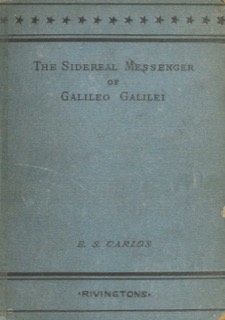
The Sidereal Messenger

by Galileo Galilei

Length: 29,189 words, about 117 pages, about 2 hours to read

Science and nature

Read The Sidereal Messenger free, starting with its best pages and lines below. Listen to it free too, read aloud by your phone's own voice.

The best passages

Pages from the book itself, chosen to make you want to read on. Each opens in the reader at that exact spot.

THE ASTRONOMICAL MESSENGER

THE COSMIAN STARS.3

IN the present small treatise I set forth some matters of great interest for all observers of natural phenomena to look at and consider. They are of great Introduction.interest, I think, first, from their intrinsic excellence; secondly, from their absolute novelty; and lastly, also on account of the instrument by the aid of which they have been presented to my apprehension.

The number of the Fixed Stars which observers have been able to see without artificial powers of sight up to this day can be counted. It is therefore decidedly a great feat to add to their number, and to set distinctly before the eyes other stars in myriads, which have never been seen before, and which surpass the old, previously known, stars in number more than ten times.

Again, it is a most beautiful and delightful sight to behold the body of the Moon, which is distant from us nearly sixty semi-diameters[4] of the Earth, as near as if it was at a distance of only two of the same measures; so that the diameter of this same Moon appears about thirty times larger, its surface about nine hundred times, and its solid mass nearly 27,000 times larger than when it is viewed only with the naked eye; and consequently any one may know with the certainty that is due to the use of our senses, that the Moon certainly does not possess a smooth and polished surface, but one rough and uneven, and, just like the face of the Earth itself, is everywhere full of vast protuberances, deep chasms, and sinuosities.


Keep reading from here

THE ASTRONOMICAL MESSENGER

Galileo’s account of the invention of his telescope.About ten months ago a report reached my ears that a Dutchman had constructed a telescope, by the aid of which visible objects, although at a great distance from the eye of the observer, were seen distinctly as if near; and some proofs of its most wonderful performances were reported, which some gave credence to, but others contradicted. A few days after, I received confirmation of the report in a letter written from Paris by a noble Frenchman, Jaques Badovere, which finally determined me to give myself up first to inquire into the principle of the telescope, and then to consider the means by which I might compass the invention of a similar instrument, which a little while after I succeeded in doing, through deep study of the theory of Refraction; and I prepared a tube, at first of lead, in the ends of which I fitted two glass lenses, both plane on one side, but on the other side one spherically convex, and the other concave. Then bringing my eye to the concave lens I saw objects satisfactorily large and near, for they appeared one-third of the distance off and nine times larger than when they are seen with the natural eye alone. I shortly afterwards constructed another telescope with more nicety, which magnified objects more than sixty times. At length, by sparing neither labour nor expense, I succeeded in constructing for myself an instrument so superior that objects seen through it appear magnified nearly a thousand times, and more than thirty times nearer than if viewed by the natural powers of sight alone.

Keep reading from here

THE ASTRONOMICAL MESSENGER

This strange brightness has afforded no small perplexity to philosophical minds; and some have published one thing, some another, as the cause to be alleged for it. Some have said that it is the inherent and natural brightness of the Moon; some that it is imparted to that body by the planet Venus; or, as others maintain, by all the stars; while some have said that it comes from the Sun, whose rays, they say, find a way through the solid mass of the Moon. But statements of this kind are disproved without much difficulty, and convincingly demonstrated to be false. For if this kind of light were the Moon’s own, or were contributed by the stars, the Moon would retain it, particularly in eclipses, and would show it then, when left in an unusually dark sky, but this is contrary to experience. For the brightness which is seen on the Moon in eclipses is far less intense, being somewhat reddish, and almost copper-coloured, whereas this is brighter and whiter; besides, the brightness seen during an eclipse is changeable and shifting, for it wanders over the face of the Moon, so that that part which is near the circumference of the circle of shadow thrown by the Earth is bright, but the rest of the Moon is always seen to be dark. From which circumstance we understand without hesitation that this brightness is due to the proximity of the Sun’s rays coming into contact with some denser region which surrounds the Moon as an envelope; owing to which contact a sort of dawn-light is diffused over the neighbouring regions of the Moon, just as the twilight spreads in the morning and evening on the Earth:11 but I will treat more fully of this matter in my book upon the System of the Universe.12

Keep reading from here

THE ASTRONOMICAL MESSENGER

As a second example I have depicted the six stars of the constellation Taurus, called the Pleiades (I say six intentionally, since the seventh is scarcely ever visible), a group of stars which is enclosed in the heavens within very narrow precincts. Near these there lie more than forty others invisible to the naked eye, no one of which is much more than half a degree off any of the aforesaid six; of these I have noticed only thirty-six in my diagram. I have preserved their intervals, magnitudes, and the distinction between the old and the new stars, just as in the case of the constellation Orion.

The Milky Way consists entirely of stars in countless numbers and of various magnitudes. The next object which I have observed is the essence or substance of the Milky Way. By the aid of a telescope any one may behold this in a manner which so distinctly appeals to the senses that all the disputes which have tormented philosophers through so many ages are exploded at once by the irrefragable evidence of our eyes, and we are freed from wordy disputes upon this subject, for the Galaxy is nothing else but a mass of innumerable stars planted together in clusters. Upon whatever part of it you direct the telescope straightway a vast crowd of stars presents itself to view; many of them are tolerably large and extremely bright, but the number of small ones is quite beyond determination.

Keep reading from here

THE ASTRONOMICAL MESSENGER

Discovery of Jupiter’s satellites, Jan. 7, 1610: record of Galileo’s observations during two months. I have now finished my brief account of the observations which I have thus far made with regard to the Moon, the Fixed Stars, and the Galaxy. There remains the matter, which seems to me to deserve to be considered the most important in this work, namely, that I should disclose and publish to the world the occasion of discovering and observing four PLANETS, never seen from the very beginning of the world up to our own times, their positions, and the observations made during the last two months about their movements and their changes of magnitude; and I summon all astronomers to apply themselves to examine and determine their periodic times, which it has not been permitted me to achieve up to this day, owing to the restriction of my time. I give them warning however again, so that they may not approach such an inquiry to no purpose, that they will want a very accurate telescope, and such as I have described in the beginning of this account.

Keep reading from here

9 of the best lines

It is therefore decidedly a great feat to add to their number, and to set distinctly before the eyes other stars in myriads, which have never been seen before, and which surpass the old, previously known, stars in number more than ten times.

THE ASTRONOMICAL MESSENGERKeep reading from here

At length, by sparing neither labour nor expense, I succeeded in constructing for myself an instrument so superior that objects seen through it appear magnified nearly a thousand times, and more than thirty times nearer than if viewed by the natural powers of sight alone.

THE ASTRONOMICAL MESSENGERKeep reading from here

Now let me review the observations made by me during the two months just past, again inviting the attention of all who are eager for true philosophy to the beginnings which led to the sight of most important phenomena.

THE ASTRONOMICAL MESSENGERKeep reading from here

Now, is it not the case on the Earth before sunrise, that while the level plain is still in shadow, the peaks of the most lofty mountains are illuminated by the Sun’s rays?

THE ASTRONOMICAL MESSENGERKeep reading from here

The grandeur, however, of such prominences and depressions in the Moon seems to surpass both in magnitude and extent the ruggedness of the Earth’s surface, as I shall hereafter show.

THE ASTRONOMICAL MESSENGERKeep reading from here

This strange brightness has afforded no small perplexity to philosophical minds; and some have published one thing, some another, as the cause to be alleged for it.

THE ASTRONOMICAL MESSENGERKeep reading from here

Again, to assert that this sort of light is imparted to the Moon by the planet Venus is so childish as to be undeserving of an answer; for who is so ignorant as not to understand that at conjunction and within an angular distance of 60° it is quite impossible for the part of the Moon turned away from the Sun to be seen by the planet Venus?

THE ASTRONOMICAL MESSENGERKeep reading from here

The Earth, with fair and grateful exchange, pays back to the Moon an illumination like that which it receives from the Moon nearly the whole time during the darkest gloom of night.

THE ASTRONOMICAL MESSENGERKeep reading from here

Upon whatever part of it you direct the telescope straightway a vast crowd of stars presents itself to view; many of them are tolerably large and extremely bright, but the number of small ones is quite beyond determination.

THE ASTRONOMICAL MESSENGERKeep reading from here

All 9 The Sidereal Messenger quotes, with the words around each

Reviews

No reviews yet. Be the first, in the app.

Write a review in Doomreader

Contents

  1. PREFATORY NOTE.
  2. INTRODUCTION.
  3. SIDEREAL MESSENGER
  4. COSMO DE’ MEDICI, THE SECOND,
  5. THE ASTRONOMICAL MESSENGER
  6. Extract from the Preface of Kepler’s Dioptrics. Augsburg, 1611.
  7. FOOTNOTES:

Listen to The Sidereal Messenger free

The Sidereal Messenger as a free audiobook: Doomreader reads any book aloud, free, in your phone's or computer's own voice. Open the book and tap listen, at the speed you like, hands free.

Want a more natural voice? The AI voices read with AI credits.

Listen free in Doomreader

Download The Sidereal Messenger free

The whole book as an EPUB file, free and legal, from Project Gutenberg. It opens in any ebook app, or read it here in Doomreader with nothing to install.

Download the EPUB (0.5 MB)

More like The Sidereal Messenger

About this edition

Text from Project Gutenberg. In the public domain in the USA. The Project Gutenberg License is kept inside the file. Every passage and line on this page is the book's own words, checked against the text.