Doomreader

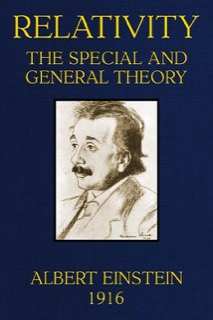
Relativity: The Special and General Theory

by Albert Einstein

Length: 33,248 words, about 133 pages, about 2 hours to read

Science and nature

Read Relativity: The Special and General Theory free, starting with its best pages and lines below. Listen to it free too, read aloud by your phone's own voice.

The best passages

Pages from the book itself, chosen to make you want to read on. Each opens in the reader at that exact spot.

I. PHYSICAL MEANING OF GEOMETRICAL PROPOSITIONS

In your schooldays most of you who read this book made acquaintance with the noble building of Euclid’s geometry, and you remember—perhaps with more respect than love—the magnificent structure, on the lofty staircase of which you were chased about for uncounted hours by conscientious teachers. By reason of our past experience, you would certainly regard everyone with disdain who should pronounce even the most out-of-the-way proposition of this science to be untrue. But perhaps this feeling of proud certainty would leave you immediately if some one were to ask you: “What, then, do you mean by the assertion that these propositions are true?” Let us proceed to give this question a little consideration.

Geometry sets out from certain conceptions such as “plane,” “point,” and “straight line,” with which we are able to associate more or less definite ideas, and from certain simple propositions (axioms) which, in virtue of these ideas, we are inclined to accept as “true.” Then, on the basis of a logical process, the justification of which we feel ourselves compelled to admit, all remaining propositions are shown to follow from those axioms, i.e. they are proven. A proposition is then correct (“true”) when it has been derived in the recognised manner from the axioms. The question of “truth” of the individual geometrical propositions is thus reduced to one of the “truth” of the axioms. Now it has long been known that the last question is not only unanswerable by the methods of geometry, but that it is in itself entirely without meaning. We cannot ask whether it is true that only one straight line goes through two points. We can only say that Euclidean geometry deals with things called “straight lines,” to each of which is ascribed the property of being uniquely determined by two points situated on it.

Keep reading from here

III. SPACE AND TIME IN CLASSICAL MECHANICS

The purpose of mechanics is to describe how bodies change their position in space with “time.” I should load my conscience with grave sins against the sacred spirit of lucidity were I to formulate the aims of mechanics in this way, without serious reflection and detailed explanations. Let us proceed to disclose these sins.

It is not clear what is to be understood here by “position” and “space.” I stand at the window of a railway carriage which is travelling uniformly, and drop a stone on the embankment, without throwing it. Then, disregarding the influence of the air resistance, I see the stone descend in a straight line. A pedestrian who observes the misdeed from the footpath notices that the stone falls to earth in a parabolic curve. I now ask: Do the “positions” traversed by the stone lie “in reality” on a straight line or on a parabola? Moreover, what is meant here by motion “in space”? From the considerations of the previous section the answer is self-evident. In the first place we entirely shun the vague word “space,” of which, we must honestly acknowledge, we cannot form the slightest conception, and we replace it by “motion relative to a practically rigid body of reference.” The positions relative to the body of reference (railway carriage or embankment) have already been defined in detail in the preceding section. If instead of “body of reference” we insert “system of co-ordinates,” which is a useful idea for mathematical description, we are in a position to say: The stone traverses a

Keep reading from here

VII. THE APPARENT INCOMPATIBILITY OF THE LAW OF PROPAGATION OF LIGHT WITH THE PRINCIPLE OF RELATIVITY

There is hardly a simpler law in physics than that according to which light is propagated in empty space. Every child at school knows, or believes he knows, that this propagation takes place in straight lines with a velocity c = 300,000 km./sec. At all events we know with great exactness that this velocity is the same for all colours, because if this were not the case, the minimum of emission would not be observed simultaneously for different colours during the eclipse of a fixed star by its dark neighbour. By means of similar considerations based on observations of double stars, the Dutch astronomer De Sitter was also able to show that the velocity of propagation of light cannot depend on the velocity of motion of the body emitting the light. The assumption that this velocity of propagation is dependent on the direction “in space” is in itself improbable.

In short, let us assume that the simple law of the constancy of the velocity of light c (in vacuum) is justifiably believed by the child at school. Who would imagine that this simple law has plunged the conscientiously thoughtful physicist into the greatest intellectual difficulties? Let us consider how these difficulties arise.

Keep reading from here

VIII. ON THE IDEA OF TIME IN PHYSICS

Lightning has struck the rails on our railway embankment at two places A and B far distant from each other. I make the additional assertion that these two lightning flashes occurred simultaneously. If I ask you whether there is sense in this statement, you will answer my question with a decided “Yes.” But if I now approach you with the request to explain to me the sense of the statement more precisely, you find after some consideration that the answer to this question is not so easy as it appears at first sight.

After some time perhaps the following answer would occur to you: “The significance of the statement is clear in itself and needs no further explanation; of course it would require some consideration if I were to be commissioned to determine by observations whether in the actual case the two events took place simultaneously or not.” I cannot be satisfied with this answer for the following reason. Supposing that as a result of ingenious considerations an able meteorologist were to discover that the lightning must always strike the places A and B simultaneously, then we should be faced with the task of testing whether or not this theoretical result is in accordance with the reality. We encounter the same difficulty with all physical statements in which the conception “simultaneous” plays a part. The concept does not exist for the physicist until he has the possibility of discovering whether or not it is fulfilled in an actual case.

Keep reading from here

XX. THE EQUALITY OF INERTIAL AND GRAVITATIONAL MASS AS AN ARGUMENT FOR THE GENERAL POSTULATE OF RELATIVITY

We imagine a large portion of empty space, so far removed from stars and other appreciable masses, that we have before us approximately the conditions required by the fundamental law of Galilei. It is then possible to choose a Galileian reference-body for this part of space (world), relative to which points at rest remain at rest and points in motion continue permanently in uniform rectilinear motion. As reference-body let us imagine a spacious chest resembling a room with an observer inside who is equipped with apparatus. Gravitation naturally does not exist for this observer. He must fasten himself with strings to the floor, otherwise the slightest impact against the floor will cause him to rise slowly towards the ceiling of the room.

To the middle of the lid of the chest is fixed externally a hook with rope attached, and now a “being” (what kind of a being is immaterial to us) begins pulling at this with a constant force. The chest together with the observer then begin to move “upwards” with a uniformly accelerated motion. In course of time their velocity will reach unheard-of values—provided that we are viewing all this from another reference-body which is not being pulled with a rope.

Keep reading from here

10 of the best lines

In your schooldays most of you who read this book made acquaintance with the noble building of Euclid’s geometry, and you remember—perhaps with more respect than love—the magnificent structure, on the lofty staircase of which you were chased about for uncounted hours by conscientious teachers.

I. PHYSICAL MEANING OF GEOMETRICAL PROPOSITIONSKeep reading from here

Every description of the scene of an event or of the position of an object in space is based on the specification of the point on a rigid body (body of reference) with which that event or object coincides.

II. THE SYSTEM OF CO-ORDINATESKeep reading from here

A pedestrian who observes the misdeed from the footpath notices that the stone falls to earth in a parabolic curve.

III. SPACE AND TIME IN CLASSICAL MECHANICSKeep reading from here

Every child at school knows, or believes he knows, that this propagation takes place in straight lines with a velocity c = 300,000 km./sec.

VII. THE APPARENT INCOMPATIBILITY OF THE LAW OF PROPAGATION OF LIGHT WITH THE PRINCIPLE OF RELATIVITYKeep reading from here

Every reference-body (co-ordinate system) has its own particular time; unless we are told the reference-body to which the statement of time refers, there is no meaning in a statement of the time of an event.

IX. THE RELATIVITY OF SIMULTANEITYKeep reading from here

As a consequence of its motion the clock goes more slowly than when at rest.

XII. THE BEHAVIOUR OF MEASURING-RODS AND CLOCKS IN MOTIONKeep reading from here

And yet there is no more common-place statement than that the world in which we live is a four-dimensional space-time continuum.

XVII. MINKOWSKI’S FOUR-DIMENSIONAL SPACEKeep reading from here

No fairer destiny could be allotted to any physical theory, than that it should of itself point out the way to the introduction of a more comprehensive theory, in which it lives on as a limiting case.

XXII. A FEW INFERENCES FROM THE GENERAL PRINCIPLE OF RELATIVITYKeep reading from here

Such a finite material universe would be destined to become gradually but systematically impoverished.

XXX. COSMOLOGICAL DIFFICULTIES OF NEWTON’S THEORYKeep reading from here

The theory finds the justification for its existence in the fact that it correlates a large number of single observations, and it is just here that the “truth” of the theory lies.

APPENDIX III THE EXPERIMENTAL CONFIRMATION OF THE GENERAL THEORY OF RELATIVITYKeep reading from here

All 21 Relativity: The Special and General Theory quotes, with the words around each

Reviews

No reviews yet. Be the first, in the app.

Write a review in Doomreader

Contents

All 45 parts
  1. Authorised Translation by Robert W. Lawson
  2. PREFACE
  3. PART I: THE SPECIAL THEORY OF RELATIVITY
  4. I. PHYSICAL MEANING OF GEOMETRICAL PROPOSITIONS
  5. II. THE SYSTEM OF CO-ORDINATES
  6. III. SPACE AND TIME IN CLASSICAL MECHANICS
  7. IV. THE GALILEIAN SYSTEM OF CO-ORDINATES
  8. V. THE PRINCIPLE OF RELATIVITY (IN THE RESTRICTED SENSE)
  9. VI. THE THEOREM OF THE ADDITION OF VELOCITIES EMPLOYED IN CLASSICAL MECHANICS
  10. VII. THE APPARENT INCOMPATIBILITY OF THE LAW OF PROPAGATION OF LIGHT WITH THE PRINCIPLE OF RELATIVITY
  11. VIII. ON THE IDEA OF TIME IN PHYSICS
  12. IX. THE RELATIVITY OF SIMULTANEITY
  13. X. ON THE RELATIVITY OF THE CONCEPTION OF DISTANCE
  14. XI. THE LORENTZ TRANSFORMATION
  15. XII. THE BEHAVIOUR OF MEASURING-RODS AND CLOCKS IN MOTION
  16. XIII. THEOREM OF THE ADDITION OF VELOCITIES. THE EXPERIMENT OF FIZEAU
  17. XIV. THE HEURISTIC VALUE OF THE THEORY OF RELATIVITY
  18. XV. GENERAL RESULTS OF THE THEORY
  19. XVI. EXPERIENCE AND THE SPECIAL THEORY OF RELATIVITY
  20. XVII. MINKOWSKI’S FOUR-DIMENSIONAL SPACE
  21. PART II: THE GENERAL THEORY OF RELATIVITY
  22. XVIII. SPECIAL AND GENERAL PRINCIPLE OF RELATIVITY
  23. XIX. THE GRAVITATIONAL FIELD
  24. XX. THE EQUALITY OF INERTIAL AND GRAVITATIONAL MASS AS AN ARGUMENT FOR THE GENERAL POSTULATE OF RELATIVITY
  25. XXI. IN WHAT RESPECTS ARE THE FOUNDATIONS OF CLASSICAL MECHANICS AND OF THE SPECIAL THEORY OF RELATIVITY UNSATISFACTORY?
  26. XXII. A FEW INFERENCES FROM THE GENERAL PRINCIPLE OF RELATIVITY
  27. XXIII. BEHAVIOUR OF CLOCKS AND MEASURING-RODS ON A ROTATING BODY OF REFERENCE
  28. XXIV. EUCLIDEAN AND NON-EUCLIDEAN CONTINUUM
  29. XXV. GAUSSIAN CO-ORDINATES
  30. XXVI. THE SPACE-TIME CONTINUUM OF THE SPECIAL THEORY OF RELATIVITY CONSIDERED AS A EUCLIDEAN CONTINUUM
  31. XXVII. THE SPACE-TIME CONTINUUM OF THE GENERAL THEORY OF RELATIVITY IS NOT A EUCLIDEAN CONTINUUM
  32. XXVIII. EXACT FORMULATION OF THE GENERAL PRINCIPLE OF RELATIVITY
  33. XXIX. THE SOLUTION OF THE PROBLEM OF GRAVITATION ON THE BASIS OF THE GENERAL PRINCIPLE OF RELATIVITY
  34. PART III: CONSIDERATIONS ON THE UNIVERSE AS A WHOLE
  35. XXX. COSMOLOGICAL DIFFICULTIES OF NEWTON’S THEORY
  36. XXXI. THE POSSIBILITY OF A “FINITE” AND YET “UNBOUNDED” UNIVERSE
  37. XXXII. THE STRUCTURE OF SPACE ACCORDING TO THE GENERAL THEORY OF RELATIVITY
  38. APPENDICES
  39. APPENDIX I SIMPLE DERIVATION OF THE LORENTZ TRANSFORMATION (SUPPLEMENTARY TO SECTION XI)
  40. APPENDIX II MINKOWSKI’S FOUR-DIMENSIONAL SPACE (“WORLD”) (SUPPLEMENTARY TO SECTION XVII)
  41. APPENDIX III THE EXPERIMENTAL CONFIRMATION OF THE GENERAL THEORY OF RELATIVITY
  42. (a) Motion of the Perihelion of Mercury
  43. (b) Deflection of Light by a Gravitational Field
  44. (c) Displacement of Spectral Lines Towards the Red
  45. APPENDIX IV THE STRUCTURE OF SPACE ACCORDING TO THE GENERAL THEORY OF RELATIVITY (SUPPLEMENTARY TO SECTION XXXII)

Listen to Relativity: The Special and General Theory free

Relativity: The Special and General Theory as a free audiobook: Doomreader reads any book aloud, free, in your phone's or computer's own voice. Open the book and tap listen, at the speed you like, hands free.

Want a more natural voice? The AI voices read with AI credits.

Listen free in Doomreader

Download Relativity: The Special and General Theory free

The whole book as an EPUB file, free and legal, from Project Gutenberg. It opens in any ebook app, or read it here in Doomreader with nothing to install.

Download the EPUB (1.0 MB)

More by Albert Einstein

More like Relativity: The Special and General Theory

About this edition

Text from Project Gutenberg. In the public domain in the USA. The Project Gutenberg License is kept inside the file. Every passage and line on this page is the book's own words, checked against the text.