Doomreader

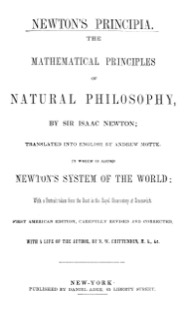
Newton's Principia

by Isaac Newton

Length: 266,357 words, about 1,065 pages, about 19 hours to read

Science and nature

Read Newton's Principia free, starting with its best pages and lines below. Listen to it free too, read aloud by your phone's own voice.

The best passages

Pages from the book itself, chosen to make you want to read on. Each opens in the reader at that exact spot.

DEFINITIONS.

DEFINITION I.

The quantity of matter is the measure of the same, arising from its density and bulk conjunctly.

Thus air of a double density, in a double space, is quadruple in quantity; in a triple space, sextuple in quantity. The same thing is to be understood of snow, and fine dust or powders, that are condensed by compression or liquefaction; and of all bodies that are by any causes whatever differently condensed. I have no regard in this place to a medium, if any such there is, that freely pervades the interstices between the parts of bodies. It is this quantity that I mean hereafter everywhere under the name of body or mass. And the same is known by the weight of each body; for it is proportional to the weight, as I have found by experiments on pendulums, very accurately made, which shall be shewn hereafter.

DEFINITION II.

The quantity of motion is the measure of the same, arising from the velocity and quantity of matter conjunctly.

The motion of the whole is the sum of the motions of all the parts; and therefore in a body double in quantity, with equal velocity, the motion is double; with twice the velocity, it is quadruple.

DEFINITION III.

The vis insita, or innate force of matter, is a power of resisting, by which every body, as much as in it lies, endeavours to persevere in its present state, whether it be of rest, or of moving uniformly forward in a right line.

Keep reading from here

DEFINITIONS.

SCHOLIUM.

Hitherto I have laid down the definitions of such words as are less known, and explained the sense in which I would have them to be understood in the following discourse. I do not define time, space, place and motion, as being well known to all. Only I must observe, that the vulgar conceive those quantities under no other notions but from the relation they bear to sensible objects. And thence arise certain prejudices, for the removing of which, it will be convenient to distinguish them into absolute and relative, true and apparent, mathematical and common.

I. Absolute, true, and mathematical time, of itself, and from its own nature flows equably without regard to anything external, and by another name is called duration: relative, apparent, and common time, is some sensible and external (whether accurate or unequable) measure of duration by the means of motion, which is commonly used instead of true time; such as an hour, a day, a month, a year.

Keep reading from here

AXIOMS, OR LAWS OF MOTION.

LAW III.

To every action there is always opposed an equal reaction: or the mutual actions of two bodies upon each other are always equal, and directed to contrary parts.

Whatever draws or presses another is as much drawn or pressed by that other. If you press a stone with your finger, the finger is also pressed by the stone. If a horse draws a stone tied to a rope, the horse (if I may so say) will be equally drawn back towards the stone: for the distended rope, by the same endeavour to relax or unbend itself, will draw the horse as much towards the stone, as it does the stone towards the horse, and will obstruct the progress of the one as much as it advances that of the other. If a body impinge upon another, and by its force change the motion of the other, that body also (because of the equality of the mutual pressure) will undergo an equal change, in its own motion, towards the contrary part. The changes made by these actions are equal, not in the velocities but in the motions of bodies; that is to say, if the bodies are not hindered by any other impediments. For, because the motions are equally changed, the changes of the velocities made towards contrary parts are reciprocally proportional to the bodies. This law takes place also in attractions, as will be proved in the next scholium.

Keep reading from here

AXIOMS, OR LAWS OF MOTION.

And thus the third Law, so far as it regards percussions and reflexions, is proved by a theory exactly agreeing with experience.

In attractions, I briefly demonstrate the thing after this manner. Suppose an obstacle is interposed to hinder the congress of any two bodies A, B, mutually attracting one the other: then if either body, as A, is more attracted towards the other body B, than that other body B is towards the first body A, the obstacle will be more strongly urged by the pressure of the body A than by the pressure of the body B, and therefore will not remain in equilibrio: but the stronger pressure will prevail, and will make the system of the two bodies, together with the obstacle, to move directly towards the parts on which B lies; and in free spaces, to go forward in infinitum with a motion perpetually accelerated; which is absurd and contrary to the first Law. For, by the first Law, the system ought to persevere in its state of rest, or of moving uniformly forward in a right line; and therefore the bodies must equally press the obstacle, and be equally attracted one by the other. I made the experiment on the loadstone and iron. If these, placed apart in proper vessels, are made to float by one another in standing water, neither of them will propel the other; but, by being equally attracted, they will sustain each other's pressure, and rest at last in an equilibrium.

Keep reading from here

10 of the best lines

As a blind man has no idea of colours, so have we no idea of the manner by which the all-wise God perceives and understands all things.

LIFE OF SIR ISAAC NEWTON.Keep reading from here

I do not define time, space, place and motion, as being well known to all.

DEFINITIONS.Keep reading from here

For it may be that there is no body really at rest, to which the places and motions of others may be referred.

DEFINITIONS.Keep reading from here

One conic section cannot cut another conic section in more than four points.

SECTION V.Keep reading from here

The common weights are nothing else but the excess of the true weights above the weight of the air.

SECTION V.Keep reading from here

And if the quantity of matter in a given space can, by any rarefaction, be diminished, what should hinder a diminution to infinity?

PROPOSITIONS.Keep reading from here

And now we have described the system of the sun, the earth, moon, and planets, it remains that we add something about the comets.

PROPOSITIONS.Keep reading from here

He is not eternity or infinity, but eternal and infinite; he is not duration or space, but he endures and is present.

PROPOSITIONS.Keep reading from here

And to us it is enough that gravity does really exist, and act according to the laws which we have explained, and abundantly serves to account for all the motions of the celestial bodies, and of our sea.

PROPOSITIONS.Keep reading from here

But it is none of our present business to explain the causes of the appearances of nature.

THE SYSTEM OF THE WORLD.Keep reading from here

All 55 Newton's Principia quotes, with the words around each

Reviews

No reviews yet. Be the first, in the app.

Write a review in Doomreader

Contents

All 46 parts
  1. THE MATHEMATICAL PRINCIPLES OF NATURAL PHILOSOPHY,
  2. DEDICATION.
  3. INTRODUCTION TO THE AMERICAN EDITION.
  4. LIFE OF SIR ISAAC NEWTON.
  5. THE PRINCIPIA.
  6. THE AUTHOR'S PREFACE
  7. BOOK I.
  8. THE MATHEMATICAL PRINCIPLES OF NATURAL PHILOSOPHY.
  9. DEFINITIONS.
  10. AXIOMS, OR LAWS OF MOTION.
  11. BOOK I. OF THE MOTION OF BODIES.
  12. SECTION I.
  13. SECTION II.
  14. SECTION III.
  15. SECTION IV.
  16. SECTION V.
  17. SECTION VI.
  18. SECTION VII.
  19. SECTION VIII.
  20. SECTION IX.
  21. SECTION X.
  22. SECTION XI.
  23. SECTION XII.
  24. SECTION XIII.
  25. SECTION XIV.
  26. BOOK II.
  27. BOOK II.
  28. SECTION I.
  29. SECTION II.
  30. SECTION III.
  31. SECTION IV.
  32. SECTION V.
  33. SECTION VI.
  34. SECTION VII.
  35. SECTION VIII.
  36. SECTION IX.
  37. BOOK III.
  38. BOOK III.
  39. RULES OF REASONING IN PHILOSOPHY.
  40. PHÆNOMENA, OR APPEARANCES.
  41. PROPOSITIONS.
  42. FOOTNOTES:
  43. THE SYSTEM OF THE WORLD.
  44. THE SYSTEM OF THE WORLD.
  45. CONTENTS OF THE SYSTEM OF THE WORLD.
  46. INDEX TO THE PRINCIPIA.

Listen to Newton's Principia free

Newton's Principia as a free audiobook: Doomreader reads any book aloud, free, in your phone's or computer's own voice. Open the book and tap listen, at the speed you like, hands free.

Want a more natural voice? The AI voices read with AI credits.

Listen free in Doomreader

Download Newton's Principia free

The whole book as an EPUB file, free and legal, from Project Gutenberg. It opens in any ebook app, or read it here in Doomreader with nothing to install.

Download the EPUB (7.4 MB)

More by Isaac Newton

More like Newton's Principia

About this edition

Text from Project Gutenberg. In the public domain in the USA. The Project Gutenberg License is kept inside the file. Every passage and line on this page is the book's own words, checked against the text.