Doomreader

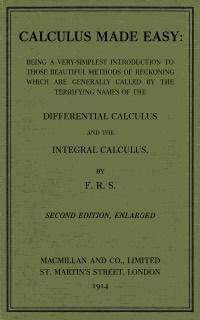
Calculus Made Easy

by Silvanus P. Thompson

Length: 86,153 words, about 345 pages, about 6 hours to read

Science and nature

Read Calculus Made Easy free, starting with its best pages and lines below. Listen to it free too, read aloud by your phone's own voice.

The best passages

Pages from the book itself, chosen to make you want to read on. Each opens in the reader at that exact spot.

PROLOGUE

CONSIDERING how many fools can calculate, it is surprising that it should be thought either a difficult or a tedious task for any other fool to learn how to master the same tricks.

Some calculus-tricks are quite easy. Some are enormously difficult. The fools who write the textbooks of advanced mathematics—and they are mostly clever fools-seldom take the trouble to show you how easy the easy calculations are. On the contrary, they seem to desire to impress you with their tremendous cleverness by going about it in the most difficult way.

Being myself a remarkably stupid fellow, I have had to unteach myself the difficulties, and now beg to present to my fellow fools the parts that are not hard. Master these thoroughly, and the rest will follow. What one fool can do, another can.

Keep reading from here

CHAPTER I. TO DELIVER YOU FROM THE PRELIMINARY TERRORS.

THE preliminary terror, which chokes off most fifth-form boys from even attempting to learn how to calculate, can be abolished once for all by simply stating what is the meaning-in common-sense terms-of the two principal symbols that are used in calculating.

These dreadful symbols are:

(1) d which merely means "a little bit of."

Thus d x means a little bit of x; or d u means a little bit of u. Ordinary mathematicians think it more polite to say "an element of," instead of "a little bit of." Just as you please. But you will find that these little bits (or elements) may be considered to be indefinitely small.

(2) integral which is merely a long upper S, and may be called (if you like) "the sum of."

Thus integral d x means the sum of all the little bits of x; or integral d t means the sum of all the little bits of t. Ordinary mathematicians call this symbol "the integral of." Now any fool can see that if x is considered as made up of a lot of little bits, each of which is called d x, if you add them all up together you get the sum of all the d x's, (which is the same thing as the whole of x). The word "integral" simply means "the whole." If you think of the duration of time for one hour, you may (if you like) think of it as cut up into 3600 little bits called seconds. The whole of the 3600 little bits added up together make one hour.

Keep reading from here

CHAPTER II. ON DIFFERENT DEGREES OF SMALLNESS.

Fig. 3.

Suppose a millionaire were to say to his secretary: next week I will give you a small fraction of any money that comes in to me. Suppose that the secretary were to say to his boy: I will give you a small fraction of what I get. Suppose the fraction in each case to be StartFraction 1 Over 100 EndFraction part. Now if Mr. Millionaire received during the next week pound sign 1000, the secretary would receive pound sign 10 and the boy 2 shillings. Ten pounds would be a small quantity compared with pound sign 1000; but two shillings is a small small quantity indeed, of a very secondary order. But what would be the disproportion if the fraction, instead of being StartFraction 1 Over 100 EndFraction, had been settled at StartFraction 1 Over 1000 EndFraction part? Then, while Mr. Millionaire got his pound sign 1000, Mr. Secretary would get only pound sign 1, and the boy less than one farthing!

The witty Dean Swift[2] once wrote:

"So, Nat'ralists observe, a Flea

"Hath smaller Fleas that on him prey.

"And these have smaller Fleas to bite 'em,

"And so proceed ad infinitum."

An ox might worry about a flea of ordinary size—a small creature of the first order of smallness. But he would probably not trouble himself about a flea's flea; being of the second order of smallness, it would be negligible. Even a gross of fleas' fleas would not be of much account to the ox.

Keep reading from here

CHAPTER III. ON RELATIVE GROWINGS.

We call the ratio StartFraction d y Over d x EndFraction "the differential coefficient of y with respect to x." It is a solemn scientific name for this very simple thing. But we are not going to be frightened by solemn names, when the things themselves are so easy. Instead of being frightened we will simply pronounce a brief curse on the stupidity of giving long crack-jaw names; and, having relieved our minds, will go on to the simple thing itself, namely the ratio StartFraction d y Over d x EndFraction.

In ordinary algebra which you learned at school, you were always hunting after some unknown quantity which you called x or y; or sometimes there were two unknown quantities to be hunted for simultaneously. You have now to learn to go hunting in a new way; the fox being now neither x nor y. Instead of this you have to hunt for this curious cub called StartFraction d y Over d x EndFraction. The process of finding the value of StartFraction d y Over d x EndFraction is called "differentiating." But, remember, what is wanted is the value of this ratio when both d y and d x are themselves indefinitely small. The true value of the differential coefficient is that to which it approximates in the limiting case when each of them is considered as infinitesimally minute.

Let us now learn how to go in quest of StartFraction d y Over d x EndFraction.

Keep reading from here

10 of the best lines

CONSIDERING how many fools can calculate, it is surprising that it should be thought either a difficult or a tedious task for any other fool to learn how to master the same tricks.

PROLOGUEKeep reading from here

The word "integral" simply means "the whole."

CHAPTER I. TO DELIVER YOU FROM THE PRELIMINARY TERRORS.Keep reading from here

Even a farthing becomes important if only it is multiplied by a few hundred.

CHAPTER II. ON DIFFERENT DEGREES OF SMALLNESS.Keep reading from here

You have now learned how to differentiate powers of x. How easy it is!

CHAPTER IV. SIMPLEST CASES.Keep reading from here

I suppose you could worry it out by the rule of try, try, try again.

CHAPTER XI. MAXIMA AND MINIMA.Keep reading from here

The integral is simply the whole lot.

CHAPTER XVII. INTEGRATION.Keep reading from here

A great part of the labour of integrating things consists in licking them into some shape that can be integrated.

CHAPTER XX. DODGES, PITFALLS, AND TRIUMPHS.Keep reading from here

First, it shows how ridiculously easy most of the operations of the calculus really are.

EPILOGUE AND APOLOGUE.Keep reading from here

You don't object to the musician playing on a violin that he has not himself constructed.

EPILOGUE AND APOLOGUE.Keep reading from here

They are earnestly requested not to give the author away, nor to tell the mathematicians what a fool he really is.

EPILOGUE AND APOLOGUE.Keep reading from here

All 33 Calculus Made Easy quotes, with the words around each

Reviews

No reviews yet. Be the first, in the app.

Write a review in Doomreader

Contents

All 33 parts
  1. PROLOGUE
  2. CHAPTER I. TO DELIVER YOU FROM THE PRELIMINARY TERRORS.
  3. CHAPTER II. ON DIFFERENT DEGREES OF SMALLNESS.
  4. FOOTNOTES:
  5. CHAPTER III. ON RELATIVE GROWINGS.
  6. NOTE TO CHAPTER III. How to read Differentials.
  7. CHAPTER IV. SIMPLEST CASES.
  8. FOOTNOTES:
  9. CHAPTER V. NEXT STAGE. WHAT TO DO WITH CONSTANTS.
  10. FOOTNOTES:
  11. CHAPTER VI. SUMS, DIFFERENCES, PRODUCTS AND QUOTIENTS.
  12. CHAPTER VII. SUCCESSIVE DIFFERENTIATION.
  13. CHAPTER VIII. WHEN TIME VARIES.
  14. CHAPTER IX. INTRODUCING A USEFUL DODGE.
  15. CHAPTER X. GEOMETRICAL MEANING OF DIFFERENTIATION.
  16. CHAPTER XI. MAXIMA AND MINIMA.
  17. CHAPTER XII. Curvature of curves.
  18. CHAPTER XIII. OTHER USEFUL DODGES.
  19. CHAPTER XIV. ON TRUE COMPOUND INTEREST AND THE LAW OF ORGANIC GROWTH.
  20. CHAPTER XV. HOW TO DEAL WITH SINES AND COSINES.
  21. CHAPTER XVI. PARTIAL DIFFERENTIATION.
  22. CHAPTER XVII. INTEGRATION.
  23. CHAPTER XVIII. INTEGRATING AS THE REVERSE OF DIFFERENTIATING.
  24. FOOTNOTES:
  25. CHAPTER XIX. ON FINDING AREAS BY INTEGRATING.
  26. CHAPTER XX. DODGES, PITFALLS, AND TRIUMPHS.
  27. FOOTNOTES:
  28. CHAPTER XXI. FINDING SOME SOLUTIONS.
  29. FOOTNOTES:
  30. EPILOGUE AND APOLOGUE.
  31. TABLE OF STANDARD FORMS.
  32. ANSWERS.
  33. A SELECTION OF MATHEMATICAL WORKS

Listen to Calculus Made Easy free

Calculus Made Easy as a free audiobook: Doomreader reads any book aloud, free, in your phone's or computer's own voice. Open the book and tap listen, at the speed you like, hands free.

Want a more natural voice? The AI voices read with AI credits.

Listen free in Doomreader

Download Calculus Made Easy free

The whole book as an EPUB file, free and legal, from Project Gutenberg. It opens in any ebook app, or read it here in Doomreader with nothing to install.

Download the EPUB (0.3 MB)

More by Silvanus P. Thompson

More like Calculus Made Easy

About this edition

Text from Project Gutenberg. In the public domain in the USA. The Project Gutenberg License is kept inside the file. Every passage and line on this page is the book's own words, checked against the text.