Doomreader

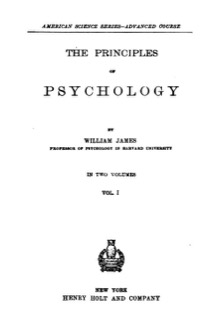
The Principles of Psychology, Volume 1

by William James

Length: 279,524 words, about 1,118 pages, about 20 hours to read

Psychology and mind

Read The Principles of Psychology, Volume 1 free, starting with its best pages and lines below. Listen to it free too, read aloud by your phone's own voice.

The best passages

Pages from the book itself, chosen to make you want to read on. Each opens in the reader at that exact spot.

THE SCOPE OF PSYCHOLOGY.

Psychology is the Science of Mental Life, both of its phenomena and of their conditions. The phenomena are such things as we call feelings, desires, cognitions, reasonings, decisions, and the like; and, superficially considered, their variety and complexity is such as to leave a chaotic impression on the observer. The most natural and consequently the earliest way of unifying the material was, first, to classify it as well as might be, and, secondly, to affiliate the diverse mental modes thus found, upon a simple entity, the personal Soul, of which they are taken to be so many facultative manifestations. Now, for instance, the Soul manifests its faculty of Memory, now of Reasoning, now of Volition, or again its Imagination or its Appetite. This is the orthodox 'spiritualistic' theory of scholasticism and of common-sense. Another and a less obvious way of unifying the chaos is to seek common elements in the divers mental facts rather than a common agent behind them, and to explain them constructively by the various forms of arrangement of these elements, as one explains houses by stones and bricks. The 'associationist' schools of Herbart in Germany, and of Hume the Mills and Bain in Britain have thus constructed a psychology without a soul by taking discrete 'ideas,' faint or vivid, and


Keep reading from here

THE SCOPE OF PSYCHOLOGY.

If now we pass from such actions as these to those of living things, we notice a striking difference. Romeo wants Juliet as the filings want the magnet; and if no obstacles intervene he moves towards her by as straight a line as they. But Romeo and Juliet, if a wall be built between them, do not remain idiotically pressing their faces against its opposite sides like the magnet and the filings with the card. Romeo soon finds a circuitous way, by scaling the wall or otherwise, of touching Juliet's lips directly. With the filings the path is fixed; whether it reaches the end depends on accidents. With the lover it is the end which is fixed, the path may be modified indefinitely.

Suppose a living frog in the position in which we placed our bubbles of air, namely, at the bottom of a jar of water. The want of breath will soon make him also long to rejoin the mother-atmosphere, and he will take the shortest path to his end by swimming straight upwards. But if a jar full of water be inverted over him, he will not, like the bubbles, perpetually press his nose against its unyielding roof, but will restlessly explore the neighborhood until by re-descending again he has discovered a path round its brim to the goal of his desires. Again the fixed end, the varying means!

Keep reading from here

GENERAL NOTION OF HEMISPHERES.

Every spring an immense sacrifice of batrachian life takes place from these causes alone.

No one need be told how dependent all human social elevation is upon the prevalence of chastity. Hardly any factor measures more than this the difference between civilisation and barbarism. Physiologically interpreted, chastity means nothing more than the fact that present solicitations of sense are overpowered by suggestions of æsthetic and moral fitness which the circumstances awaken in the cerebrum; and that upon the inhibitory or permissive influence of these alone action directly depends.

Within the psychic life due to the cerebrum itself the same general distinction obtains, between considerations of the more immediate and considerations of the more remote. In all ages the man whose determinations are swayed by reference to the most distant ends has been held to possess the highest intelligence. The tramp who lives from hour to hour; the bohemian whose engagements are from day to day; the bachelor who builds but for a single life; the father who acts for another generation; the patriot who thinks of a whole community and many generations; and finally, the philosopher and saint whose cares are for humanity and for eternity,—these range themselves in an unbroken hierarchy, wherein each successive grade results from an increased manifestation of the special form of action by which the cerebral centres are distinguished from all below them.

Keep reading from here

FINAL CORRECTION OF THE MEYNERT SCHEME.

We have already noticed the absence of reactions from fear and hunger in the ordinary brainless frog. Schrader gives a striking account of the instinctless condition of his brainless pigeons, active as they were in the way of locomotion and voice. "The hemisphereless animal moves in a world of bodies which ... are all of equal value for him.... He is, to use Goltz's apt expression, impersonal.... Every object is for him only a space-occupying mass, he turns out of his path for an ordinary pigeon no otherwise than for a stone. He may try to climb over both. All authors agree that they never found any difference, whether it was an inanimate body, a cat, a dog, or a bird of prey which came in their pigeon's way. The creature knows neither friends nor enemies, in the thickest company it lives like a hermit. The languishing cooing of the male awakens no more impression than the rattling of the peas, or the call-whistle which in the days before the injury used to make the birds hasten to be fed. Quite as little as the earlier observers have I seen hemisphereless she-birds answer the courting of the male. A hemisphereless male will coo all day long and show distinct signs of sexual excitement, but his activity is without any object, it is entirely indifferent to him whether the she-bird be there or not. If one is placed near him, he leaves her unnoticed....

Keep reading from here

HABIT.

"Habit a second nature! Habit is ten times nature," the Duke of Wellington is said to have exclaimed; and the degree to which this is true no one can probably appreciate as well as one who is a veteran soldier himself. The daily drill and the years of discipline end by fashioning a man completely over again, as to most of the possibilities of his conduct.

"There is a story, which is credible enough, though it may not be true, of a practical joker, who, seeing a discharged veteran carrying home his dinner, suddenly called out, 'Attention!' whereupon the man instantly brought his hands down, and lost his mutton and potatoes in the gutter. The drill had been thorough, and its effects had become embodied in the man's nervous structure."[151]

Keep reading from here

10 of the best lines

Psychology is the Science of Mental Life, both of its phenomena and of their conditions.

THE SCOPE OF PSYCHOLOGY.Keep reading from here

The marksman sees the bird, and, before he knows it, he has aimed and shot.

HABIT.Keep reading from here

A locomotive will carry its train through an open drawbridge as cheerfully as to any other destination.

REASONS AGAINST THE THEORY.Keep reading from here

Into the awareness of the thunder itself the awareness of the previous silence creeps and continues; for what we hear when the thunder crashes is not thunder pure, but thunder-breaking-upon-silence-and-contrasting-with-it.

3) Within each personal consciousness, thought is sensibly continuous.Keep reading from here

I, who for the time have staked my all on being a psychologist, am mortified if others know much more psychology than I.

RIVALRY AND CONFLICT OF THE DIFFERENT SELVES.Keep reading from here

We surely know not the merits which may give to one being a claim on eternity, nor the defects which would cut others off.

The Theory of the Soul.Keep reading from here

Only those items which I notice shape my mind—without selective interest, experience is an utter chaos.

ATTENTION.Keep reading from here

Conceptions form the one class of entities that cannot under any circumstances change.

CONCEPTIONS ARE UNCHANGEABLE.Keep reading from here

Our consciousness would be like a glow-worm spark, illuminating the point it immediately covered, but leaving all beyond in total darkness.

THE PERCEPTION OF TIME.Keep reading from here

It is a case of better remembering by better thinking.

ONE'S NATIVE RETENTIVENESS IS UNCHANGEABLE.Keep reading from here

All 234 The Principles of Psychology, Volume 1 quotes, with the words around each

Reviews

No reviews yet. Be the first, in the app.

Write a review in Doomreader

Contents

All 123 parts
  1. PROFESSOR OF PSYCHOLOGY IN HARVARD UNIVERSITY
  2. IN TWO VOLUMES VOL. I
  3. PREFACE.
  4. PSYCHOLOGY.
  5. THE SCOPE OF PSYCHOLOGY.
  6. THE FUNCTIONS OF THE BRAIN.
  7. THE FROG'S NERVE-CENTRES.
  8. GENERAL NOTION OF HEMISPHERES.
  9. THE EDUCATION OF THE HEMISPHERES.
  10. THE PHRENOLOGICAL CONCEPTION.
  11. THE LOCALIZATION OF FUNCTIONS IN THE HEMISPHERES.
  12. Sight.
  13. Hearing.
  14. Smell.
  15. Taste
  16. Touch.
  17. MAN'S CONSCIOUSNESS LIMITED TO THE HEMISPHERES.
  18. THE RESTITUTION OF FUNCTION.
  19. FINAL CORRECTION OF THE MEYNERT SCHEME.
  20. CONCLUSION.
  21. ON SOME GENERAL CONDITIONS OF BRAIN-ACTIVITY.
  22. THE SUMMATION OF STIMULI
  23. REACTION-TIME.
  24. CEREBRAL BLOOD-SUPPLY.
  25. CEREBRAL THERMOMETRY.
  26. Phosphorus and Thought.
  27. HABIT.
  28. THE AUTOMATON-THEORY.
  29. REASONS FOR THE THEORY.
  30. REASONS AGAINST THE THEORY.
  31. THE MIND-STUFF THEORY.
  32. EVOLUTIONARY PSYCHOLOGY DEMANDS A MIND-DUST.
  33. SOME ALLEGED PROOFS THAT MIND-DUST EXISTS.
  34. INSUFFICIENCY OF THESE PROOFS.
  35. SELF-COMPOUNDING OF MENTAL FACTS IS INADMISSIBLE.
  36. CAN STATES OF MIND BE UNCONSCIOUS?
  37. DO UNCONSCIOUS MENTAL STATES EXIST?
  38. DIFFICULTY OF STATING THE CONNECTION BETWEEN MIND AND BRAIN.
  39. THE MATERIAL-MONAD THEORY.
  40. THE SOUL-THEORY.
  41. THE METHODS AND SNARES OF PSYCHOLOGY
  42. PSYCHOLOGY IS A NATURAL SCIENCE.
  43. THE METHODS OF INVESTIGATION.
  44. THE SOURCES OF ERROR IN PSYCHOLOGY.
  45. THE RELATIONS OF MINDS TO OTHER THINGS.
  46. TIME-RELATIONS.
  47. Are we ever wholly unconscious?
  48. 'Unconsciousness' in Hysterics.
  49. RELATIONS OF CONSCIOUSNESS TO SPACE.
  50. THE RELATIONS OF MINDS TO OTHER OBJECTS
  51. THE STREAM OF THOUGHT.
  52. FIVE CHARACTERS IN THOUGHT.
  53. 1) Thought tends to Personal Form.
  54. 2) Thought is in Constant Change.
  55. 3) Within each personal consciousness, thought is sensibly continuous.
  56. Feelings of Tendency.
  57. 4. Human thought appears to deal with objects independent of itself; that is, it is cognitive, or possesses the function of knowing.
  58. 5) It is always interested more in one part of its object than in another, and welcomes and rejects, or chooses, all the while it thinks.
  59. THE CONSCIOUSNESS OF SELF.
  60. THE EMPIRICAL SELF OR ME.
  61. 2. SELF-FEELING.
  62. 3. SELF-SEEKING AND SELF-PRESERVATION.
  63. RIVALRY AND CONFLICT OF THE DIFFERENT SELVES.
  64. WHAT SELF IS LOVED IN 'SELF-LOVE'?
  65. THE PURE EGO.
  66. The Sense of Personal Identity.
  67. THE PURE SELF OR INNER PRINCIPLE OF PERSONAL UNITY.
  68. The Theory of the Soul.
  69. The Associationist Theory.
  70. THE TRANSCENDENTALIST THEORY.
  71. Certain vicissitudes in the me demand our notice.
  72. THE MUTATIONS OF THE SELF
  73. SUMMARY.
  74. ATTENTION.
  75. TO HOW MANY THINGS CAN WE ATTEND AT ONCE?
  76. THE VARIETIES OF ATTENTION.
  77. THE EFFECTS OF ATTENTION.
  78. THE INTIMATE NATURE OF THE ATTENTIVE PROCESS.
  79. IS VOLUNTARY ATTENTION A RESULTANT OR A FORCE?
  80. INATTENTION.
  81. CONCEPTION. THE SENSE OF SAMENESS.
  82. CONCEPTION DEFINED.
  83. CONCEPTIONS ARE UNCHANGEABLE.
  84. 'ABSTRACT' IDEAS.
  85. UNIVERSALS.
  86. DISCRIMINATION AND COMPARISON.
  87. THE PRINCIPLE OF MEDIATE COMPARISON.
  88. ARE ALL DIFFERENCES DIFFERENCES OF COMPOSITION?
  89. THE CONDITIONS OF DISCRIMINATION.
  90. THE PROCESS OF ANALYSIS.
  91. THE PROCESS OF ABSTRACTION.
  92. THE IMPROVEMENT OF DISCRIMINATION BY PRACTICE.
  93. PRACTICAL INTERESTS LIMIT DISCRIMINATION.
  94. REACTION-TIME AFTER DISCRIMINATION.
  95. THE PERCEPTION OF LIKENESS.
  96. THE MAGNITUDE OF DIFFERENCES.
  97. THE MEASURE OF DISCRIMINATIVE SENSIBILITY.
  98. Theoretic Interpretation of Weber's Law
  99. Weber's law is probably purely physiological.
  100. ASSOCIATION.
  101. THE RAPIDITY OF ASSOCIATION.
  102. THE LAW OF CONTIGUITY.
  103. THE ELEMENTARY LAW OF ASSOCIATION.
  104. Impartial Redintegration.
  105. ORDINARY OR MIXED ASSOCIATION.
  106. ASSOCIATION BY SIMILARITY.
  107. ASSOCIATION IN VOLUNTARY THOUGHT.
  108. SIMILARITY NO ELEMENTARY LAW.
  109. THE HISTORY OF OPINION CONCERNING ASSOCIATION
  110. THE PERCEPTION OF TIME.
  111. THE SENSIBLE PRESENT HAS DURATION.
  112. ACCURACY OF OUR ESTIMATE OF SHORT DURATIONS.
  113. WE HAVE NO SENSE FOR EMPTY TIME.
  114. THE FEELING OF PAST TIME IS A PRESENT FEELING.
  115. TO WHAT CEREBRAL PROCESS IS THE SENSE OF TIME DUE?
  116. MEMORY.
  117. PRIMARY MEMORY.
  118. ANALYSIS OF THE PHENOMENON OF MEMORY.
  119. MEMORY'S CAUSES.
  120. THE CONDITIONS OF GOODNESS IN MEMORY.
  121. ONE'S NATIVE RETENTIVENESS IS UNCHANGEABLE.
  122. EXACT MEASUREMENTS OF MEMORY
  123. FORGETTING.

Listen to The Principles of Psychology, Volume 1 free

The Principles of Psychology, Volume 1 as a free audiobook: Doomreader reads any book aloud, free, in your phone's or computer's own voice. Open the book and tap listen, at the speed you like, hands free.

Want a more natural voice? The AI voices read with AI credits.

Listen free in Doomreader

Download The Principles of Psychology, Volume 1 free

The whole book as an EPUB file, free and legal, from Project Gutenberg. It opens in any ebook app, or read it here in Doomreader with nothing to install.

Download the EPUB (1.5 MB)

More by William James

More like The Principles of Psychology, Volume 1

About this edition

Text from Project Gutenberg. In the public domain in the USA. The Project Gutenberg License is kept inside the file. Every passage and line on this page is the book's own words, checked against the text.