Doomreader

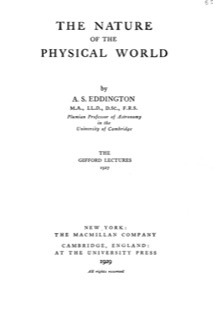
The Nature of the Physical World

by Arthur Stanley Eddington

Length: 110,620 words, about 442 pages, about 8 hours to read

Science and nature

Read The Nature of the Physical World free, starting with its best pages and lines below. Listen to it free too, read aloud by your phone's own voice.

The best passages

Pages from the book itself, chosen to make you want to read on. Each opens in the reader at that exact spot.

INTRODUCTION

I have settled down to the task of writing these lectures and have drawn up my chairs to my two tables. Two tables! Yes; there are duplicates of every object about me—two tables, two chairs, two pens.

This is not a very profound beginning to a course which ought to reach transcendent levels of scientific philosophy. But we cannot touch bedrock immediately; we must scratch a bit at the surface of things first. And whenever I begin to scratch the first thing I strike is—my two tables.

One of them has been familiar to me from earliest years. It is a commonplace object of that environment which I call the world. How shall I describe it? It has extension; it is comparatively permanent; it is coloured; above all it is substantial. By substantial I do not merely mean that it does not collapse when I lean upon it; I mean that it is constituted of “substance” and by that word I am trying to convey to you some conception of its intrinsic nature. It is a thing; not like space, which is a mere negation; nor like time, which is—Heaven knows what! But that will not help you to my meaning because it is the distinctive characteristic of a “thing” to have this substantiality, and I do not think substantiality can be described better than by saying that it is the kind of nature exemplified by an ordinary table. And so we go round in circles. After all if you are a plain commonsense man, not too much worried with scientific scruples, you will be confident that you understand the nature of an ordinary table.

Keep reading from here

Chapter I THE DOWNFALL OF CLASSICAL PHYSICS

Consequences of the Contraction. This result alone, although it may not quite lead you to the theory of relativity, ought to make you uneasy about classical physics. The physicist when he wishes to measure a length—and he cannot get far in any experiment without measuring a length—takes a scale and turns it in the direction needed. It never occurred to him that in spite of all precautions the scale would change length when he did this; but unless the earth happens to be at rest a change must occur. The constancy of a measuring scale is the rock on which the whole structure of physics has been reared; and that rock has crumbled away. You may think that this assumption cannot have betrayed the physicist very badly; the changes of length cannot be serious or they would have been noticed. Wait and see.

Let us look at some of the consequences of the FitzGerald contraction. First take what may seem to be a rather fantastic case. Imagine you are on a planet moving very fast indeed, say 161,000 miles a second. For this speed the contraction is one-half. Any solid contracts to half its original length when turned from across to along the line of motion. A railway journey between two towns which was 100 miles at noon is shortened to 50 miles at 6 p.m. when the planet has turned through a right angle. The inhabitants copy Alice in Wonderland; they pull out and shut up like a telescope.

Keep reading from here

Chapter IV THE RUNNING-DOWN OF THE UNIVERSE

If you take a pack of cards as it comes from the maker and shuffle it for a few minutes, all trace of the original systematic order disappears. The order will never come back however long you shuffle. Something has been done which cannot be undone, namely, the introduction of a random element in place of arrangement.

Illustrations may be useful even when imperfect, and therefore I have slurred over two points, which affect the illustration rather than the application which we are about to make. It was scarcely true to say that the shuffling cannot be undone. You can sort out the cards into their original order if you like. But in considering the shuffling which occurs in the physical world we are not troubled by a deus ex machina like you. I am not prepared to say how far the human mind is bound by the conclusions we shall reach. So I exclude you—at least I exclude that activity of your mind which you employ in sorting the cards. I allow you to shuffle them because you can do that absent-mindedly.

Secondly, it is not quite true that the original order never comes back. There is a ghost of a chance that some day a thoroughly shuffled pack will be found to have come back to the original order. That is because of the comparatively small number of cards in the pack. In our applications the units are so numerous that this kind of contingency can be disregarded.

We shall put forward the contention that—

Keep reading from here

Chapter VI GRAVITATION—THE LAW

NEWTON. Letters to Bentley.

The Man in the Lift. About 1915 Einstein made a further development of his theory of relativity extending it to non-uniform motion. The easiest way to approach this subject is by considering the Man in the Lift.

Suppose that this room is a lift. The support breaks and down we go with ever-increasing velocity, falling freely.

Let us pass the time by performing physical experiments. The lift is our laboratory and we shall start at the beginning and try to discover all the laws of Nature—that is to say, Nature as interpreted by the Man in the Lift. To a considerable extent this will be a repetition of the history of scientific discovery already made in the laboratories on terra firma. But there is one notable difference.

I perform the experiment of dropping an apple held in the hand. The apple cannot fall any more than it was doing already. You remember that our lift and all things contained in it are falling freely. Consequently the apple remains poised by my hand. There is one incident in the history of science which will not repeat itself to the men in the lift, viz. Newton and the apple tree. The magnificent conception that the agent which guides the stars in their courses is the same as that which in our common experience causes apples to drop, breaks down because it is our common experience in the lift that apples do not drop.

Keep reading from here

Chapter IX THE QUANTUM THEORY

The Origin of the Trouble. Nowadays whenever enthusiasts meet together to discuss theoretical physics the talk sooner or later turns in a certain direction. You leave them conversing on their special problems or the latest discoveries; but return after an hour and it is any odds that they will have reached an all-engrossing topic—the desperate state of their ignorance. This is not a pose. It is not even scientific modesty, because the attitude is often one of naïve surprise that Nature should have hidden her fundamental secret successfully from such powerful intellects as ours. It is simply that we have turned a corner in the path of progress and our ignorance stands revealed before us, appalling and insistent. There is something radically wrong with the present fundamental conceptions of physics and we do not see how to set it right.

The cause of all this trouble is a little thing called which crops up continually in a wide range of experiments.

Keep reading from here

10 of the best lines

Two tables! Yes; there are duplicates of every object about me—two tables, two chairs, two pens.

INTRODUCTIONKeep reading from here

Nature has been too subtle for him; she has not left anything to betray the frame which she used.

Chapter II RELATIVITYKeep reading from here

Shuffling is the only thing which Nature cannot undo.

Chapter IV THE RUNNING-DOWN OF THE UNIVERSEKeep reading from here

If the physicist as advocate for reason takes this line, just whisper to him the word Entropy.

Chapter V “BECOMING”Keep reading from here

The law of gravitation is not a stern ruler controlling the heavenly bodies; it is a kind-hearted accomplice who covers up their delinquencies.

Chapter VII GRAVITATION—THE EXPLANATIONKeep reading from here

The light calls the tune, therefore the light must pay the piper.

Chapter IX THE QUANTUM THEORYKeep reading from here

Not once in the dim past, but continuously by conscious mind is the miracle of the Creation wrought.

Chapter XI WORLD BUILDINGKeep reading from here

Mind is—but you know what mind is like, so why should I say more about its nature?

Chapter XIII REALITYKeep reading from here

It simply does not do to expose the inner workings of a joke.

Chapter XV SCIENCE AND MYSTICISMKeep reading from here

For if those who hold that there must be a physical basis for everything hold that these mystical views are nonsense, we may ask—What then is the physical basis of nonsense?

CONCLUSIONKeep reading from here

All 213 The Nature of the Physical World quotes, with the words around each

Reviews

No reviews yet. Be the first, in the app.

Write a review in Doomreader

Contents

  1. PREFACE
  2. INTRODUCTION
  3. Chapter I THE DOWNFALL OF CLASSICAL PHYSICS
  4. Chapter II RELATIVITY
  5. Chapter III TIME
  6. Chapter IV THE RUNNING-DOWN OF THE UNIVERSE
  7. Chapter V “BECOMING”
  8. Chapter VI GRAVITATION—THE LAW
  9. Chapter VII GRAVITATION—THE EXPLANATION
  10. Chapter VIII MAN’S PLACE IN THE UNIVERSE
  11. Chapter IX THE QUANTUM THEORY
  12. Chapter X THE NEW QUANTUM THEORY
  13. Chapter XI WORLD BUILDING
  14. Chapter XII POINTER READINGS
  15. Chapter XIII REALITY
  16. Chapter XIV CAUSATION
  17. Chapter XV SCIENCE AND MYSTICISM
  18. CONCLUSION

Listen to The Nature of the Physical World free

The Nature of the Physical World as a free audiobook: Doomreader reads any book aloud, free, in your phone's or computer's own voice. Open the book and tap listen, at the speed you like, hands free.

Want a more natural voice? The AI voices read with AI credits.

Listen free in Doomreader

Download The Nature of the Physical World free

The whole book as an EPUB file, free and legal, from Project Gutenberg. It opens in any ebook app, or read it here in Doomreader with nothing to install.

Download the EPUB (1.3 MB)

More like The Nature of the Physical World

About this edition

Text from Project Gutenberg. In the public domain in the USA. The Project Gutenberg License is kept inside the file. Every passage and line on this page is the book's own words, checked against the text.