Doomreader

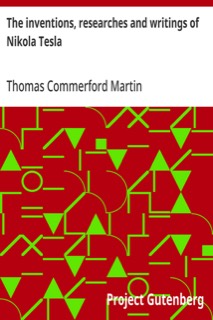
The Inventions, Researches and Writings of Nikola Tesla

by Thomas Commerford Martin

Length: 170,459 words, about 682 pages, about 12 hours to read

Science and nature, Lives and letters

Read The Inventions, Researches and Writings of Nikola Tesla free, starting with its best pages and lines below. Listen to it free too, read aloud by your phone's own voice.

The best passages

Pages from the book itself, chosen to make you want to read on. Each opens in the reader at that exact spot.

Biographical and Introductory.

Nikola Tesla was born in 1857 at Smiljan, Lika, a borderland region of Austro-Hungary, of the Serbian race, which has maintained against Turkey and all comers so unceasing a struggle for freedom. His family is an old and representative one among these Switzers of Eastern Europe, and his father was an eloquent clergyman in the Greek Church. An uncle is to-day Metropolitan in Bosnia. His mother was a woman of inherited ingenuity, and delighted not only in skilful work of the ordinary household character, but in the construction of such mechanical appliances as looms and churns and other machinery required in a rural community. Nikola was educated at Gospich in the public school for four years, and then spent three years in the Real Schule. He was then sent to Carstatt, Croatia, where he continued his studies for three years in the Higher Real Schule. There for the first time he saw a steam locomotive. He graduated in 1873, and, surviving an attack of cholera, devoted himself to experimentation, especially in electricity and magnetism. His father would have had him maintain the family tradition by entering the Church, but native genius was too strong, and he was allowed to enter the Polytechnic School at Gratz, to finish his studies, and with the object of becoming a professor of mathematics and physics. One of the machines there experimented with was a Gramme dynamo, used as a motor. Despite his instructor's perfect demonstration of the fact that it was impossible to operate a dynamo without commutator or brushes, Mr. Tesla could not be convinced that such accessories were necessary or desirable.

Keep reading from here

Biographical and Introductory.

It was during this period, and as early as 1882, that he began serious and continued efforts to embody the rotating field principle in operative apparatus. He was enthusiastic about it; believed it to mark a new departure in the electrical arts, and could think of nothing else. In fact, but for the solicitations of a few friends in commercial circles who urged him to form a company to exploit the invention, Mr. Tesla, then a youth of little worldly experience, would have sought an immediate opportunity to publish his ideas, believing them to be worthy of note as a novel and radical advance in electrical theory as well as destined to have a profound influence on all dynamo electric machinery.

At last he determined that it would be best to try his fortunes in America. In France he had met many Americans, and in contact with them learned the desirability of turning every new idea in electricity to practical use. He learned also of the ready encouragement given in the United States to any inventor who could attain some new and valuable result. The resolution was formed with characteristic quickness, and abandoning all his prospects in Europe, he at once set his face westward.

Keep reading from here

Biographical and Introductory.

Arrived in the United States, Mr. Tesla took off his coat the day he arrived, in the Edison Works. That place had been a goal of his ambition, and one can readily imagine the benefit and stimulus derived from association with Mr. Edison, for whom Mr. Tesla has always had the strongest admiration. It was impossible, however, that, with his own ideas to carry out, and his own inventions to develop, Mr. Tesla could long remain in even the most delightful employ; and, his work now attracting attention, he left the Edison ranks to join a company intended to make and sell an arc lighting system based on some of his inventions in that branch of the art. With unceasing diligence he brought the system to perfection, and saw it placed on the market. But the thing which most occupied his time and thoughts, however, all through this period, was his old discovery of the rotating field principle for alternating current work, and the application of it in motors that have now become known the world over.

Keep reading from here

Introduction.—The Scope of the Tesla Lectures.

There is still another and more striking peculiarity of such a high frequency streamer, namely, it is hot. The heat is easily perceptible with frequencies of about 10,000, even if the potential is not excessively high. The heating effect is, of course, due to the molecular impacts and collisions. Could the frequency and potential be pushed far enough, then a brush could be produced resembling in every particular a flame and giving light and heat, yet without a chemical process taking place.

The hot brush, when properly produced, resembles a jet of burning gas escaping under great pressure, and it emits an extraordinary strong smell of ozone. The great ozonizing action is ascribed to the fact that the agitation of the molecules of the air is more violent in such a brush than in the ordinary streamer of a static machine. But the most powerful brush discharges were produced by employing currents of much higher frequencies than it was possible to obtain by means of the alternators. These currents were obtained by disruptively discharging a condenser and setting up oscillations. In this manner currents of a frequency of several hundred thousand were obtained.

Keep reading from here

Experiments with Alternate Currents of High Potential and High Frequency.[2]

Here is a simple glass tube from which the air has been partially exhausted. I take hold of it; I bring my body in contact with a wire conveying alternating currents of high potential, and the tube in my hand is brilliantly lighted. In whatever position I may put it, wherever I move it in space, as far as I can reach, its soft, pleasing light persists with undiminished brightness.

Here is an exhausted bulb suspended from a single wire. Standing on an insulated support, I grasp it, and a platinum button mounted in it is brought to vivid incandescence.

Here, attached to a leading wire, is another bulb, which, as I touch its metallic socket, is filled with magnificent colors of phosphorescent light.

Here still another, which by my fingers' touch casts a shadow—the Crookes shadow—of the stem inside of it.

Keep reading from here

10 of the best lines

Great ideas and real inventions win their own way, determining their own place by intrinsic merit.

PREFACE.Keep reading from here

The hot brush, when properly produced, resembles a jet of burning gas escaping under great pressure, and it emits an extraordinary strong smell of ozone.

Introduction.—The Scope of the Tesla Lectures.Keep reading from here

The field is wide and completely unexplored, and at every step a new truth is gleaned, a novel fact observed.

Experiments With Alternate Currents of Very High Frequency and Their Application to Methods of Artificial Illumination.[1]Keep reading from here

Is there, I ask, can there be, a more interesting study than that of alternating currents?

Experiments with Alternate Currents of High Potential and High Frequency.[2]Keep reading from here

Such paradoxes and apparent impossibilities we encounter at every step in this line of work, and therein lies, to a great extent, the charm of the study.

Experiments with Alternate Currents of High Potential and High Frequency.[2]Keep reading from here

So intimate is this relation, that it is often said, the very soul shows itself in the eye.

On Light and Other High Frequency Phenomena.[3]Keep reading from here

Matter at rest, if such a thing could exist, would be matter dead.

On Light and Other High Frequency Phenomena.[3]Keep reading from here

The day when we shall know exactly what "electricity" is, will chronicle an event probably greater, more important than any other recorded in the history of the human race.

On Light and Other High Frequency Phenomena.[3]Keep reading from here

It is very likely that resonant vibration plays a most important part in all manifestations of energy in nature.

On Light and Other High Frequency Phenomena.[3]Keep reading from here

It is characteristic of fundamental discoveries, of great achievements of intellect, that they retain an undiminished power upon the imagination of the thinker.

Improvement in "Unipolar" Generators.Keep reading from here

All 63 The Inventions, Researches and Writings of Nikola Tesla quotes, with the words around each

Reviews

No reviews yet. Be the first, in the app.

Write a review in Doomreader

Contents

All 104 parts
  1. OF
  2. NIKOLA TESLA
  3. TO HIS COUNTRYMEN
  4. IN EASTERN EUROPE THIS RECORD OF THE WORK ALREADY ACCOMPLISHED BY
  5. NIKOLA TESLA
  6. IS RESPECTFULLY DEDICATED
  7. THE INVENTIONS RESEARCHES AND WRITINGS
  8. Nikola Tesla
  9. WITH SPECIAL REFERENCE TO HIS WORK IN POLYPHASE CURRENTS AND HIGH POTENTIAL LIGHTING
  10. Editor The Electrical Engineer; Past-President American Institute Electrical Engineers
  11. 1894 THE ELECTRICAL ENGINEER NEW YORK D. VAN NOSTRAND COMPANY, NEW YORK.
  12. Entered according to Act of Congress in the year 1893 by T. C. MARTIN in the office of the Librarian of Congress at Washington
  13. PREFACE.
  14. PART I. POLYPHASE CURRENTS.
  15. CHAPTER I.
  16. Biographical and Introductory.
  17. CHAPTER II.
  18. A New System of Alternating Current Motors and Transformers.
  19. CHAPTER III.
  20. The Tesla Rotating Magnetic Field.—Motors With Closed Conductors.—Synchronizing Motors.—Rotating Field Transformers.
  21. CHAPTER IV.
  22. Modifications and Expansions of the Tesla Polyphase Systems.
  23. CHAPTER V.
  24. Utilizing Familiar Types of Generator of the Continuous Current Type.
  25. CHAPTER VI.
  26. Method of Obtaining Desired Speed of Motor or Generator.
  27. CHAPTER VII.
  28. Regulator for Rotary Current Motors.
  29. CHAPTER VIII.
  30. Single Circuit, Self-Starting Synchronizing Motors.
  31. CHAPTER IX.
  32. Change From Double Current to Single Current Motor.
  33. CHAPTER X.
  34. Motor With "Current Lag" Artificially Secured.
  35. CHAPTER XI.
  36. Another Method of Transformation from a Torque to a Synchronizing Motor.
  37. CHAPTER XII.
  38. "Magnetic Lag" Motor.
  39. CHAPTER XIII.
  40. Method of Obtaining Difference of Phase by Magnetic Shielding.
  41. CHAPTER XIV.
  42. Type of Tesla Single-Phase Motor.
  43. CHAPTER XV.
  44. Motors with Circuits of Different Resistance.
  45. CHAPTER XVI.
  46. Motor With Equal Magnetic Energies in Field and Armature.
  47. CHAPTER XVII.
  48. Motors With Coinciding Maxima of Magnetic Effect in Armature and Field.
  49. CHAPTER XVIII.
  50. Motor Based on the Difference of Phase in the Magnetization of the Inner and Outer Parts of an Iron Core.
  51. CHAPTER XIX.
  52. Another Type of Tesla Induction Motor.
  53. CHAPTER XX.
  54. Combinations of Synchronizing Motor and Torque Motor.
  55. CHAPTER XXI.
  56. Motor with a Condenser in the Armature Circuit.
  57. CHAPTER XXII.
  58. Motor with Condenser in one of the Field Circuits.
  59. CHAPTER XXIII.
  60. Tesla Polyphase Transformer.
  61. CHAPTER XXIV.
  62. A Constant Current Transformer with Magnetic Shield Between Coils of Primary and Secondary.
  63. PART II. THE TESLA EFFECTS WITH HIGH FREQUENCY AND HIGH POTENTIAL CURRENTS.
  64. CHAPTER XXV.
  65. Introduction.—The Scope of the Tesla Lectures.
  66. CHAPTER XXVI.
  67. Experiments With Alternate Currents of Very High Frequency and Their Application to Methods of Artificial Illumination.[1]
  68. CHAPTER XXVII.
  69. Experiments with Alternate Currents of High Potential and High Frequency.[2]
  70. CHAPTER XXVIII.
  71. On Light and Other High Frequency Phenomena.[3]
  72. CHAPTER XXIX.
  73. Tesla Alternating Current Generators for High Frequency, in Detail.
  74. CHAPTER XXX.
  75. Alternate Current Electrostatic Induction Apparatus.[6]
  76. CHAPTER XXXI.
  77. "Massage" With Currents of High Frequency.[7]
  78. CHAPTER XXXII.
  79. Electric Discharge in Vacuum Tubes.[8]
  80. PART III. MISCELLANEOUS INVENTIONS AND WRITINGS.
  81. CHAPTER XXXIII.
  82. Method of Obtaining Driect From Alternating Currents.
  83. CHAPTER XXXIV.
  84. Condensers with Plates in Oil.
  85. CHAPTER XXXV.
  86. Electrolytic Registering Meter.
  87. CHAPTER XXXVI.
  88. Thermo-Magnetic Motors and Pyro-Magnetic Generators.
  89. CHAPTER XXXVII.
  90. Anti-Sparking Dynamo Brush and Commutator.
  91. CHAPTER XXXVIII.
  92. Auxiliary Brush Regulation of Direct Current Dynamos.
  93. CHAPTER XXXIX.
  94. Improvement in the Construction of Dynamos and Motors.
  95. CHAPTER XL.
  96. Tesla Direct Current Arc Lighting System.
  97. CHAPTER XLI.
  98. Improvement in "Unipolar" Generators.
  99. PART IV. APPENDIX.—EARLY PHASE MOTORS AND THE TESLA MECHANICAL AND ELECTRICAL OSCILLATOR.
  100. CHAPTER XLII.
  101. Mr. Tesla's Personal Exhibit at the World's Fair.
  102. CHAPTER XLIII.
  103. The Tesla Mechanical and Electrical Oscillators.
  104. FOOTNOTES

Listen to The Inventions, Researches and Writings of Nikola Tesla free

The Inventions, Researches and Writings of Nikola Tesla as a free audiobook: Doomreader reads any book aloud, free, in your phone's or computer's own voice. Open the book and tap listen, at the speed you like, hands free.

Want a more natural voice? The AI voices read with AI credits.

Listen free in Doomreader

Download The Inventions, Researches and Writings of Nikola Tesla free

The whole book as an EPUB file, free and legal, from Project Gutenberg. It opens in any ebook app, or read it here in Doomreader with nothing to install.

Download the EPUB (0.4 MB)

More like The Inventions, Researches and Writings of Nikola Tesla

About this edition

Text from Project Gutenberg. In the public domain in the USA. The Project Gutenberg License is kept inside the file. Every passage and line on this page is the book's own words, checked against the text.