Doomreader

The Book of Khalid

by Ameen Rihani

Length: 90,761 words, about 363 pages, about 6 hours to read

Satire and humour

Read The Book of Khalid free, starting with its best pages and lines below. Listen to it free too, read aloud by your phone's own voice.

What it is

A Lebanese iconoclast emigrates to America and embarks on a quixotic quest for the truth.

The best passages

Pages from the book itself, chosen to make you want to read on. Each opens in the reader at that exact spot.

II: The City of Baal

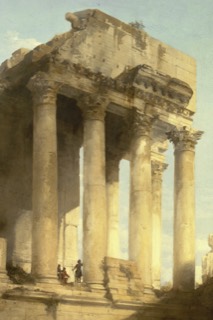
The City of Baal, or Baalbek, is between the desert and the deep sea. It lies at the foot of Anti-Libanus, in the sunny plains of Coele-Syria, a day’s march from either Damascus or Beirut. It is a city with a past as romantic as Rome’s, as wicked as Babel’s; its ruins testify both to its glory and its shame. It is a city with a future as brilliant as any New-World city; the railroad at its gate, the modern agricultural implements in its fields, and the porcelain bathtubs in its hotels, can testify to this. It is a city that enticed and still entices the mighty of the earth; Roman Emperors in the past came to appease the wrath of its gods, a German Emperor today comes to pilfer its temples. For the Acropolis in the poplar grove is a mine of ruins. The porphyry pillars, the statues, the tablets, the exquisite friezes, the palimpsests, the bas-reliefs⁠—Time and the Turks have spared a few of these. And when the German Emperor came, Abdul Hamid blinked, and the Berlin Museum is now the richer for it.
Keep reading from here

IV: On the Wharf of Enchantment

’Tis further set down in the Histoire Intime:

“We rented a cellar, as deep and dark and damp as could be found. And our landlord was a Teague, nay, a kindhearted old Irishman, who helped us put up the shelves, and never called for the rent in the dawn of the first day of the month. In the front part of this cellar we had our shop; in the rear, our home. On the floor we laid our mattresses, on the shelves, our goods. And never did we stop to think who in this case was better off. The safety of our merchandise before our own. But ten days after we had settled down, the water issued forth from the floor and inundated our shop and home. It rose so high that it destroyed half of our capital stock and almost all our furniture. And yet, we continued to live in the cellar, because, perhaps, every one of our compatriot-merchants did so. We were all alike subject to these inundations in the winter season. I remember when the water first rose in our store, Khalid was so hard set and in such a pucker that he ran out capless and in his shirt sleeves to discover in the next street the source of the flood. And one day, when we were pumping out the water he asked me if I thought this was easier than rolling our roofs in Baalbek. For truly, the paving-roller is child’s play to this pump. And a leaky roof is better than an inundated cellar.”

Keep reading from here

VII: In the Twilight of an Idea

“Here, Khalid, absentminded, laid down his box and sat upon it, and I stretched my limbs on the grass. But of a sudden, he jumped up, opened the bottom drawer of his case, and drew from it the bottle. It is quite in order now, I mused; but ere I had enjoyed the thought, Khalid had placed his box at a little distance, and, standing there beside it, bottle in hand, delivered himself in a semi-solemn, semi-mocking manner of the following: ‘This is the oil,’ I remember him saying, ‘with which I anoint thee⁠—the extreme unction I apply to thy soul.’ And he poured the contents of the bottle into the bottom drawer and over the box, and applied to it a match. The bottle was filled with kerosene, and in a jiffy the box was covered with the flame. Yes; and so quickly, so neatly it was done, that I could not do aught to prevent it. The match was applied to what I thought at first was whiskey, and I was left in speechless amazement. He would not even help me to save a few things from the fire. I conjured him in the name of Allah, but in vain. I clamoured and remonstrated, but to no purpose. And when I asked him why he had done this, he asked me in reply, ‘And why have you not done the same? Now, methinks I deserve my mujaddara. And not until you do likewise, will you deserve yours, O Shakib. Here are the lies, now turned to ashes, which brought me my bread and are still bringing you yours. Here are our instruments of deception, our poisoned sources of lucre. I am most happy now, O Shakib.

Keep reading from here

V: Priesto-Parental

For Khalid begins to suspect that the Jesuits are the cause of his banishment from home, that his father’s religious ferocity is fuelled and fanned by these good people. One day, before Khalid was banished, Shakib tells us, one of them, Father Farouche by name, comes to pay a visit of courtesy, and finds Khalid sitting cross-legged on a mat writing a letter.

The Padre is received by Khalid’s mother who takes his hand, kisses it, and offers him the seat of honour on the divan. Khalid continues writing. And after he had finished, he turns round in his cross-legged posture and greets his visitor. Which greeting is surely to be followed by a conversation of the sword-and-shield kind.

“How is your health?” this from Father Farouche in miserable Arabic.

“As you see: I breathe with an effort, and can hardly speak.”

“But the health of the body is nothing compared with the health of the soul.”

“I know that too well, O Reverend” (Ya Muhtaram).

“And one must have recourse to the physician in both instances.”

“I do not believe in physicians, O Reverend.”

“Not even the physician of the soul?”

“You said it, O Reverend.”

The mother of Khalid serves the coffee, and whispers to her son a word. Whereupon Khalid rises and sits on the divan near the Padre.

“But one must follow the religion of one’s father,” the Jesuit resumes.

“When one’s father has a religion, yes; but when he curses the religion of his son for not being ferociously religious like himself⁠—”

Keep reading from here

VII: The Howdaj of Falsehood

She is gone to church, to mass, but she’ll return soon.”

But Najma is long gone; returns not; and the third-class Dodo will call again tomorrow. Now, Abu-Najma brings out his rope, soaps it well, nooses and suspends it from the rafter in the ceiling. And when his daughter returns from the spring, he takes her by the arm, shows her the rope, and tells her laconically to choose between his Excellency and this. Poor Najma has not the courage to die, and so soon. Her cousin Khalid is in prison, is excommunicated⁠—what can she do? Run away? The Church will follow her⁠—punish her. There’s something satanic in Khalid⁠—the Church said so⁠—the Church knows. Najma rolls these things in her mind, looks at her father beseechingly. Her father points to the noose. Najma falls to weeping. The noose serves well its purpose.

For hereafter, when the Dodo comes decorated, she has to offer him the cushion, bring him the masnad, make for him the coffee. And eventually, as the visits accumulate, she goes with him to the dressmaker in Beirut. The bridal gown shall be of the conventional silk this time; for his Excellency is travelled, and knows and reverences the fashion. But why prolong these painful details?

“Allah, in the mysterious working of his Providence,” says Shakib, “preordained it thus: Khalid, having served his turn in prison, Najma begins her own; for a few days after he was set free, she was placed in bonds forged for her by the Jesuits. Now, when Khalid returned from Damascus, he came straightway to me and asked that we go to see Najma and try to prevail upon her, to persuade her to go with him, to run away.

Keep reading from here

10 of the best lines

The most important in the history of nations and individuals was once the most trivial, and vice versa.

I: Probing the TrivialKeep reading from here

Wherever one is happy, Shakib, there is the Primo.

III: Via DolorosaKeep reading from here

A sanitarium this for the hebephreniac. And like all sanitariums, you go into it with one disease and come out of it with ten.

V: The Cellar of the SoulKeep reading from here

Thy throne is mortised with their bones, cemented with their blood.

VII: In the Twilight of an IdeaKeep reading from here

It is either the first or the last star of night. And who shall say which it is?

IV: The Last StarKeep reading from here

Fruitful is thy word, O woman!

VI: Flounces and RufflesKeep reading from here

Khalid himself says that to be truly, deeply, piously in love, one must needs hate himself.

VII: The Howdaj of FalsehoodKeep reading from here

“Because the Government,” replies our monk in a dry, droll air and gesture, “does not eat cheese.”

IX: Signs of the HermitKeep reading from here

Consistency is superficial, narrow, one-sided.

III: The Self EcstaticKeep reading from here

Cannons can destroy Empires; but only the living voice, the inspired voice can build them.

VII: A Dream of EmpireKeep reading from here

All 38 The Book of Khalid quotes, with the words around each

Reviews

No reviews yet. Be the first, in the app.

Write a review in Doomreader

Contents

All 36 parts
  1. Al-Fatihah
  2. Book the First: In the Exchange
  3. To Man
  4. I: Probing the Trivial
  5. II: The City of Baal
  6. III: Via Dolorosa
  7. IV: On the Wharf of Enchantment
  8. V: The Cellar of the Soul
  9. VI: The Summer Afternoon of a Sham
  10. VII: In the Twilight of an Idea
  11. VIII: With the Houris
  12. Book the Second: In the Temple
  13. To Nature
  14. I: The Dowry of Democracy
  15. II: Subtranscendental
  16. III: The False Dawn
  17. IV: The Last Star
  18. V: Priesto-Parental
  19. VI: Flounces and Ruffles
  20. VII: The Howdaj of Falsehood
  21. VIII: The Kaaba of Solitude
  22. IX: Signs of the Hermit
  23. X: The Vineyard in the Kaaba
  24. Book the Third: In Kulmakan
  25. To God
  26. I: The Disentanglement of the Me
  27. II: The Voice of the Dawn
  28. III: The Self Ecstatic
  29. IV: On the Open Highway
  30. V: Union and Progress
  31. VI: Revolutions Within and Without
  32. VII: A Dream of Empire
  33. VIII: Adumbrations
  34. IX: The Stoning and Flight
  35. X: The Desert
  36. Al-Khatimah

Listen to The Book of Khalid free

The Book of Khalid as a free audiobook: Doomreader reads any book aloud, free, in your phone's or computer's own voice. Open the book and tap listen, at the speed you like, hands free.

Want a more natural voice? The AI voices read with AI credits.

Listen free in Doomreader

Download The Book of Khalid free

The whole book as an EPUB file, free and legal, from Standard Ebooks. It opens in any ebook app, or read it here in Doomreader with nothing to install.

Download the EPUB (1.1 MB)

More by Ameen Rihani

More like The Book of Khalid

About this edition

Text from Standard Ebooks. Standard Ebooks dedicate their edition to the public domain (CC0 1.0). Every passage and line on this page is the book's own words, checked against the text.