Doomreader

The Wind in the Willows

by Kenneth Grahame

Length: 59,021 words, about 236 pages, about 4 hours to read

Fantasy, Satire and humour, Children's

Read The Wind in the Willows free, starting with its best pages and lines below. Listen to it free too, read aloud by your phone's own voice.

What it is

Four animals adventure through the bucolic English countryside.

The best passages

Pages from the book itself, chosen to make you want to read on. Each opens in the reader at that exact spot.

I: The River Bank

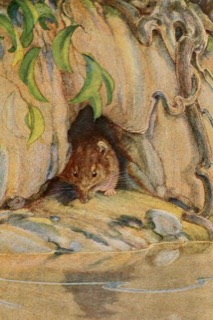
The Mole had been working very hard all the morning, spring-cleaning his little home. First with brooms, then with dusters; then on ladders and steps and chairs, with a brush and a pail of whitewash; till he had dust in his throat and eyes, and splashes of whitewash all over his black fur, and an aching back and weary arms. Spring was moving in the air above and in the earth below and around him, penetrating even his dark and lowly little house with its spirit of divine discontent and longing. It was small wonder, then, that he suddenly flung down his brush on the floor, said, “Bother!” and “O blow!” and also “Hang spring-cleaning!” and bolted out of the house without even waiting to put on his coat. Something up above was calling him imperiously, and he made for the steep little tunnel which answered in his case to the gravelled carriage-drive owned by animals whose residences are nearer to the sun and air. So he scraped and scratched and scrabbled and scrooged, and then he scrooged again and scrabbled and scratched and scraped, working busily with his little paws and muttering to himself, “Up we go! Up we go!” till at last, pop! his snout came out into the sunlight and he found himself rolling in the warm grass of a great meadow.

“This is fine!” he said to himself. “This is better than whitewashing!”
Keep reading from here

I: The River Bank

“Nice? It’s the only thing,” said the Water Rat solemnly as he leant forward for his stroke. “Believe me, my young friend, there is nothing⁠—absolute nothing⁠—half so much worth doing as simply messing about in boats. Simply messing,” he went on dreamily: “messing⁠—about⁠—in⁠—boats; messing⁠—”

“Look ahead, Rat!” cried the Mole suddenly.

It was too late. The boat struck the bank full tilt. The dreamer, the joyous oarsman, lay on his back at the bottom of the boat, his heels in the air.

“⁠—about in boats⁠—or with boats,” the Rat went on composedly, picking himself up with a pleasant laugh. “In or out of ’em, it doesn’t matter. Nothing seems really to matter, that’s the charm of it. Whether you get away, or whether you don’t; whether you arrive at your destination or whether you reach somewhere else, or whether you never get anywhere at all, you’re always busy, and you never do anything in particular; and when you’ve done it there’s always something else to do, and you can do it if you like, but you’d much better not. Look here! If you’ve really nothing else on hand this morning, supposing we drop down the river together, and have a long day of it?”

Keep reading from here

II: The Open Road

He led the way to the stable-yard accordingly, the Rat following with a most mistrustful expression; and there, drawn out of the coach-house into the open, they saw a gipsy caravan, shining with newness, painted a canary-yellow picked out with green, and red wheels.

“There you are!” cried the Toad, straddling and expanding himself. “There’s real life for you, embodied in that little cart. The open road, the dusty highway, the heath, the common, the hedgerows, the rolling downs! Camps, villages, towns, cities! Here today, up and off to somewhere else tomorrow! Travel, change, interest, excitement! The whole world before you, and a horizon that’s always changing! And mind! this is the very finest cart of its sort that was ever built, without any exception. Come inside and look at the arrangements. Planned ’em all myself, I did!”

The Mole was tremendously interested and excited, and followed him eagerly up the steps and into the interior of the caravan. The Rat only snorted and thrust his hands deep into his pockets, remaining where he was.

It was indeed very compact and comfortable. Little sleeping bunks⁠—a little table that folded up against the wall⁠—a cooking-stove, lockers, bookshelves, a birdcage with a bird in it; and pots, pans, jugs, and kettles of every size and variety.

Keep reading from here

III: The Wild Wood

Everything was very still now. The dusk advanced on him steadily, rapidly, gathering in behind and before; and the light seemed to be draining away like flood-water.

Then the faces began.

It was over his shoulder, and indistinctly, that he first thought he saw a face, a little, evil, wedge-shaped face, looking out at him from a hole. When he turned and confronted it, the thing had vanished.

He quickened his pace, telling himself cheerfully not to begin imagining things or there would be simply no end to it. He passed another hole, and another, and another; and then⁠—yes!⁠—no!⁠—yes! certainly a little, narrow face, with hard eyes, had flashed up for an instant from a hole, and was gone. He hesitated⁠—braced himself up for an effort and strode on. Then suddenly, and as if it had been so all the time, every hole, far and near, and there were hundreds of them, seemed to possess its face, coming and going rapidly, all fixing on him glances of malice and hatred: all hard-eyed and evil and sharp.

If he could only get away from the holes in the banks, he thought, there would be no more faces. He swung off the path and plunged into the untrodden places of the wood.

Then the whistling began.

Keep reading from here

X: The Further Adventures of Toad

“So you’re in the washing business, ma’am?” said the barge-woman politely, as they glided along. “And a very good business you’ve got too, I dare say, if I’m not making too free in saying so.”

“Finest business in the whole country,” said Toad airily. “All the gentry come to me⁠—wouldn’t go to anyone else if they were paid, they know me so well. You see, I understand my work thoroughly, and attend to it all myself. Washing, ironing, clear-starching, making up gents’ fine shirts for evening wear⁠—everything’s done under my own eye!”

“But surely you don’t do all that work yourself, ma’am?” asked the barge-woman respectfully.

“O, I have girls,” said Toad lightly: “twenty girls or thereabouts, always at work. But you know what girls are, ma’am! Nasty little hussies, that’s what I call ’em!”

“So do I, too,” said the barge-woman with great heartiness. “But I dare say you set yours to rights, the idle trollops! And are you very fond of washing?”

“I love it,” said Toad. “I simply dote on it. Never so happy as when I’ve got both arms in the washtub. But, then, it comes so easy to me! No trouble at all! A real pleasure, I assure you, ma’am!”

“What a bit of luck, meeting you!” observed the barge-woman, thoughtfully. “A regular piece of good fortune for both of us!”

“Why, what do you mean?” asked Toad, nervously.

Keep reading from here

10 of the best lines

After all, the best part of a holiday is perhaps not so much to be resting yourself, as to see all the other fellows busy working.

I: The River BankKeep reading from here

Packing the basket was not quite such pleasant work as unpacking the basket. It never is.

I: The River BankKeep reading from here

There’s no security, or peace and tranquillity, except underground.

IV: Mr. BadgerKeep reading from here

For this is the last best gift that the kindly demigod is careful to bestow on those to whom he has revealed himself in their helping: the gift of forgetfulness.

VII: The Piper at the Gates of DawnKeep reading from here

Nature’s Grand Hotel has its Season, like the others.

IX: Wayfarers AllKeep reading from here

Poor Ratty did his best, by degrees, to explain things; but how could he put into cold words what had mostly been suggestion?

IX: Wayfarers AllKeep reading from here

He tried coaxing, he tried slapping, he tried punching; they smiled back at him out of the tub unconverted, happy in their original sin.

X: The Further Adventures of ToadKeep reading from here

It was, perhaps, the most conceited song that any animal ever composed.

X: The Further Adventures of ToadKeep reading from here

He’s always rather low and despondent when he’s wanting his victuals. In half an hour’s time he’ll be quite a different animal.

XI: “Like Summer Tempests Came His Tears”Keep reading from here

Those are always the best and the raciest adventures; and why should they not be truly ours, as much as the somewhat inadequate things that really come off?

XI: “Like Summer Tempests Came His Tears”Keep reading from here

All 36 The Wind in the Willows quotes, with the words around each

Reviews

No reviews yet. Be the first, in the app.

Write a review in Doomreader

Contents

  1. I: The River Bank
  2. II: The Open Road
  3. III: The Wild Wood
  4. IV: Mr. Badger
  5. V: Dulce Domum
  6. VI: Mr. Toad
  7. VII: The Piper at the Gates of Dawn
  8. VIII: Toad’s Adventures
  9. IX: Wayfarers All
  10. X: The Further Adventures of Toad
  11. XI: “Like Summer Tempests Came His Tears”
  12. XII: The Return of Ulysses

Listen to The Wind in the Willows free

The Wind in the Willows as a free audiobook: Doomreader reads any book aloud, free, in your phone's or computer's own voice. Open the book and tap listen, at the speed you like, hands free.

Want a more natural voice? The AI voices read with AI credits.

Listen free in Doomreader

Download The Wind in the Willows free

The whole book as an EPUB file, free and legal, from Standard Ebooks. It opens in any ebook app, or read it here in Doomreader with nothing to install.

Download the EPUB (0.8 MB)

More like The Wind in the Willows

About this edition

Text from Standard Ebooks. Standard Ebooks dedicate their edition to the public domain (CC0 1.0). Every passage and line on this page is the book's own words, checked against the text.