Doomreader

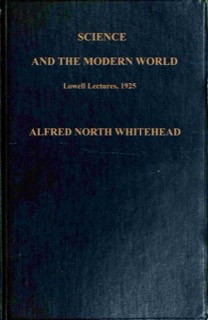
Science and the Modern World

by Alfred North Whitehead

Length: 81,425 words, about 326 pages, about 6 hours to read

Science and nature, Philosophy

Read Science and the Modern World free, starting with its best pages and lines below. Listen to it free too, read aloud by your phone's own voice.

The best passages

Pages from the book itself, chosen to make you want to read on. Each opens in the reader at that exact spot.

CHAPTER I THE ORIGINS OF MODERN SCIENCE

The progress of civilisation is not wholly a uniform drift towards better things. It may perhaps wear this aspect if we map it on a scale which is large enough. But such broad views obscure the details on which rest our whole understanding of the process. New epochs emerge with comparative suddenness, if we have regard to the scores of thousands of years throughout which the complete history extends. Secluded races suddenly take their places in the main stream of events: technological discoveries transform the mechanism of human life: a primitive art quickly flowers into full satisfaction of some aesthetic craving: great religions in their crusading youth spread through the nations the peace of Heaven and the sword of the Lord.


Keep reading from here

CHAPTER I THE ORIGINS OF MODERN SCIENCE

The progress of science has now reached a turning point. The stable foundations of physics have broken up: also for the first time physiology is asserting itself as an effective body of knowledge, as distinct from a scrap-heap. The old foundations of scientific thought are becoming unintelligible. Time, space, matter, material, ether, electricity, mechanism, organism, configuration, structure, pattern, function, all require reinterpretation. What is the sense of talking about a mechanical explanation when you do not know what you mean by mechanics?

The truth is that science started its modern career by taking over ideas derived from the weakest side of the philosophies of Aristotle’s successors. In some respects it was a happy choice. It enabled the knowledge of the seventeenth century to be formularised so far as physics and chemistry were concerned, with a completeness which has lasted to the present time. But the progress of biology and psychology has probably been checked by the uncritical assumption of half-truths. If science is not to degenerate into a medley of ad hoc hypotheses, it must become philosophical and must enter upon a thorough criticism of its own foundations.

Keep reading from here

CHAPTER III THE CENTURY OF GENIUS

Locke, writing with a knowledge of Newtonian dynamics, places mass among the primary qualities of bodies. In short, he elaborates a theory of primary and secondary qualities in accordance with the state of physical science at the close of the seventeenth century. The primary qualities are the essential qualities of substances whose spatio-temporal relationships constitute nature. The orderliness of these relationships constitutesconstitutes nature. The orderliness of these relationships constitutes the order of nature. The occurrences of nature are in some way apprehended by minds, which are associated with living bodies. Primarily, the mental apprehension is aroused by the occurrences in certain parts of the correlated body, the occurrences in the brain, for instance. But the mind in apprehending also experiences sensations which, properly speaking, are qualities of the mind alone. These sensations are projected by the mind so as to clothe appropriate bodies in external nature. Thus the bodies are perceived as with qualities which in reality do not belong to them, qualities which in fact are purely the offspring of the mind. Thus nature gets credit which should in truth be reserved for ourselves: the rose for its scent: the nightingale for his song: and the sun for his radiance. The poets are entirely mistaken. They should address their lyrics to themselves, and should turn them into odes of self-congratulation on the excellency of the human mind. Nature is a dull affair, soundless, scentless, colourless; merely the hurrying of material, endlessly, meaninglessly.

Keep reading from here

CHAPTER VI THE NINETEENTH CENTURY

The process of change was slow, unconscious, and unexpected.

In the nineteenth century, the process became quick, conscious, and expected. The earlier half of the century was the period in which this new attitude to change was first established and enjoyed. It was a peculiar period of hope, in the sense in which, sixty or seventy years later, we can now detect a note of disillusionment, or at least of anxiety.

The greatest invention of the nineteenth century was the invention of the method of invention. A new method entered into life. In order to understand our epoch, we can neglect all the details of change, such as railways, telegraphs, radios, spinning machines, synthetic dyes. We must concentrate on the method in itself; that is the real novelty, which has broken up the foundations of the old civilisation. The prophecy of Francis Bacon has now been fulfilled; and man, who at times dreamt of himself as a little lower than the angels, has submitted to become the servant and the minister of nature. It still remains to be seen whether the same actor can play both parts.

The whole change has arisen from the new scientific information. Science, conceived not so much in its principles as in its results, is an obvious storehouse of ideas for utilisation.

Keep reading from here

10 of the best lines

The progress of civilisation is not wholly a uniform drift towards better things.

CHAPTER I THE ORIGINS OF MODERN SCIENCEKeep reading from here

Thought is abstract; and the intolerant use of abstractions is the major vice of the intellect.

CHAPTER I THE ORIGINS OF MODERN SCIENCEKeep reading from here

If you have had your attention directed to the novelties in thought in your own lifetime, you will have observed that almost all really new ideas have a certain aspect of foolishness when they are first produced.

CHAPTER III THE CENTURY OF GENIUSKeep reading from here

Thus nature is a structure of evolving processes. The reality is the process.

CHAPTER IV THE EIGHTEENTH CENTURYKeep reading from here

It still remains to be seen whether the same actor can play both parts.

CHAPTER VI THE NINETEENTH CENTURYKeep reading from here

Epochs do not rise from the dead.

CHAPTER IX SCIENCE AND PHILOSOPHYKeep reading from here

To acquiesce in discrepancy is destructive of candour, and of moral cleanliness.

CHAPTER XII RELIGION AND SCIENCEKeep reading from here

The worship of God is not a rule of safety—it is an adventure of the spirit, a flight after the unattainable.

CHAPTER XII RELIGION AND SCIENCEKeep reading from here

There can be nothing real without both. Mere change without conservation is a passage from nothing to nothing.

CHAPTER XIII REQUISITES FOR SOCIAL PROGRESSKeep reading from here

The great society will put up the men for the occasions.

CHAPTER XIII REQUISITES FOR SOCIAL PROGRESSKeep reading from here

All 155 Science and the Modern World quotes, with the words around each

Reviews

No reviews yet. Be the first, in the app.

Write a review in Doomreader

Contents

  1. PREFACE
  2. CHAPTER I THE ORIGINS OF MODERN SCIENCE
  3. CHAPTER II MATHEMATICS AS AN ELEMENT IN THE HISTORY OF THOUGHT
  4. CHAPTER III THE CENTURY OF GENIUS
  5. CHAPTER IV THE EIGHTEENTH CENTURY
  6. CHAPTER V THE ROMANTIC REACTION
  7. CHAPTER VI THE NINETEENTH CENTURY
  8. CHAPTER VII RELATIVITY
  9. CHAPTER VIII THE QUANTUM THEORY
  10. CHAPTER IX SCIENCE AND PHILOSOPHY
  11. CHAPTER X ABSTRACTION
  12. CHAPTER XI GOD
  13. CHAPTER XII RELIGION AND SCIENCE
  14. CHAPTER XIII REQUISITES FOR SOCIAL PROGRESS

Listen to Science and the Modern World free

Science and the Modern World as a free audiobook: Doomreader reads any book aloud, free, in your phone's or computer's own voice. Open the book and tap listen, at the speed you like, hands free.

Want a more natural voice? The AI voices read with AI credits.

Listen free in Doomreader

Download Science and the Modern World free

The whole book as an EPUB file, free and legal, from Project Gutenberg. It opens in any ebook app, or read it here in Doomreader with nothing to install.

Download the EPUB (0.4 MB)

More like Science and the Modern World

About this edition

Text from Project Gutenberg. In the public domain in the USA. The Project Gutenberg License is kept inside the file. Every passage and line on this page is the book's own words, checked against the text.