Doomreader

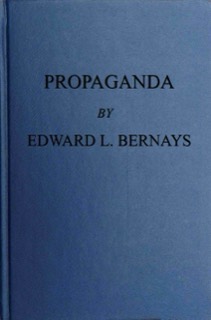
Propaganda

by Edward L. Bernays

Length: 36,288 words, about 145 pages, about 3 hours to read

Psychology and mind, Politics and society, Business and work

Read Propaganda free, starting with its best pages and lines below. Listen to it free too, read aloud by your phone's own voice.

The best passages

Pages from the book itself, chosen to make you want to read on. Each opens in the reader at that exact spot.

CHAPTER I ORGANIZING CHAOS

The conscious and intelligent manipulation of the organized habits and opinions of the masses is an important element in democratic society. Those who manipulate this unseen mechanism of society constitute an invisible government which is the true ruling power of our country.

We are governed, our minds are molded, our tastes formed, our ideas suggested, largely by men we have never heard of. This is a logical result of the way our democratic society is organized. Vast numbers of human beings must coöperate in this manner if they are to live together as a smoothly functioning society.

Our invisible governors are, in many cases, unaware of the identity of their fellow members in the inner cabinet.

They govern us by their qualities of natural leadership, their ability to supply needed ideas and by their key position in the social structure. Whatever attitude one chooses to take toward this condition, it remains a fact that in almost every act of our daily lives, whether in the sphere of politics or business, in our social conduct or our ethical thinking, we are dominated by the relatively small number of persons—a trifling fraction of our hundred and twenty million—who understand the mental processes and social patterns of the masses. It is they who pull the wires which control the public mind, who harness old social forces and contrive new ways to bind and guide the world.

Keep reading from here

CHAPTER II THE NEW PROPAGANDA

In the days when kings were kings, Louis XIV made his modest remark, “L’Etat c’est moi.” He was nearly right.

But times have changed. The steam engine, the multiple press, and the public school, that trio of the industrial revolution, have taken the power away from kings and given it to the people. The people actually gained power which the king lost. For economic power tends to draw after it political power; and the history of the industrial revolution shows how that power passed from the king and the aristocracy to the bourgeoisie. Universal suffrage and universal schooling reënforced this tendency, and at last even the bourgeoisie stood in fear of the common people. For the masses promised to become king.

To-day, however, a reaction has set in. The minority has discovered a powerful help in influencing majorities. It has been found possible so to mold the mind of the masses that they will throw their newly gained strength in the desired direction. In the present structure of society, this practice is inevitable. Whatever of social importance is done to-day, whether in politics, finance, manufacture, agriculture, charity, education, or other fields, must be done with the help of propaganda. Propaganda is the executive arm of the invisible government.

Keep reading from here

CHAPTER II THE NEW PROPAGANDA

Business offers graphic examples of the effect that may be produced upon the public by interested groups, such as textile manufacturers losing their markets. This problem arose, not long ago, when the velvet manufacturers were facing ruin because their product had long been out of fashion. Analysis showed that it was impossible to revive a velvet fashion within America. Anatomical hunt for the vital spot! Paris! Obviously! But yes and no. Paris is the home of fashion. Lyons is the home of silk. The attack had to be made at the source. It was determined to substitute purpose for chance and to utilize the regular sources for fashion distribution and to influence the public from these sources. A velvet fashion service, openly supported by the manufacturers, was organized. Its first function was to establish contact with the Lyons manufactories and the Paris couturiers to discover what they were doing, to encourage them to act on behalf of velvet, and to help in the proper exploitation of their wares. An intelligent Parisian was enlisted in the work. He visited Lanvin and Worth, Agnès and Patou, and others and induced them to use velvet in their gowns and hats. It was he who arranged for the distinguished Countess This or Duchess That to wear the hat or the gown. And as for the presentation of the idea to the public, the American buyer or the American woman of fashion was simply shown the velvet creations in the atelier of the dressmaker or the milliner.

Keep reading from here

CHAPTER III THE NEW PROPAGANDISTS

Nor, what is still more important, the extent to which our thoughts and habits are modified by authorities.

In some departments of our daily life, in which we imagine ourselves free agents, we are ruled by dictators exercising great power. A man buying a suit of clothes imagines that he is choosing, according to his taste and his personality, the kind of garment which he prefers. In reality, he may be obeying the orders of an anonymous gentleman tailor in London. This personage is the silent partner in a modest tailoring establishment, which is patronized by gentlemen of fashion and princes of the blood. He suggests to British noblemen and others a blue cloth instead of gray, two buttons instead of three, or sleeves a quarter of an inch narrower than last season. The distinguished customer approves of the idea.

But how does this fact affect John Smith of Topeka?

The gentleman tailor is under contract with a certain large American firm, which manufactures men’s suits, to send them instantly the designs of the suits chosen by the leaders of London fashion. Upon receiving the designs, with specifications as to color, weight and texture, the firm immediately places an order with the cloth makers for several hundred thousand dollars’ worth of cloth. The suits made up according to the specifications are then advertised as the latest fashion. The fashionable men in New York, Chicago, Boston and Philadelphia wear them. And the Topeka man, recognizing this leadership, does the same.

Keep reading from here

CHAPTER IV THE PSYCHOLOGY OF PUBLIC RELATIONS

Men are rarely aware of the real reasons which motivate their actions. A man may believe that he buys a motor car because, after careful study of the technical features of all makes on the market, he has concluded that this is the best. He is almost certainly fooling himself. He bought it, perhaps, because a friend whose financial acumen he respects bought one last week; or because his neighbors believed he was not able to afford a car of that class; or because its colors are those of his college fraternity.

It is chiefly the psychologists of the school of Freud who have pointed out that many of man’s thoughts and actions are compensatory substitutes for desires which he has been obliged to suppress. A thing may be desired not for its intrinsic worth or usefulness, but because he has unconsciously come to see in it a symbol of something else, the desire for which he is ashamed to admit to himself. A man buying a car may think he wants it for purposes of locomotion, whereas the fact may be that he would really prefer not to be burdened with it, and would rather walk for the sake of his health. He may really want it because it is a symbol of social position, an evidence of his success in business, or a means of pleasing his wife.

This general principle, that men are very largely actuated by motives which they conceal from themselves, is as true of mass as of individual psychology.

Keep reading from here

CHAPTER VI PROPAGANDA AND POLITICAL LEADERSHIP

The great political problem in our modern democracy is how to induce our leaders to lead. The dogma that the voice of the people is the voice of God tends to make elected persons the will-less servants of their constituents. This is undoubtedly part cause of the political sterility of which certain American critics constantly complain.

No serious sociologist any longer believes that the voice of the people expresses any divine or specially wise and lofty idea. The voice of the people expresses the mind of the people, and that mind is made up for it by the group leaders in whom it believes and by those persons who understand the manipulation of public opinion. It is composed of inherited prejudices and symbols and clichés and verbal formulas supplied to them by the leaders.

Fortunately, the sincere and gifted politician is able, by the instrument of propaganda, to mold and form the will of the people.

Disraeli cynically expressed the dilemma, when he said: “I must follow the people. Am I not their leader?” He might have added: “I must lead the people. Am I not their servant?”

Keep reading from here

10 of the best lines

The conscious and intelligent manipulation of the organized habits and opinions of the masses is an important element in democratic society.

CHAPTER I ORGANIZING CHAOSKeep reading from here

Each man’s rubber stamps are the duplicates of millions of others, so that when those millions are exposed to the same stimuli, all receive identical imprints.

CHAPTER II THE NEW PROPAGANDAKeep reading from here

A presidential candidate may be “drafted” in response to “overwhelming popular demand,” but it is well known that his name may be decided upon by half a dozen men sitting around a table in a hotel room.

CHAPTER III THE NEW PROPAGANDISTSKeep reading from here

Trotter and Le Bon concluded that the group mind does not think in the strict sense of the word. In place of thoughts it has impulses, habits and emotions.

CHAPTER IV THE PSYCHOLOGY OF PUBLIC RELATIONSKeep reading from here

The public relations activities of a business cannot be a protective coloring to hide its real aims.

CHAPTER V BUSINESS AND THE PUBLICKeep reading from here

Political campaigns to-day are all side shows, all honors, all bombast, glitter, and speeches.

CHAPTER VI PROPAGANDA AND POLITICAL LEADERSHIPKeep reading from here

Propaganda is of no use to the politician unless he has something to say which the public, consciously or unconsciously, wants to hear.

CHAPTER VI PROPAGANDA AND POLITICAL LEADERSHIPKeep reading from here

Cloistered seclusion used to be considered the first essential of scholarship.

CHAPTER VIII PROPAGANDA FOR EDUCATIONKeep reading from here

Propaganda is accustoming the public to change and progress.

CHAPTER X ART AND SCIENCEKeep reading from here

Propaganda will never die out. Intelligent men must realize that propaganda is the modern instrument by which they can fight for productive ends and help to bring order out of chaos.

CHAPTER XI THE MECHANICS OF PROPAGANDAKeep reading from here

All 100 Propaganda quotes, with the words around each

Reviews

No reviews yet. Be the first, in the app.

Write a review in Doomreader

Contents

  1. CHAPTER I ORGANIZING CHAOS
  2. CHAPTER II THE NEW PROPAGANDA
  3. CHAPTER III THE NEW PROPAGANDISTS
  4. CHAPTER IV THE PSYCHOLOGY OF PUBLIC RELATIONS
  5. CHAPTER V BUSINESS AND THE PUBLIC
  6. CHAPTER VI PROPAGANDA AND POLITICAL LEADERSHIP
  7. CHAPTER VII WOMEN’S ACTIVITIES AND PROPAGANDA
  8. CHAPTER VIII PROPAGANDA FOR EDUCATION
  9. CHAPTER IX PROPAGANDA IN SOCIAL SERVICE
  10. CHAPTER X ART AND SCIENCE
  11. CHAPTER XI THE MECHANICS OF PROPAGANDA

Listen to Propaganda free

Propaganda as a free audiobook: Doomreader reads any book aloud, free, in your phone's or computer's own voice. Open the book and tap listen, at the speed you like, hands free.

Want a more natural voice? The AI voices read with AI credits.

Listen free in Doomreader

Download Propaganda free

The whole book as an EPUB file, free and legal, from Project Gutenberg. It opens in any ebook app, or read it here in Doomreader with nothing to install.

Download the EPUB (0.3 MB)

More by Edward L. Bernays

More like Propaganda

About this edition

Text from Project Gutenberg. In the public domain in the USA. The Project Gutenberg License is kept inside the file. Every passage and line on this page is the book's own words, checked against the text.