Doomreader

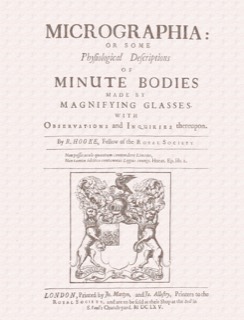
Micrographia

by Robert Hooke

Length: 157,477 words, about 630 pages, about 11 hours to read

Science and nature

Read Micrographia free, starting with its best pages and lines below. Listen to it free too, read aloud by your phone's own voice.

The best passages

Pages from the book itself, chosen to make you want to read on. Each opens in the reader at that exact spot.

THE PREFACE.

The truth is, the Science of Nature has been already too long made only a work of the Brain and the Fancy: It is now high time that it should return to the plainness and soundness of Observations on material and obvious things. It is said of great Empires, That the best way to preserve them from decay, is to bring them back to the first Principles, and Arts, on which they did begin. The same is undoubtedly true in Philosophy, that by wandring far away into invisible Notions, has almost quite destroy’d it self, and it can never be recovered, or continued, but by returning into the same sensible paths, in which it did at first proceed.

If therefore the Reader expects from me any infallible Deductions, or certainty of Axioms, I am to say for my self, that those stronger Works of Wit and Imagination are above my weak Abilities; or if they had


Keep reading from here

Observ. I. Of the Point of a sharp small Needle.

Illuminated A in Ass in Geometry, the most natural way of beginning is from a Mathematical point; so is the same method in Observations and Natural history the most genuine, simple, and instructive. We must first endevour to make letters, and draw single strokes true, before we venture to write whole Sentences, or to draw large Pictures. And in Physical Enquiries, we must endevour to follow Nature in the more plain and easie ways she treads in the most simple and uncompounded bodies, to trace her steps, and be acquainted with her manner of walking there, before we venture our selves into the multitude of meanders she has in bodies of a more complicated nature; lest, being unable to distinguish and judge of our way, we quickly lose both Nature our Guide, and our selves too, and are left to wander in the labyrinth of groundless opinions; wanting both judgment, that light, and experience, that clew, which should direct our proceedings.

We will begin these our Inquiries therefore with the Observations of Bodies of the most simple nature first, and so gradually proceed to those of a more compounded one. In prosecution of which method, we shall begin with a Physical point; of which kind the Point of a Needle is commonly reckon’d for one; and is indeed, for the most part, made so sharp, that the naked eye cannot distinguish any parts of it: It very easily pierces, and makes its way through all kind of bodies softer then it self: But if view’d with a very good Microscope, we may find that the top of a Needle (though

Keep reading from here

Observ. I. Of the Point of a sharp small Needle.

But to proceed: The Image we have here exhibited in the first Figure, was the top of a small and very sharp Needle, whose point aa nevertheless appear’d through the Microscope above a quarter of an inch broad, not round nor flat, but irregular and uneven; so that it seem’d to have been big enough to have afforded a hundred armed Mites room enough to be rang’d by each other without endangering the breaking one anothers necks, by being thrust off on either side. The surface of which, though appearing to the naked eye very smooth, could not nevertheless hide a multitude of holes and scratches and ruggednesses from being discover’d by the Microscope to invest it, several of which inequalities (as A, B, C, seem’d holes made by some small specks of Rust; and D some adventitious body, that stuck very close to it) were casual. All the rest that roughen the surface, were onely so many marks of the rudeness and bungling of Art. So unaccurate is it, in all its productions, even in those which seem most neat, that if examin’d with an organ more acute then that by which they were made, the more we see of their shape, the less appearance will there be of their beauty: whereas in the works of Nature, the deepest Discoveries shew us the greatest Excellencies. An evident Argument, that he that was the Author of all these things, was no other then Omnipotent; being able to include as great a variety of

Keep reading from here

Observ. II. Of the Edge of a Razor.

The sharpest Edge hath the same kind of affinity to the sharpest Point in Physicks, as a line hath to a point in Mathematicks; and therefore the Treaty concerning this, may very properly be annexed to the former. A Razor doth appear to be a Body of a very neat and curious aspect, till more closely viewed by the Microscope, and there we may observe its very Edge to be of all kind of shapes, except what it should be. For examining that of a very sharp one, I could not find that any part of it had any thing of sharpness in it; but it appeared a rough surface of a very considerable bredth from side to side, the narrowest part not seeming thinner then the back of a pretty thick Knife. Nor is’t likely that it should appear any otherwise, since as we just now shew’d that a point appear’d a circle, ’tis rational a line should be a parallelogram.

Schem. 2. Fig. 2.

Keep reading from here

Observ. XXV. Of the stinging points and juice of Nettles, and some other venomous Plants.

A Nettle is a Plant so well known to every one, as to what the appearance of it is to the naked eye, that it needs no description; and there are very few that have not felt as well as seen it; and therefore it will be no news to tell that a gentle and slight touch of the skin by a Nettle, does oftentime, not onely create very sensible and acute pain, much like that of a burn or scald, but often also very angry and hard swellings and inflamations of the parts, such as will presently rise, and continue swoln divers hours. These observations, I say, are common enough; but how the pain is so suddenly created, and by what means continued, augmented for a time, and afterwards diminish’d, and at length quite exstinguish’d, has not, that I know, been explain’d by any.

And here we must have recourse to our Microscope, and that will, if almost any part of the Plant be looked on, shew us the whole surface of it very thick set with turn-Pikes, or sharp Needles, of the Schem. 15. Fig. 1. shape of those represented in the 15. Scheme and first Figure by AB, which are visible also to the naked eye; each of which consists of two parts very distinct for shape, and differing also in quality from one another. For the part A, is shaped very much like a round Bodkin, from B tapering till it end in a very sharp point; it is of substance very hard and stiff, exceedingly transparent and cleer, and, as I by many trials certainly found, is hollow from top to bottom.

Keep reading from here

10 of the best lines

We must not therefore esteem the riches of our Philosophical treasure by the number only, but chiefly by the weight;

THE PREFACE.Keep reading from here

The truth is, the Science of Nature has been already too long made only a work of the Brain and the Fancy: It is now high time that it should return to the plainness and soundness of Observations on material and obvious things.

THE PREFACE.Keep reading from here

The Understanding is to order all the inferiour services of the lower Faculties; but yet it is to do this only as a lawful Master, and not as a Tyrant.

THE PREFACE.Keep reading from here

For the Productions of art are such rude mis-shapen things, that when view’d with a Microscope, is little else observable, but their deformity.

Observ. V. Of watered Silks, or Stuffs.Keep reading from here

We know there may be as much curiosity of contrivance, and excellency of form in a very small Pocket-clock, that takes not up an Inch square of room, as there may be in a Church-clock that fills a whole room

Observ. XXI. Of Moss, and several other small vegetative Substances.Keep reading from here

Nature in this, as it were, expressing her Needle-work, or imbroidery.

Observ. XXIV. Of the surfaces of Rosemary, and other leaves.Keep reading from here

Who knows but Adam might from some such contemplation, give names to all creatures?

Observ. XXIX. Of the Seeds of Tyme.Keep reading from here

And can any be so sottish, as to think all those things the productions of chance?

Observ. XXXVII. Of the Feet of Flies, and several other Insects.Keep reading from here

It being a general rule in Nature’s proceedings, that where she begins to display any excellency, if the subject be further search’d into, it will manifest, that there is not less curiosity in those parts which our single eye cannot reach, then in those which are more obvious.

Observ. LI. Of the Crab-like Insect.Keep reading from here

The strength and beauty of this small creature, had it no other relation at all to man, would deserve a description.

Observ. LIII. Of a Flea.Keep reading from here

All 16 Micrographia quotes, with the words around each

Reviews

No reviews yet. Be the first, in the app.

Write a review in Doomreader

Contents

All 73 parts
  1. MICROGRAPHIA: OR SOME Physiological Descriptions OF MINUTE BODIES MADE BY MAGNIFYING GLASSES WITH OBSERVATIONS and INQUIRIES thereupon.
  2. THE PREFACE.
  3. Observ. I. Of the Point of a sharp small Needle.
  4. Observ. II. Of the Edge of a Razor.
  5. Observ. III. Of fine Lawn, or Linnen Cloth.
  6. Observ. IV. Of fine waled Silk, or Taffety.
  7. Observ. V. Of watered Silks, or Stuffs.
  8. Observ. VI. Of Small Glass Canes.
  9. To make small shot of different sizes; Communicated by his Highness P.R.
  10. Observ. VII. Of some Phænomena of Glass drops.
  11. Observ. VIII. Of the fiery Sparks struck from a Flint or Steel.
  12. Observ. IX. Of the Colours observable in Muscovy-Glass, and other thin Bodies.
  13. Observ. X. Of Metalline, and other real Colours.
  14. Observ. XI. Of Figures observ’d in small Sand.
  15. Observ. XII. Of Gravel in Urine.
  16. Observ. XIII. Of the small Diamants, or Sparks in Flints.
  17. Observ. XIV. Of several kindes of frozen Figures.
  18. I. Several Observables in the six-branched Figures form’d on the surface of Urine by freezing.
  19. II. Observables in figur’d Snow.
  20. III. Several kinds of Figures in Water frozen.
  21. Observ. XV. Of Kettering-stone, and of the pores of Inanimate bodies.
  22. Observ. XVI. Of Charcoal, or burnt Vegetables.
  23. Observ. XVII. Of Petrify’d wood, and other Petrify’d bodies.
  24. Observ. XVIII. Of the Schematisme or Texture of Cork, and of the Cells and Pores of some other such frothy Bodies.
  25. Observations on the Humble and Sensible Plants in M Chiffin’s Garden in Saint James’s Park, made August the 9th, 1661. Present, the Lord Brouncker, Sr. Robert Moray, Dr. Wilkins, Mr. Evelin, Dr. Henshaw, and Dr. Clark.
  26. Observ. XIX. Of a Plant growing in the blighted or yellow specks of Damask-rose-leaves, Bramble-leaves, and some other kind of leaves.
  27. Observ. XX. Of blue Mould, and of the first Principles of Vegetation arising from Putrefaction.
  28. Observ. XXI. Of Moss, and several other small vegetative Substances.
  29. Observ. XXII. Of common Sponges, and several other Spongie fibrous bodies.
  30. Observ. XXIII. Of the curious texture of Sea-weeds.
  31. Observ. XXIV. Of the surfaces of Rosemary, and other leaves.
  32. Observ. XXV. Of the stinging points and juice of Nettles, and some other venomous Plants.
  33. Observ. XXVI. Of Cowage, and the itching operation of some bodies.
  34. Observ. XXVII. Of the Beard of a wilde Oat, and the use that may be made of it for exhibiting always to the Eye the temperature of the Air, as to driness and moisture.
  35. Observ. XXVIII. Of the Seeds of Venus looking-glass, or Corn Violet.
  36. Observ. XXIX. Of the Seeds of Tyme.
  37. Observ. XXX. Of the Seeds of Poppy.
  38. Observ. XXXI. Of Purslane-seed.
  39. Observ. XXXII. Of the Figure of several sorts of Hair, and of the texture of the skin.
  40. Observations on several other sorts of Hair.
  41. Observ. XXXIII. Of the Scales of a Soal, and other Fishes.
  42. Observ. XXXIV. Of the Sting of a Bee.
  43. Observ. XXXV. Of the contexture and shape of the particles of Feathers.
  44. Observ. XXXVI. Of Peacocks, Ducks, and other Feathers of changeable colours.
  45. Observ. XXXVII. Of the Feet of Flies, and several other Insects.
  46. Observ. XXXVIII. Of the Structure and motion of the Wings of Flies.
  47. Observ. XXXIX. Of the Eyes and Head of a Grey drone-Fly, and of several other creatures.
  48. Observ. XL. Of the Teeth of a Snail.
  49. Observ. XLI. Of the Eggs of Silk-worms, and other Insects.
  50. Observ. XLII. Of a blue Fly.
  51. Observ. XLIII. Of the Water Insect or Gnat.
  52. Postscript.
  53. Observ. XLIV. Of the tufted or Brush-horn’d Gnat.
  54. Observ. XLV. Of the great Belly’d Gnat or female Gnat.
  55. Observ. XLVI. Of the white featherwing’d Moth or Tinea Argentea.
  56. Observ. XLVII. Of the Shepherd Spider, or long-legg’d Spider.
  57. Observ. XLVIII. Of the hunting Spider, and several other sorts of Spiders.
  58. Observ. XLIX. Of an Ant or Pismire.
  59. Observ. L. Of the wandring Mite.
  60. Observ. LI. Of the Crab-like Insect.
  61. Observ. LII. Of the small Silver-colour’d Book-worm.
  62. Observ. LIII. Of a Flea.
  63. Observ. LIV. Of a Louse.
  64. Observ. LV. Of Mites.
  65. Observ. LVI. Of a small Creature hatch’d on a Vine.
  66. Observ. LVII. Of the Eels in Vinegar.
  67. Observ. LVIII. Of a new Property in the Air, and several other transparent Mediums nam’d Inflection, whereby very many considerable Phænomena are attempted to be solv’d, and divers other uses are hinted.
  68. A Table of the Elastick power of the Air, both Experimentally and Hypothetically calculated, according to its various Dimensions.
  69. Observ. LIX. Of multitudes of small Stars discoverable by the Telescope.
  70. Observ. LX. Of the Moon.
  71. FINIS.
  72. THE TABLE.
  73. The Schemes.

Listen to Micrographia free

Micrographia as a free audiobook: Doomreader reads any book aloud, free, in your phone's or computer's own voice. Open the book and tap listen, at the speed you like, hands free.

Want a more natural voice? The AI voices read with AI credits.

Listen free in Doomreader

Download Micrographia free

The whole book as an EPUB file, free and legal, from Project Gutenberg. It opens in any ebook app, or read it here in Doomreader with nothing to install.

Download the EPUB (7.9 MB)

More like Micrographia

About this edition

Text from Project Gutenberg. In the public domain in the USA. The Project Gutenberg License is kept inside the file. Every passage and line on this page is the book's own words, checked against the text.