Doomreader

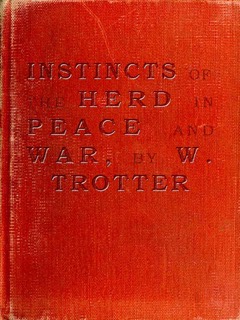
Instincts of the Herd in Peace and War

by Wilfred Trotter

Length: 80,293 words, about 321 pages, about 6 hours to read

Psychology and mind

Read Instincts of the Herd in Peace and War free, starting with its best pages and lines below. Listen to it free too, read aloud by your phone's own voice.

The best passages

Pages from the book itself, chosen to make you want to read on. Each opens in the reader at that exact spot.

SOME PRINCIPLES OF A BIOLOGICAL PSYCHOLOGY.

Man and a certain number of other species widely distributed throughout the animal kingdom show, in addition to the instincts of self-preservation, nutrition, and sex, specialized inherited modes of response to the needs, not directly of the individual but of the herd to which he belongs. These responses, which are perfectly well marked and characteristic, are those of the herd instinct. It is {98} important to grasp clearly the relation of this instinct to the individual. It must be understood that each separate member of a gregarious species inherits characters deeply rooted in his being which effectually differentiate him from any non-gregarious animal. These characters are such that in presence of certain stimuli they will ensure his responding in a specialized way which will be quite different from the response of a solitary animal. The response when examined will be found not necessarily to favour the survival of the individual as such, but to favour his survival as a member of a herd. A very simple example will make this plain. The dog and the cat are our two most familiar examples of the social and the solitary animal respectively. Their different attitudes towards feeding must have been observed by all. The cat takes her food leisurely, without great appearance of appetite and in small amounts at a time; the dog is voracious and will eat hurriedly as much as he can get, growling anxiously if he is approached. In doing so he is expressing a deeply ingrained characteristic.

Keep reading from here

THE BIOLOGY OF GREGARIOUSNESS.

The extent to which the hive makes use of the powers of its individuals is the measure of the completeness with which the social habit is developed in it. The worker bee has practically no activities which are not directly devoted to the hive, and yet she goes about her ceaseless tasks in a way that never fails to impress the observer with its exuberant energy and even its appearance of joyfulness. It is thought that the average worker bee works herself to death in about two months. That is a fact which can scarcely fail to arouse, even in the least imaginative, at any rate a moment of profound contemplation.

If we could suppose her to be conscious in the human sense, we must imagine the bee to be possessed by an enthusiasm for the hive more intense than a mother’s devotion to her son, without personal ambitions, or doubts or fears, and if we are to judge by the imperfect experience man has yet had of the same lofty passion, we must think of her consciousness, insignificant spark as it is, as a little fire ablaze with altruistic feeling. Doubtless, such {107} an attribution of emotion to the bee is a quite unjustified fallacy of an­thro­po­mor­phism. Nevertheless, it is not altogether valueless as a hint of what social unity might effect in an animal of larger mental life. There can be little doubt that the perfection to which the communal life of the bee has attained is dependent on the very smallness of the mental development of which the individuals are capable. Their capacity to assimilate experience is necessarily from their structure, and is known by experience to be, small and their path is marked out

Keep reading from here

CHARACTERS OF THE GREGARIOUS ANIMAL DISPLAYED BY MAN.

2. He is more sensitive to the voice of the herd than to any other influence. It can inhibit or stimulate his thought and conduct. It is the source of his moral codes, of the sanctions of his ethics and philosophy. It can endow him with energy, courage, and endurance, and can as easily take these away. {115} It can make him acquiese in his own punishment and embrace his executioner, submit to poverty, bow to tyranny, and sink without complaint under starvation. Not merely can it make him accept hardship and suffering unresistingly, but it can make him accept as truth the explanation that his perfectly preventable afflictions are sublimely just and gentle. It is in this acme of the power of herd suggestion that is perhaps the most absolutely incontestable proof of the profoundly gregarious nature of man. That a creature of strong appetites and luxurious desires should come to tolerate uncomplainingly his empty belly, his chattering teeth, his naked limbs, and his hard bed is miracle enough. What are we to say of a force which, when he is told by the full-fed and well-warmed that his state is the more blessed can make him answer, “How beautiful! How true!” In the face of so effectual a negation, not merely of experience and common sense but also of actual hunger and privation, it is not possible to set any limits to the power of the herd over the individual.

Keep reading from here

CHARACTERS OF THE GREGARIOUS ANIMAL DISPLAYED BY MAN.

4. He is remarkably susceptible to leadership. This quality in man may very naturally be thought to have a basis essentially rational rather than instinctive if its manifestations are not regarded with a special effort to attain an objective attitude. How thoroughly reasonable it appears that a body of men seeking a common object should put themselves under the guidance of some strong and expert {116} personality who can point out the path most profitably to be pursued, who can hearten his followers and bring all their various powers into a harmonious pursuit of the common object. The rational basis of the relation is, however, seen to be at any rate open to discussion when we consider the qualities in a leader upon which his authority so often rests, for there can be little doubt that their appeal is more generally to instinct than to reason. In ordinary politics it must be admitted that the gift of public speaking is of more decisive value than anything else. If a man is fluent, dextrous, and ready on the platform, he possesses the one indispensable requisite for statesmanship; if in addition he has the gift of moving deeply the emotions of his hearers, his capacity for guiding the infinite complexities of national life becomes undeniable. Experience has shown that no exceptional degree of any other capacity is necessary to make a successful leader. There need be no specially arduous training, no great weight of knowledge either of affairs or the human heart, no receptiveness to new ideas, no outlook into reality.

Keep reading from here

ENGLAND AGAINST GERMANY—ENGLAND.

It is one of the most impressive facts about the war, that while Germany is the very type of a perfected aggressive herd, England is perhaps the most complete example of a socialized herd. Corresponding with this biological difference is the striking difference in their history. Germany has modelled her soul upon the wolf’s, and has rushed through the possibilities of her archetype in fifty feverish years of development; already she is a finished product, her moral ideal is fulfilled and leaves her nothing to strive for except the imposition of it upon the world. England has taken as her model the bee, and still lags infinitely far behind the fulfilment of her ideal. In the unbroken security of her land, for near a thousand years, she has leisurely, perhaps lazily, and with infinite slowness, pursued her path towards a social integration of an {202} ever closer and deeper kind. She has stolidly, even stupidly, and always in a grossly practical spirit, held herself to the task of shaping a society in which free men could live and yet be citizens. She has had no theory of herself, no consciousness of her destiny, no will to power. She has had almost no national heroes, and has always been constitutionally frigid to her great men, grudging them the material for their experimentations on her people, indifferent to their expositions of her duty and her imperial destiny, granting them a chance to die for her with no more encouragement than an impatient sigh. She has allowed an empire to be won for her by her restless younger sons, has shown no gratification in their conquests, and so far from thrilling with the

Keep reading from here

10 of the best lines

The cardinal quality of the herd is homogeneity.

(b) Deductive ConsiderationsKeep reading from here

Conscience, then, and the feelings of guilt and of duty are the peculiar possessions of the gregarious animal.

(b) Deductive ConsiderationsKeep reading from here

The “degeneracy,” therefore, which we see developed as a secondary quality in these sensitive minds is no evidence against the degenerate, but an indictment of the disorderly environment which has ruined them

GREGARIOUSNESS AND THE FUTURE OF MAN.Keep reading from here

All her most elaborate creations have “risen in the world” and are descended in the direct line from creatures of the mud and dust.

Chapter IVKeep reading from here

In slang which has a sound biological basis we say he “wolfs” his food.

SOME PRINCIPLES OF A BIOLOGICAL PSYCHOLOGY.Keep reading from here

The successful shepherd thinks like his sheep, and can lead his flock only if he keeps no more than the shortest distance in advance.

CHARACTERS OF THE GREGARIOUS ANIMAL DISPLAYED BY MAN.Keep reading from here

The best way to get our work done is to get the worker to want to do it.

GREGARIOUS SPECIES AT WAR.Keep reading from here

The flock of sheep has its shepherd, but the pack of hounds has its Whips.

ENGLAND AGAINST GERMANY—GERMANY.Keep reading from here

The sense of rectitude is in fact and manifestly a product of mere belligerency

PREJUDICE IN TIME OF WAR.Keep reading from here

To live dangerously was supposed to be its ideal, but dread was the very atmosphere it breathed.

PSYCHOLOGICAL ANTICIPATIONSKeep reading from here

All 37 Instincts of the Herd in Peace and War quotes, with the words around each

Reviews

No reviews yet. Be the first, in the app.

Write a review in Doomreader

Contents

All 31 parts
  1. PREFACE
  2. HERD INSTINCT AND ITS BEARING ON THE PSYCHOLOGY OF CIVILIZED MAN
  3. I. INTRODUCTION
  4. II. PSYCHOLOGICAL ASPECTS OF INSTINCT.
  5. III. BIOLOGICAL SIGNIFICANCE OF GREGARIOUSNESS.
  6. IV. MENTAL CHARACTERISTICS OF THE GREGARIOUS ANIMAL.
  7. (a) Current Views in Sociology and Psychology.
  8. (b) Deductive Considerations
  9. SOCIOLOGICAL APPLICATIONS OF THE PSYCHOLOGY OF HERD INSTINCT
  10. GREGARIOUSNESS AND THE FUTURE OF MAN.
  11. SPECULATIONS UPON THE HUMAN MIND IN 1915
  12. MAN’S PLACE IN NATURE AND NATURE’S PLACE IN MAN
  13. COMMENTS ON AN OBJECTIVE SYSTEM OF HUMAN PSYCHOLOGY
  14. Chapter I
  15. Chapter II
  16. Chapter III
  17. Chapter IV
  18. SOME PRINCIPLES OF A BIOLOGICAL PSYCHOLOGY.
  19. THE BIOLOGY OF GREGARIOUSNESS.
  20. CHARACTERS OF THE GREGARIOUS ANIMAL DISPLAYED BY MAN.
  21. SOME PECULIARITIES OF THE SOCIAL HABIT IN MAN.
  22. IMPERFECTIONS OF THE SOCIAL HABIT IN MAN.
  23. GREGARIOUS SPECIES AT WAR.
  24. ENGLAND AGAINST GERMANY—GERMANY.
  25. ENGLAND AGAINST GERMANY—ENGLAND.
  26. POSTSCRIPT OF 1919
  27. PREJUDICE IN TIME OF WAR.
  28. PSYCHOLOGICAL ANTICIPATIONS
  29. AFTER THE WAR.
  30. THE INSTABILITY OF CIVILIZATION.
  31. SOME CHARACTERS OF A RATIONAL STATECRAFT.

Listen to Instincts of the Herd in Peace and War free

Instincts of the Herd in Peace and War as a free audiobook: Doomreader reads any book aloud, free, in your phone's or computer's own voice. Open the book and tap listen, at the speed you like, hands free.

Want a more natural voice? The AI voices read with AI credits.

Listen free in Doomreader

Download Instincts of the Herd in Peace and War free

The whole book as an EPUB file, free and legal, from Project Gutenberg. It opens in any ebook app, or read it here in Doomreader with nothing to install.

Download the EPUB (0.3 MB)

More like Instincts of the Herd in Peace and War

About this edition

Text from Project Gutenberg. In the public domain in the USA. The Project Gutenberg License is kept inside the file. Every passage and line on this page is the book's own words, checked against the text.