Doomreader

An Autobiography

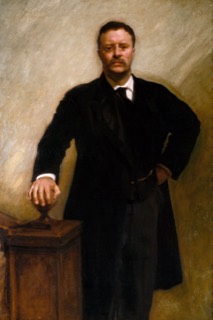
by Theodore Roosevelt

Length: 217,756 words, about 871 pages, about 15 hours to read

Lives and letters

Read An Autobiography free, starting with its best pages and lines below. Listen to it free too, read aloud by your phone's own voice.

What it is

The autobiography of American President Theodore Roosevelt.

The best passages

Pages from the book itself, chosen to make you want to read on. Each opens in the reader at that exact spot.

I: Boyhood and Youth

My grandfather on my father’s side was of almost purely Dutch blood. When he was young he still spoke some Dutch, and Dutch was last used in the services of the Dutch Reformed Church in New York while he was a small boy.

About 1644 his ancestor Klaes Martensen van Roosevelt came to New Amsterdam as a “settler”⁠—the euphemistic name for an immigrant who came over in the steerage of a sailing ship in the seventeenth century instead of the steerage of a steamer in the nineteenth century. From that time for the next seven generations from father to son every one of us was born on Manhattan Island.

My father’s paternal ancestors were of Holland stock; except that there was one named Waldron, a wheelwright, who was one of the Pilgrims who remained in Holland when the others came over to found Massachusetts, and who then accompanied the Dutch adventurers to New Amsterdam.
Keep reading from here

I: Boyhood and Youth

The punishing incident I have referred to happened when I was four years old. I bit my elder sister’s arm. I do not remember biting her arm, but I do remember running down to the yard, perfectly conscious that I had committed a crime. From the yard I went into the kitchen, got some dough from the cook, and crawled under the kitchen table. In a minute or two my father entered from the yard and asked where I was. The warmhearted Irish cook had a characteristic contempt for “informers,” but although she said nothing she compromised between informing and her conscience by casting a look under the table. My father immediately dropped on all fours and darted for me. I feebly heaved the dough at him, and, having the advantage of him because I could stand up under the table, got a fair start for the stairs, but was caught halfway up them. The punishment that ensued fitted the crime, and I hope⁠—and believe⁠—that it did me good.

Keep reading from here

II: The Vigor of Life

Having been a sickly boy, with no natural bodily prowess, and having lived much at home, I was at first quite unable to hold my own when thrown into contact with other boys of rougher antecedents. I was nervous and timid. Yet from reading of the people I admired⁠—ranging from the soldiers of Valley Forge, and Morgan’s riflemen, to the heroes of my favorite stories⁠—and from hearing of the feats performed by my Southern forefathers and kinsfolk, and from knowing my father, I felt a great admiration for men who were fearless and who could hold their own in the world, and I had a great desire to be like them. Until I was nearly fourteen I let this desire take no more definite shape than daydreams. Then an incident happened that did me real good. Having an attack of asthma, I was sent off by myself to Moosehead Lake. On the stagecoach ride thither I encountered a couple of other boys who were about my own age, but very much more competent and also much more mischievous. I have no doubt they were good-hearted boys, but they were boys! They found that I was a foreordained and predestined victim, and industriously proceeded to make life miserable for me. The worst feature was that when I finally tried to fight them I discovered that either one singly could not only handle me with easy contempt, but handle me so as not to hurt me much and yet to prevent my doing any damage whatever in return.

Keep reading from here

IV: In Cowboy Land

It was still the Wild West in those days, the Far West, the West of Owen Wister’s stories and Frederic Remington’s drawings, the West of the Indian and the buffalo hunter, the soldier and the cowpuncher. That land of the West has gone now, “gone, gone with lost Atlantis,” gone to the isle of ghosts and of strange dead memories. It was a land of vast silent spaces, of lonely rivers, and of plains where the wild game stared at the passing horseman. It was a land of scattered ranches, of herds of longhorned cattle, and of reckless riders who unmoved looked in the eyes of life or of death. In that land we led a free and hardy life, with horse and with rifle. We worked under the scorching midsummer sun, when the wide plains shimmered and wavered in the heat; and we knew the freezing misery of riding night guard round the cattle in the late fall roundup. In the soft springtime the stars were glorious in our eyes each night before we fell asleep; and in the winter we rode through blinding blizzards, when the driven snow-dust burned our faces. There were monotonous days, as we guided the trail cattle or the beef herds, hour after hour, at the slowest of walks; and minutes or hours teeming with excitement as we stopped stampedes or swam the herds across rivers treacherous with quicksands or brimmed with running ice.

Keep reading from here

VII: The War of America the Unready

I had not enjoyed the Guasimas fight at all, because I had been so uncertain as to what I ought to do. But the San Juan fight was entirely different. The Spaniards had a hard position to attack, it is true, but we could see them, and I knew exactly how to proceed. I kept on horseback, merely because I found it difficult to convey orders along the line, as the men were lying down; and it is always hard to get men to start when they cannot see whether their comrades are also going. So I rode up and down the lines, keeping them straightened out, and gradually worked through line after line until I found myself at the head of the regiment. By the time I had reached the lines of the regulars of the first brigade I had come to the conclusion that it was silly to stay in the valley firing at the hills, because that was really where we were most exposed, and that the thing to do was to try to rush the entrenchments. Where I struck the regulars there was no one of superior rank to mine, and after asking why they did not charge, and being answered that they had no orders, I said I would give the order. There was naturally a little reluctance shown by the elderly officer in command to accept my order, so I said, “Then let my men through, sir,” and I marched through, followed by my grinning men.

Keep reading from here

10 of the best lines

Naturally, there are chapters of my autobiography which cannot now be written.

ForewordKeep reading from here

Play should never be allowed to interfere with work; and a life devoted merely to play is, of all forms of existence, the most dismal.

II: The Vigor of LifeKeep reading from here

Do not hit at all if it can be avoided; but never hit softly.

III: Practical PoliticsKeep reading from here

“Well,” said Bill Jones, “if Snyder hadn’t caught the lunatic, I’d have whaled hell out of Snyder!”

IV: In Cowboy LandKeep reading from here

The selfish individual needs to be taught that we must now shackle cunning by law exactly as a few centuries back we shackled force by law.

V: Applied IdealismKeep reading from here

His feeling was that war was an illegitimate interruption to the work of the War Department.

VII: The War of America the UnreadyKeep reading from here

I could no more tolerate wrong committed in the name of property than wrong committed against property.

VIII: The New York GovernorshipKeep reading from here

“Well, Doctor, you see it isn’t very long since I used to take fourteen china animals to bed with me every night!”

IX: Outdoors and IndoorsKeep reading from here

No straightforward man can believe, and no fearless man will assert, that a trade union is always right.

XIII: Social and Industrial JusticeKeep reading from here

“I am delighted with the Australian people. I think your harbor the finest in the world. I am very tired and would like to go to sleep.”

XV: The Peace of RighteousnessKeep reading from here

All 132 An Autobiography quotes, with the words around each

Reviews

No reviews yet. Be the first, in the app.

Write a review in Doomreader

Contents

All 26 parts
  1. Foreword
  2. Frontispiece
  3. I: Boyhood and Youth
  4. II: The Vigor of Life
  5. III: Practical Politics
  6. IV: In Cowboy Land
  7. V: Applied Idealism
  8. VI: The New York Police
  9. VII: The War of America the Unready
  10. Appendix A
  11. Appendix B
  12. VIII: The New York Governorship
  13. Appendix A
  14. Appendix B
  15. IX: Outdoors and Indoors
  16. X: The Presidency; Making an Old Party Progressive
  17. XI: The Natural Resources of the Nation
  18. XII: The Big Stick and the Square Deal
  19. XIII: Social and Industrial Justice
  20. Appendix A
  21. XIV: The Monroe Doctrine and the Panama Canal
  22. Appendix A
  23. XV: The Peace of Righteousness
  24. Appendix A
  25. Appendix B
  26. Appendix C

Listen to An Autobiography free

An Autobiography as a free audiobook: Doomreader reads any book aloud, free, in your phone's or computer's own voice. Open the book and tap listen, at the speed you like, hands free.

Want a more natural voice? The AI voices read with AI credits.

Listen free in Doomreader

Download An Autobiography free

The whole book as an EPUB file, free and legal, from Standard Ebooks. It opens in any ebook app, or read it here in Doomreader with nothing to install.

Download the EPUB (5.5 MB)

More by Theodore Roosevelt

More like An Autobiography

About this edition

Text from Standard Ebooks. Standard Ebooks dedicate their edition to the public domain (CC0 1.0). Every passage and line on this page is the book's own words, checked against the text.