Doomreader

Through the Brazilian Wilderness

by Theodore Roosevelt

Length: 114,582 words, about 458 pages, about 8 hours to read

History and travel, Science and nature

Read Through the Brazilian Wilderness free, starting with its best pages and lines below. Listen to it free too, read aloud by your phone's own voice.

What it is

Theodore Roosevelt’s autobiographical account of his expedition into the uncharted depths of the Brazilian rainforest.

The best passages

Pages from the book itself, chosen to make you want to read on. Each opens in the reader at that exact spot.

I: The Start

One day in 1908, when my presidential term was coming to a close, Father Zahm, a priest whom I knew, came in to call on me. Father Zahm and I had been cronies for some time, because we were both of us fond of Dante and of history and of science⁠—I had always commended to theologians his book, Evolution and Dogma. He was an Ohio boy, and his early schooling had been obtained in old-time American fashion in a little log school; where, by the way, one of the other boys was Januarius Aloysius MacGahan, afterward the famous war correspondent and friend of Skobeloff. Father Zahm told me that MacGahan even at that time added an utter fearlessness to chivalric tenderness for the weak, and was the defender of any small boy who was oppressed by a larger one. Later Father Zahm was at Notre Dame University, in Indiana, with Maurice Egan, whom, when I was President, I appointed minister to Denmark.
Keep reading from here

I: The Start

So placid were its actions that I did not at first suppose that it meant to attack, for there was not the slightest exhibition of anger or excitement.

It was the jararaca that began the fight. It showed no fear whatever of its foe, but its irritable temper was aroused by the proximity and actions of the other, and like a flash it drew back its head and struck, burying its fangs in the forward part of the mussurama’s body. Immediately the latter struck in return, and the counterattack was so instantaneous that it was difficult to see just what had happened. There was tremendous writhing and struggling on the part of the jararaca; and then, leaning over the knot into which the two serpents were twisted, I saw that the mussurama had seized the jararaca by the lower jaw, putting its own head completely into the wide-gaping mouth of the poisonous snake. The long fangs were just above the top of the mussurama’s head; and it appeared, as well as I could see, that they were once again driven into the mussurama; but without the slightest effect. Then the fangs were curved back in the jaw, a fact which I particularly noted, and all effort at the offensive was abandoned by the poisonous snake.

Meanwhile the mussurama was chewing hard, and gradually shifted its grip, little by little, until it got the top of the head of the jararaca in its mouth, the lower jaw of the jararaca being spread out to one side.

Keep reading from here

I: The Start

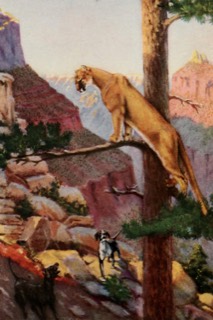
In March, 1877, Doctor Moreno with a party of men working on the boundary commission, and with a number of Patagonian horse-Indians, was encamped for some weeks beside Lake Viedma, which had not before been visited by white men for a century, and which was rarely visited even by Indians. One morning, just before sunrise, he left his camp by the south shore of the lake, to make a topographical sketch of the lake. He was unarmed, but carried a prismatic compass in a leather case with a strap. It was cold, and he wrapped his poncho of guanaco-hide round his neck and head. He had walked a few hundred yards, when a puma, a female, sprang on him from behind and knocked him down. As she sprang on him she tried to seize his head with one paw, striking him on the shoulder with the other. She lacerated his mouth and also his back, but tumbled over with him, and in the scuffle they separated before she could bite him. He sprang to his feet, and, as he said, was forced to think quickly. She had recovered herself, and sat on her haunches like a cat, looking at him, and then crouched to spring again; whereupon he whipped off his poncho, and as she sprang at him he opened it, and at the same moment hit her head with the prismatic compass in its case which he held by the strap.

Keep reading from here

III: A Jaguar Hunt on the Taquary

Returning to the fazenda (ranch) with the marsh deer on the saddle.

From photographs by Kermit Roosevelt.

In the afternoon of this same day one of the jaguar-hunters⁠—merely ranch hands, who knew something of the chase of the jaguar⁠—who had been searching for tracks, rode in with the information that he had found fresh sign at a spot in the swamp about nine miles distant. Next morning we rose at two, and had started on our jaguar-hunt at three. Colonel Rondon, Kermit, and I, with the two trailers or jaguar-hunters, made up the party, each on a weedy, undersized marsh pony, accustomed to traversing the vast stretches of morass; and we were accompanied by a brown boy, with saddlebags holding our lunch, who rode a long-horned trotting steer which he managed by a string through its nostril and lip. The two trailers carried each a long, clumsy spear. We had a rather poor pack. Besides our own two dogs, neither of which was used to jaguar-hunting, there were the ranch dogs, which were well-nigh worthless, and then two jaguar hounds borrowed for the occasion from a ranch six or eight leagues distant. These were the only hounds on which we could place any trust, and they were led in leashes by the two trailers. One was a white bitch, the other, the best one we had, was a gelded black dog. They were lean, half-starved creatures with prick ears and a look of furtive wildness.

Keep reading from here

VIII: The River of Doubt

On February 27, 1914, shortly after midday, we started down the River of Doubt into the unknown. We were quite uncertain whether after a week we should find ourselves in the Gy-Paraná, or after six weeks in the Madeira, or after three months we knew not where. That was why the river was rightly christened the Dúvida.

We had been camped close to the river, where the trail that follows the telegraph line crosses it by a rough bridge. As our laden dugouts swung into the stream, Amilcar and Miller and all the others of the Gy-Paraná party were on the banks and the bridge to wave farewell and wish us goodbye and good luck. It was the height of the rainy season, and the swollen torrent was swift and brown. Our camp was at about 12° 1′ latitude south and 60° 15′ longitude west of Greenwich. Our general course was to be northward toward the equator, by waterway through the vast forest.

We had seven canoes, all of them dugouts. One was small, one was cranky, and two were old, waterlogged, and leaky. The other three were good. The two old canoes were lashed together, and the cranky one was lashed to one of the others. Kermit with two paddlers went in the smallest of the good canoes; Colonel Rondon and Lyra with three other paddlers in the next largest; and the doctor, Cherrie, and I in the largest with three paddlers.

Keep reading from here

10 of the best lines

The venomous serpent was helpless; the fearsome master of the wild life of the forest, the deadly foe of humankind, was itself held in the grip of death.

I: The StartKeep reading from here

A full-foliaged tree of vivid green, its round surface crowded with these birds, as if it had suddenly blossomed with huge white flowers, is a sight worth seeing.

II: Up the ParaguayKeep reading from here

There was something sinister and evil in the dark stillness of the grove; it seemed as if sentient beings had writhed themselves round and were strangling other sentient beings.

V: Up the River of TapirsKeep reading from here

A cool man with a rifle, if he has mastered his weapon, need fear no foe.

VI: Through the Highland Wilderness of Western BrazilKeep reading from here

Always in the wilderness friends proclaim their presence; a silent advance marks a foe.

VII: With a Mule Train Across Nhambiquara LandKeep reading from here

We had entered a land of unknown possibilities.

VIII: The River of DoubtKeep reading from here

Genuine wilderness exploration is as dangerous as warfare.

IX: Down an Unknown River Into the Equatorial ForestKeep reading from here

“Paishon is following Julio now, and will follow him until he dies; Paishon fell forward on his hands and knees, and when a murdered man falls like that his ghost will follow the slayer as long as the slayer lives.”

IX: Down an Unknown River Into the Equatorial ForestKeep reading from here

The silence was soothing and restful.

IX: Down an Unknown River Into the Equatorial ForestKeep reading from here

It is easy to go where other men have prepared the way.

X: To the Amazon and Home; Zoological and Geographical Results of the ExpeditionKeep reading from here

All 29 Through the Brazilian Wilderness quotes, with the words around each

Reviews

No reviews yet. Be the first, in the app.

Write a review in Doomreader

Contents

  1. Frontispiece 1
  2. Frontispiece 2
  3. Preface
  4. I: The Start
  5. II: Up the Paraguay
  6. III: A Jaguar Hunt on the Taquary
  7. IV: The Headwaters of the Paraguay
  8. V: Up the River of Tapirs
  9. VI: Through the Highland Wilderness of Western Brazil
  10. VII: With a Mule Train Across Nhambiquara Land
  11. VIII: The River of Doubt
  12. IX: Down an Unknown River Into the Equatorial Forest
  13. X: To the Amazon and Home; Zoological and Geographical Results of the Expedition
  14. Appendix A: The Work of the Field Zoologist and Field Geographer in South America
  15. Appendix B: The Outfit for Travelling in the South American Wilderness
  16. Appendix C: My Letter of May 1 to General Lauro Müller

Listen to Through the Brazilian Wilderness free

Through the Brazilian Wilderness as a free audiobook: Doomreader reads any book aloud, free, in your phone's or computer's own voice. Open the book and tap listen, at the speed you like, hands free.

Want a more natural voice? The AI voices read with AI credits.

Listen free in Doomreader

Download Through the Brazilian Wilderness free

The whole book as an EPUB file, free and legal, from Standard Ebooks. It opens in any ebook app, or read it here in Doomreader with nothing to install.

Download the EPUB (14.9 MB)

More by Theodore Roosevelt

More like Through the Brazilian Wilderness

About this edition

Text from Standard Ebooks. Standard Ebooks dedicate their edition to the public domain (CC0 1.0). Every passage and line on this page is the book's own words, checked against the text.