Doomreader

The Rough Riders

by Theodore Roosevelt

Length: 69,207 words, about 277 pages, about 5 hours to read

History and travel

Read The Rough Riders free, starting with its best pages and lines below. Listen to it free too, read aloud by your phone's own voice.

What it is

The First United States Volunteer Cavalry fights in the Spanish–American War.

The best passages

Pages from the book itself, chosen to make you want to read on. Each opens in the reader at that exact spot.

I: Raising the Regiment

During the year preceding the outbreak of the Spanish War I was Assistant Secretary of the Navy. While my party was in opposition, I had preached, with all the fervor and zeal I possessed, our duty to intervene in Cuba, and to take this opportunity of driving the Spaniard from the Western World. Now that my party had come to power, I felt it incumbent on me, by word and deed, to do all I could to secure the carrying out of the policy in which I so heartily believed; and from the beginning I had determined that, if a war came, somehow or other, I was going to the front.

Meanwhile, there was any amount of work at hand in getting ready the navy, and to this I devoted myself.

Naturally, when one is intensely interested in a certain cause, the tendency is to associate particularly with those who take the same view.
Keep reading from here

I: Raising the Regiment

One of the new Indian Territory recruits, after twenty-four hours’ stay in camp, during which he had held himself distinctly aloof from the general interests, called on the Colonel in his tent, and remarked, “Well, Colonel, I want to shake hands and say we’re with you. We didn’t know how we would like you fellars at first; but you’re all right, and you know your business, and you mean business, and you can count on us every time!”

That same night, which was hot, mosquitoes were very annoying; and shortly after midnight both the Colonel and I came to the doors of our respective tents, which adjoined one another. The sentinel in front was also fighting mosquitoes. As we came out we saw him pitch his gun about ten feet off, and sit down to attack some of the pests that had swarmed up his trousers’ legs. Happening to glance in our direction, he nodded pleasantly and, with unabashed and friendly feeling, remarked, “Ain’t they bad?”

Keep reading from here

II: To Cuba

I was glad when it was decided to take him.

It was the evening of June 7th when we suddenly received orders that the expedition was to start from Port Tampa, nine miles distant by rail, at daybreak the following morning; and that if we were not aboard our transport by that time we could not go. We had no intention of getting left, and prepared at once for the scramble which was evidently about to take place. As the number and capacity of the transports were known, or ought to have been known, and as the number and size of the regiments to go were also known, the task of allotting each regiment or fraction of a regiment to its proper transport, and arranging that the regiments and the transports should meet in due order on the dock, ought not to have been difficult. However, no arrangements were made in advance; and we were allowed to shove and hustle for ourselves as best we could, on much the same principles that had governed our preparations hitherto.

We were ordered to be at a certain track with all our baggage at midnight, there to take a train for Port Tampa. At the appointed time we turned up, but the train did not. The men slept heavily, while Wood and I and various other officers wandered about in search of information which no one could give. We now and then came across a Brigadier-General, or even a Major-General; but nobody knew anything. Some regiments got aboard the trains and some did not, but as none of the trains started this made little difference. At three o’clock we received orders to march over to an entirely different track, and away we went.

Keep reading from here

III: General Young’s Fight at Las Guasimas

After reaching the top of the hill the walk was very pleasant. Now and then we came to glades or rounded hill-shoulders, whence we could look off for some distance. The tropical forest was very beautiful, and it was a delight to see the strange trees, the splendid royal palms and a tree which looked like a flat-topped acacia, and which was covered with a mass of brilliant scarlet flowers. We heard many bird-notes, too, the cooing of doves and the call of a great brush cuckoo. Afterward we found that the Spanish guerillas imitated these bird-calls, but the sounds we heard that morning, as we advanced through the tropic forest, were from birds, not guerillas, until we came right up to the Spanish lines. It was very beautiful and very peaceful, and it seemed more as if we were off on some hunting excursion than as if were about to go into a sharp and bloody little fight.

Of course, we accommodated our movements to those of the men in front. After marching for somewhat over an hour, we suddenly came to a halt, and immediately afterward Colonel Wood sent word down the line that the advance guard had come upon a Spanish outpost. Then the order was passed to fill the magazines, which was done.

The men were totally unconcerned, and I do not think they realized that any fighting was at hand; at any rate, I could hear the group nearest me discussing

Keep reading from here

VI: The Return Home

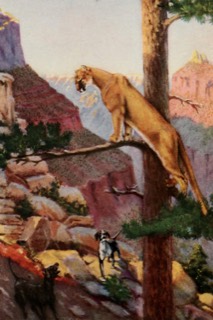
The regiment had three mascots; the two most characteristic⁠—a young mountain lion brought by the Arizona troops, and a war eagle brought by the New Mexicans⁠—we had been forced to leave behind in Tampa. The third, a rather disreputable but exceedingly knowing little dog named Cuba, had accompanied us through all the vicissitudes of the campaign. The mountain lion, Josephine, possessed an infernal temper; whereas both Cuba and the eagle, which have been named in my honor, were extremely good-humored. Josephine was kept tied up. She sometimes escaped. One cool night in early September she wandered off and, entering the tent of a Third Cavalry man, got into bed with him; whereupon he fled into the darkness with yells, much more unnerved than he would have been by the arrival of any number of Spaniards. The eagle was let loose and not only walked at will up and down the company streets, but also at times flew wherever he wished. He was a young bird, having been taken out of his nest when a fledgling. Josephine hated him and was always trying to make a meal of him, especially when we endeavored to take their photographs together. The eagle, though good-natured, was an entirely competent individual and ready at any moment to beat Josephine off. Cuba was also oppressed at times by Josephine, and was of course no match for her, but was frequently able to overawe by simple decision of character.

Keep reading from here

10 of the best lines

The difficulty in organizing was not in selecting, but in rejecting men.

I: Raising the RegimentKeep reading from here

Then there was Micah Jenkins, the captain of Troop K, a gentle and courteous South Carolinian, on whom danger acted like wine.

I: Raising the RegimentKeep reading from here

An experience in following in the trail of an enemy who might flee at one stretch through fifty miles of deathlike desert was a good school out of which to come with profound indifference for the ordinary hardships of campaigning.

I: Raising the RegimentKeep reading from here

The blood of the old men stirred to the distant breath of battle; the blood of the young men leaped hot with eager desire to accompany us.

II: To CubaKeep reading from here

It was very pleasant, sailing southward through the tropic seas toward the unknown.

II: To CubaKeep reading from here

It was very beautiful and very peaceful, and it seemed more as if we were off on some hunting excursion than as if were about to go into a sharp and bloody little fight.

III: General Young’s Fight at Las GuasimasKeep reading from here

The lofty and beautiful mountains hemmed in the Santiago plain, making it an amphitheatre for the battle.

IV: The Cavalry at SantiagoKeep reading from here

As a nation we had prided ourselves on our business ability and adroitness in the arts of peace, while outsiders, at any rate, did not credit us with any especial warlike prowess; and it was curious that when war came we should have broken down precisely on the business and administrative side, while the fighting edge of the troops certainly left little to be desired.

V: In the TrenchesKeep reading from here

The lithe college athletes had lost their spring; the tall, gaunt hunters and cowpunchers lounged listlessly in their dog-tents, which were steaming morasses during the torrential rains, and then ovens when the sun blazed down; but there were no complaints.

VI: The Return HomeKeep reading from here

War means fighting; and the soldier’s cardinal sin is timidity.

Appendix C: CorrectionsKeep reading from here

All 28 The Rough Riders quotes, with the words around each

Reviews

No reviews yet. Be the first, in the app.

Write a review in Doomreader

Contents

  1. I: Raising the Regiment
  2. II: To Cuba
  3. III: General Young’s Fight at Las Guasimas
  4. IV: The Cavalry at Santiago
  5. V: In the Trenches
  6. VI: The Return Home
  7. Appendix A: Colonel Roosevelt’s Report to the Secretary of War of September 10th
  8. Appendix B: The “Round Robin” Letter
  9. Appendix C: Corrections
  10. Appendix D
  11. Appendix E
  12. Appendix F

Listen to The Rough Riders free

The Rough Riders as a free audiobook: Doomreader reads any book aloud, free, in your phone's or computer's own voice. Open the book and tap listen, at the speed you like, hands free.

Want a more natural voice? The AI voices read with AI credits.

Listen free in Doomreader

Download The Rough Riders free

The whole book as an EPUB file, free and legal, from Standard Ebooks. It opens in any ebook app, or read it here in Doomreader with nothing to install.

Download the EPUB (0.7 MB)

More by Theodore Roosevelt

More like The Rough Riders

About this edition

Text from Standard Ebooks. Standard Ebooks dedicate their edition to the public domain (CC0 1.0). Every passage and line on this page is the book's own words, checked against the text.