Doomreader

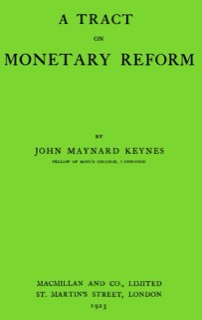
A Tract on Monetary Reform

by John Maynard Keynes

Length: 55,161 words, about 221 pages, about 4 hours to read

Economics, Money and investing

Read A Tract on Monetary Reform free, starting with its best pages and lines below. Listen to it free too, read aloud by your phone's own voice.

The best passages

Pages from the book itself, chosen to make you want to read on. Each opens in the reader at that exact spot.

CHAPTER I THE CONSEQUENCES TO SOCIETY OF CHANGES IN THE VALUE OF MONEY

Money is only important for what it will procure. Thus a change in the monetary unit, which is uniform in its operation and affects all transactions equally, has no consequences. If, by a change in the established standard of value, a man received and owned twice as much money as he did before in payment for all rights and for all efforts, and if he also paid out twice as much money for all acquisitions and for all satisfactions, he would be wholly unaffected.

It follows, therefore, that a change in the value of money, that is to say in the level of prices, is important to Society only in so far as its incidence is unequal. Such changes have produced in the past, and are producing now, the vastest social consequences, because, as we all know, when the value of money changes, it does not change equally for all persons or for all purposes. A man’s receipts and his outgoings are not all modified in one uniform proportion. Thus a change in prices and rewards, as measured in money, generally affects different classes unequally, transfers wealth from one to another, bestows affluence here and embarrassment there, and redistributes Fortune’s favours so as to frustrate design and disappoint expectation.


Keep reading from here

1. The Investing Class.

For a hundred years the system worked, throughout Europe, with an extraordinary success and facilitated the growth of wealth on an unprecedented scale. To save and to invest became at once the duty and the delight of a large class. The savings were seldom drawn on, and, accumulating at compound interest, made possible the material triumphs which we now all take for granted. The morals, the politics, the literature, and the religion of the age joined in a grand conspiracy for the promotion of saving. God and Mammon were reconciled. Peace on earth to men of good means. A rich man could, after all, enter into the Kingdom of Heaven—if only he saved. A new harmony sounded from the celestial spheres. “It is curious to observe how, through the wise and beneficent arrangement of Providence, men thus do the greatest service to the public, when they are thinking of nothing but their own gain”1; so sang the angels.

Keep reading from here

I. Inflation as a Method of Taxation

It is common to speak as though, when a Government pays its way by inflation, the people of the country avoid taxation. We have seen that this is not so. What is raised by printing notes is just as much taken from the public as is a beer-duty or an income-tax. What a Government spends the public pay for. There is no such thing as an uncovered deficit. But in some countries it seems possible to please and content the public, for a time at least, by giving them, in return for the taxes they pay, finely engraved acknowledgements on water-marked paper. The income-tax receipts, which we in England receive from the Surveyor, we throw into the wastepaper basket; in Germany they call them bank-notes and put them into their pocket-books; in France they are termed Rentes and are locked up in the family safe.

Keep reading from here

I. The Quantity Theory of Money

Now “in the long run” this is probably true. If, after the American Civil War, the American dollar had been stabilised and defined by law at 10 per cent below its present value, it would be safe to assume that n and p would now be just 10 per cent greater than they actually are and that the present values of k, r, and k´ would be entirely unaffected. But this long run is a misleading guide to current affairs. In the long run we are all dead. Economists set themselves too easy, too useless a task if in tempestuous seasons they can only tell us that when the storm is long past the ocean is flat again.

In actual experience, a change of n is liable to have a reaction both on k and k´ and on r. It will be enough to give a few typical instances.

Keep reading from here

10 of the best lines

Money is only important for what it will procure.

CHAPTER I THE CONSEQUENCES TO SOCIETY OF CHANGES IN THE VALUE OF MONEYKeep reading from here

Any one who can borrow money and is not exceptionally unlucky must make a profit, which he may have done little to deserve.

2. The Business Class.Keep reading from here

Whether it likes it or not, the technique of production under a régime of money-contract forces the business world always to carry a big speculative position; and if it is reluctant to carry this position, the productive process must be slackened.

II.—Changes in the Value of Money, As affecting Production.Keep reading from here

Has the public in the last resort no remedy, no means of protecting itself against these ingenious depredations?

I. Inflation as a Method of TaxationKeep reading from here

But it is difficult to explain, and it provokes violent prejudice by coming into conflict with the deep instincts by which the love of money protects itself.

II. Currency Depreciation versus Capital LevyKeep reading from here

Thus the theory does not provide a simple or ready-made measure of the “true” value of the exchanges.

II. The Theory of Purchasing Power Parity.Keep reading from here

The wise man will be he who turns his assets into cash, withdraws from the risks and the exertions of activity, and awaits in country retirement the steady appreciation promised him in the value of his cash.

I. Devaluation versus Deflation.Keep reading from here

Gold is liable to be either too dear or too cheap.

III. The Restoration of a Gold Standard.Keep reading from here

They allow gold back only as a constitutional monarch, shorn of his ancient despotic powers and compelled to accept the advice of a Parliament of Banks.

III. The Restoration of a Gold Standard.Keep reading from here

We have reached a stage in the evolution of money when a “managed” currency is inevitable, but we have not yet reached the point when the management can be entrusted to a single authority.

II. The United States.Keep reading from here

All 62 A Tract on Monetary Reform quotes, with the words around each

Reviews

No reviews yet. Be the first, in the app.

Write a review in Doomreader

Contents

  1. PREFACE
  2. CHAPTER I THE CONSEQUENCES TO SOCIETY OF CHANGES IN THE VALUE OF MONEY
  3. I.—Changes in the Value of Money, as affecting Distribution
  4. 1. The Investing Class.
  5. 2. The Business Class.
  6. 3. The Earner.
  7. II.—Changes in the Value of Money, As affecting Production.
  8. CHAPTER II PUBLIC FINANCE AND CHANGES IN THE VALUE OF MONEY
  9. I. Inflation as a Method of Taxation
  10. II. Currency Depreciation versus Capital Levy
  11. CHAPTER III THE THEORY OF MONEY AND OF THE FOREIGN EXCHANGES
  12. I. The Quantity Theory of Money
  13. II. The Theory of Purchasing Power Parity.
  14. III. The Seasonal Fluctuation.
  15. IV. The Forward Market in Exchanges.
  16. CHAPTER IV ALTERNATIVE AIMS IN MONETARY POLICY
  17. I. Devaluation versus Deflation.
  18. II. Stability of Prices versus Stability of Exchange.
  19. III. The Restoration of a Gold Standard.
  20. CHAPTER V POSITIVE SUGGESTIONS FOR THE FUTURE REGULATION OF MONEY
  21. I. Great Britain.
  22. II. The United States.
  23. III. Other Countries.
  24. BY THE SAME AUTHOR

Listen to A Tract on Monetary Reform free

A Tract on Monetary Reform as a free audiobook: Doomreader reads any book aloud, free, in your phone's or computer's own voice. Open the book and tap listen, at the speed you like, hands free.

Want a more natural voice? The AI voices read with AI credits.

Listen free in Doomreader

Download A Tract on Monetary Reform free

The whole book as an EPUB file, free and legal, from Project Gutenberg. It opens in any ebook app, or read it here in Doomreader with nothing to install.

Download the EPUB (0.9 MB)

More by John Maynard Keynes

More like A Tract on Monetary Reform

About this edition

Text from Project Gutenberg. In the public domain in the USA. The Project Gutenberg License is kept inside the file. Every passage and line on this page is the book's own words, checked against the text.