Doomreader

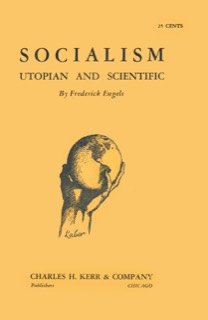
Socialism, Utopian and Scientific

by Friedrich Engels

Length: 28,052 words, about 112 pages, about 2 hours to read

Economics, Politics and society

Read Socialism, Utopian and Scientific free, starting with its best pages and lines below. Listen to it free too, read aloud by your phone's own voice.

The best passages

Pages from the book itself, chosen to make you want to read on. Each opens in the reader at that exact spot.

Chapter I

Modern Socialism is, in its essence, the direct product of the recognition, on the one hand, of the class antagonisms, existing in the society of to-day, between proprietors and non-proprietors, between capitalists and wage-workers; on the other hand, of the anarchy existing in production. But, in its theoretical form, modern Socialism originally appears ostensibly as a more logical extension of the principles laid down by the great French philosophers of the eighteenth century. Like every new theory, modern Socialism had, at first, to connect itself with the intellectual stock-in-trade ready to its hand, however deeply its roots lay in material economic facts.

The great men, who in France prepared men's minds for the coming revolution, were themselves extreme revolutionists. They recognized no external authority of any kind whatever. Religion, natural science, society, political institutions, everything, was subjected to the most unsparing criticism; everything must justify its existence before the judgment-seat of reason, or give up existence. Reason became the sole measure of everything. It was the time when, as Hegel says, the world stood upon its head;[1] first, in the sense that the human head, and the principles arrived at by its thought, claimed to be the basis of all human action and association; but by and by, also, in the wider sense that the reality which was in contradiction to these principles had, in fact, to be turned upside down. Every form of society and government then existing, every old traditional notion was flung into the lumber-room as irrational: the world had hitherto allowed itself to be led solely by prejudices; everything in the past deserved only pity and contempt.

Keep reading from here

Chapter I

But the new order of things, rational enough as compared with earlier conditions, turned out to be by no means absolutely rational. The State based upon reason completely collapsed. Rousseau's Contrat Social had found its realization in the Reign of Terror, from which the bourgeoisie, who had lost confidence in their own political capacity, had taken refuge first in the corruption of the Directorate, and, finally, under the wing of the Napoleonic despotism. The promised eternal peace was turned into an endless war of conquest. The society based upon reason had fared no better. The antagonism between rich and poor, instead of dissolving into general prosperity, had become intensified by the removal of the guild and other privileges, which had to some extent bridged it over, and by the removal of the charitable institutions of the Church. The "freedom of property" from feudal fetters, now veritably accomplished, turned out to be, for the small capitalists and small proprietors, the freedom to sell their small property, crushed under the overmastering competition of the large capitalists and landlords, to these great lords, and thus, as far as the small capitalists and peasant proprietors were concerned, became "freedom from property." The development of industry upon a capitalistic basis made poverty and misery of the working masses conditions of existence of society. Cash payment became more and more, in Carlyle's phrase, the sole nexus between man and man. The number of crimes increased from year to year. Formerly, the feudal vices had openly stalked about in broad daylight; though not eradicated, they were now at any rate thrust into the background.

Keep reading from here

Chapter I

Fourier is not only a critic; his imperturbably serene nature makes him a satirist, and assuredly one of the greatest satirists of all time. He depicts, with equal power and charm, the swindling speculations that blossomed out upon the downfall of the Revolution, and the shopkeeping spirit prevalent in, and characteristic of, French commerce at that time. Still more masterly is his criticism of the bourgeois form of the relations between the sexes, and the position of woman in bourgeois society. He was the first to declare that in any given society the degree of woman's emancipation is the natural measure of the general emancipation.

But Fourier is at his greatest in his conception of the history of society. He divides its whole course, thus far, into four stages of evolution—savagery, barbarism, the patriarchate, civilization. This last is identical with the so-called civil, or bourgeois, society of to-day—i.e., with the social order that came in with the sixteenth century. He proves "that the civilized stage raises every vice practiced by barbarism in a simple fashion, into a form of existence, complex, ambiguous, equivocal, hypocritical"—that civilization moves in "a vicious circle," in contradictions which it constantly reproduces without being able to solve them; hence it constantly arrives at the very opposite to that which it wants to attain, or pretends to want to attain, so that, e.g., "under civilization poverty is born of superabundance itself."

Keep reading from here

Chapter I

At this juncture there came forward as a reformer a manufacturer 29 years old—a man of almost sublime, childlike simplicity of character, and at the same time one of the few born leaders of men. Robert Owen had adopted the teaching of the materialistic philosophers: that man's character is the product, on the one hand, of heredity, on the other, of the environment of the individual during his lifetime, and especially during his period of development. In the industrial revolution most of his class saw only chaos and confusion, and the opportunity of fishing in these troubled waters and making large fortunes quickly. He saw in it the opportunity of putting into practice his favorite theory, and so of bringing order out of chaos. He had already tried it with success, as superintendent of more than five hundred men in a Manchester factory. From 1800 to 1829, he directed the great cotton mill at New Lanark, in Scotland, as managing partner, along the same lines, but with greater freedom of action and with a success that made him a European reputation. A population, originally consisting of the most diverse and, for the most part, very demoralized elements, a population that gradually grew to 2,500, he turned into a model colony, in which drunkenness, police, magistrates, lawsuits, poor laws, charity, were unknown. And all this simply by placing the people in conditions worthy of human beings, and especially by carefully bringing up the rising generation. He was the founder of infant schools, and introduced them first at New Lanark. At the age of two the children came to school, where they enjoyed themselves so much that they could scarcely be got home again.

Keep reading from here

Chapter III

As a matter of fact, since 1825, when the first general crisis broke out, the whole industrial and commercial world, production and exchange among all civilized peoples and their more or less barbaric hangers-on, are thrown out of joint about once every ten years. Commerce is at a stand-still, the markets are glutted, products accumulate, as multitudinous as they are unsaleable, hard cash disappears, credit vanishes, factories are closed, the mass of the workers are in want of the means of subsistence, because they have produced too much of the means of subsistence; bankruptcy follows upon bankruptcy, execution upon execution. The stagnation lasts for years; productive forces and products are wasted and destroyed wholesale, until the accumulated mass of commodities finally filter off, more or less depreciated in value, until production and exchange gradually begin to move again. Little by little the pace quickens. It becomes a trot. The industrial trot breaks into a canter, the canter in turn grows into the headlong gallop of a perfect steeplechase of industry, commercial credit, and speculation, which finally, after breakneck leaps, ends where it began—in the ditch of a crisis. And so over and over again. We have now, since the year 1825, gone through this five times, and at the present moment (1877) we are going through it for the sixth time. And the character of these crises is so clearly defined that Fourier hit all of them off, when he described the first as "crise pléthorique," a crisis from plethora.

Keep reading from here

10 of the best lines

But before there was argumentation, there was action.

INTRODUCTIONKeep reading from here

Thus, as far as he is a scientific man, as far as he knows anything, he is a materialist; outside his science, in spheres about which he knows nothing, he translates his ignorance into Greek and calls it agnosticism.

INTRODUCTIONKeep reading from here

Trade became to a greater and greater extent cheating.

Chapter IKeep reading from here

He was the first to declare that in any given society the degree of woman's emancipation is the natural measure of the general emancipation.

Chapter IKeep reading from here

To make a science of Socialism, it had first to be placed upon a real basis.

Chapter IKeep reading from here

The product governs the producers.

Chapter IIIKeep reading from here

The industrial trot breaks into a canter, the canter in turn grows into the headlong gallop of a perfect steeplechase of industry, commercial credit, and speculation, which finally, after breakneck leaps, ends where it began—in the ditch of a crisis.

Chapter IIIKeep reading from here

The capitalist has no further social function than that of pocketing dividends, tearing off coupons, and gambling on the Stock Exchange, where the different capitalists despoil one another of their capital.

Chapter IIIKeep reading from here

But when once their nature is understood, they can, in the hands of the producers working together, be transformed from master demons into willing servants.

Chapter IIIKeep reading from here

It is the ascent of man from the kingdom of necessity to the kingdom of freedom.

Chapter IIIKeep reading from here

All 20 Socialism, Utopian and Scientific quotes, with the words around each

Reviews

No reviews yet. Be the first, in the app.

Write a review in Doomreader

Contents

  1. UTOPIAN AND SCIENTIFIC
  2. CHICAGO CHARLES H. KERR & COMPANY
  3. PUBLISHER'S NOTE
  4. INTRODUCTION
  5. FOOTNOTES:
  6. SOCIALISM
  7. UTOPIAN AND SCIENTIFIC
  8. Chapter I
  9. FOOTNOTES:
  10. Chapter II
  11. Chapter III
  12. FOOTNOTES:

Listen to Socialism, Utopian and Scientific free

Socialism, Utopian and Scientific as a free audiobook: Doomreader reads any book aloud, free, in your phone's or computer's own voice. Open the book and tap listen, at the speed you like, hands free.

Want a more natural voice? The AI voices read with AI credits.

Listen free in Doomreader

Download Socialism, Utopian and Scientific free

The whole book as an EPUB file, free and legal, from Project Gutenberg. It opens in any ebook app, or read it here in Doomreader with nothing to install.

Download the EPUB (0.1 MB)

More by Friedrich Engels

More like Socialism, Utopian and Scientific

About this edition

Text from Project Gutenberg. In the public domain in the USA. The Project Gutenberg License is kept inside the file. Every passage and line on this page is the book's own words, checked against the text.