Doomreader

The Law

by Frédéric Bastiat

Length: 20,279 words, about 81 pages, about 1 hour to read

Economics, Politics and society

Read The Law free, starting with its best pages and lines below. Listen to it free too, read aloud by your phone's own voice.

The best passages

Pages from the book itself, chosen to make you want to read on. Each opens in the reader at that exact spot.

THE LAW 1

The law perverted! The law—and, in its wake, all the collective forces of the nation—the law, I say, not only diverted from its proper direction, but made to pursue one entirely contrary! The law become the tool of every kind of avarice, instead of being its check! The law guilty of that very iniquity which it was its mission to punish! Truly, this is a serious fact, if it exists, and one to which I feel bound to call the attention of my fellow citizens.

We hold from God the gift that, as far as we are concerned, contains all others, Life—physical, intellectual, and moral life.

But life cannot support itself. He who has bestowed it, has entrusted us with the care of supporting it, of developing it, and of perfecting it. To that end, He has provided us with a collection of wonderful faculties; He has plunged us into the midst of a variety of elements. It is by the application of our faculties to these elements that the phenomena of assimilation and of appropriation, by which life pursues the circle that has been assigned to it are realized.

Existence, faculties, assimilation—in other words, personality, liberty, property—this is man.

It is of these three things that it may be said, apart from all demagogic subtlety, that they are anterior and superior to all human legislation.


Keep reading from here

THE LAW 1

But there is also another disposition which is common to them. This is to live and to develop, when they can, at the expense of one another. This is no rash imputation, emanating from a gloomy, uncharitable spirit. History bears witness to the truth of it, by the incessant wars, the migrations of races, sectarian oppressions, the universality of slavery, the frauds in trade, and the monopolies with which its annals abound. This fatal disposition has its origin in the very constitution of man—in that primitive, and universal, and invincible sentiment that urges it towards its well-being, and makes it seek to escape pain.

Man can only derive life and enjoyment from a perpetual search and appropriation; that is, from a perpetual application of his faculties to objects, or from labor. This is the origin of property.

But also he may live and enjoy, by seizing and appropriating the productions of the faculties of his fellow men. This is the origin of plunder.

Now, labor being in itself a pain, and man being naturally inclined to avoid pain, it follows, and history proves it, that wherever plunder is less burdensome than labor, it prevails; and neither religion nor morality can, in this case, prevent it from prevailing.

Keep reading from here

THE LAW 1

In the first place, it would efface from everybody's conscience the distinction between justice and injustice. No society can exist unless the laws are respected to a certain degree, but the safest way to make them respected is to make them respectable. When law and morality are in contradiction to each other, the citizen finds himself in the cruel alternative of either losing his moral sense, or of losing his respect for the law—two evils of equal magnitude, between which it would be difficult to choose.

It is so much in the nature of law to support justice that in the minds of the masses they are one and the same. There is in all of us a strong disposition to regard what is lawful as legitimate, so much so that many falsely derive all justice from law. It is sufficient, then, for the law to order and sanction plunder, that it may appear to many consciences just and sacred. Slavery, protection, and monopoly find defenders, not only in those who profit by them, but in those who suffer by them. If you suggest a doubt as to the morality of these institutions, it is said directly—"You are a dangerous experimenter, a utopian, a theorist, a despiser of the laws; you would shake the basis upon which society rests."

Keep reading from here

THE LAW 1

Here I am taking on the most popular prejudice of our time. It is not considered enough that law should be just, it must be philanthropic. It is not sufficient that it should guarantee to every citizen the free and inoffensive exercise of his faculties, applied to his physical, intellectual, and moral development; it is required to extend well-being, instruction, and morality, directly over the nation. This is the fascinating side of socialism.

But, I repeat it, these two missions of the law contradict each other. We have to choose between them. A citizen cannot at the same time be free and not free. Mr. de Lamartine wrote to me one day thus: "Your doctrine is only the half of my program; you have stopped at liberty, I go on to fraternity." I answered him: "The second part of your program will destroy the first." And in fact it is impossible for me to separate the word fraternity from the word voluntary. I cannot possibly conceive fraternity legally enforced, without liberty being legally destroyed, and justice legally trampled under foot. Legal plunder has two roots: one of them, as we have already seen, is in human greed; the other is in misconceived philanthropy.

Before I proceed, I think I ought to explain myself upon the word plunder.

Keep reading from here

THE LAW 1

How is it that the strange idea of making the law produce what it does not contain—prosperity, in a positive sense, wealth, science, religion—should ever have gained ground in the political world? The modern politicians, particularly those of the Socialist school, found their different theories upon one common hypothesis; and surely a more strange, a more presumptuous notion, could never have entered a human brain.

They divide mankind into two parts. Men in general, except one, form the first; the politician himself forms the second, which is by far the most important.

In fact, they begin by supposing that men are devoid of any principle of action, and of any means of discernment in themselves; that they have no initiative; that they are inert matter, passive particles, atoms without impulse; at best a vegetation indifferent to its own mode of existence, susceptible of assuming, from an exterior will and hand an infinite number of forms, more or less symmetrical, artistic, and perfected.

Keep reading from here

10 of the best lines

It is not because men have made laws, that personality, liberty, and property exist. On the contrary, it is because personality, liberty, and property exist beforehand, that men make laws.

THE LAW 1Keep reading from here

When does plunder cease, then? When it becomes more burdensome and more dangerous than labor.

THE LAW 1Keep reading from here

No society can exist unless the laws are respected to a certain degree, but the safest way to make them respected is to make them respectable.

THE LAW 1Keep reading from here

In fact, it is not justice that has an existence of its own, it is injustice. The one results from the absence of the other.

THE LAW 1Keep reading from here

It is not spontaneous fraternity, but legal fraternity.

THE LAW 1Keep reading from here

They divide mankind into two parts. Men in general, except one, form the first; the politician himself forms the second, which is by far the most important.

THE LAW 1Keep reading from here

Poor human nature! What would become of its dignity if it were entrusted to the disciples of Rousseau?

MONTESQUIEU—Keep reading from here

So far as it is social, it places mankind beneath the mud.

LEPELLETIER—Keep reading from here

They would be our shepherds, and we are to be their flock.

LEPELLETIER—Keep reading from here

Away, then, with quacks and organizers!

LEPELLETIER—Keep reading from here

All 25 The Law quotes, with the words around each

Reviews

No reviews yet. Be the first, in the app.

Write a review in Doomreader

Contents

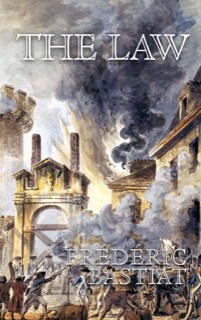
  1. Ludwig von Mises Institute Auburn, Alabama Cover: Prise de la Bastille ("The Storming of the Bastille"); 1789. Painting by Jean-Pierre Hoiiel (1735-1813). Permission was obtained from the Bibliothèque nationale de France for its use. Copyright © 2007 by the Ludwig von Mises Institute. Printed in China. Published by the Ludwig von Mises Institute 518 West Magnolia Avenue, Auburn, Alabama 36832
  2. FOREWORD
  3. FOOTNOTES: INDEX
  4. FOREWORD
  5. THE LAW 1
  6. MONTESQUIEU—
  7. RAYNAL—
  8. CONDILLAC—
  9. SAINT-JUST—
  10. ROBESPIERRE—
  11. BILLAUD VARENNES—
  12. LEPELLETIER—
  13. FOOTNOTES:

Listen to The Law free

The Law as a free audiobook: Doomreader reads any book aloud, free, in your phone's or computer's own voice. Open the book and tap listen, at the speed you like, hands free.

Want a more natural voice? The AI voices read with AI credits.

Listen free in Doomreader

Download The Law free

The whole book as an EPUB file, free and legal, from Project Gutenberg. It opens in any ebook app, or read it here in Doomreader with nothing to install.

Download the EPUB (0.6 MB)

More by Frédéric Bastiat

More like The Law

About this edition

Text from Project Gutenberg. In the public domain in the USA. The Project Gutenberg License is kept inside the file. Every passage and line on this page is the book's own words, checked against the text.