Doomreader

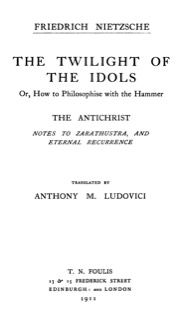
The Twilight of the Idols, and The Antichrist

by Friedrich Nietzsche

Length: 73,483 words, about 294 pages, about 5 hours to read

Philosophy

Read The Twilight of the Idols, and The Antichrist free, starting with its best pages and lines below. Listen to it free too, read aloud by your phone's own voice.

The best passages

Pages from the book itself, chosen to make you want to read on. Each opens in the reader at that exact spot.

MAXIMS AND MISSILES

Aristotle says that in order to live alone, a man must be either an animal or a god. The third alternative is lacking: a man must be both—a philosopher.

4

“All truth is simple.”—Is not this a double lie?

5

Once for all I wish to be blind to many things.—Wisdom sets bounds even to knowledge.

6

A man recovers best from his exceptional nature—his intellectuality—by giving his animal instincts a chance.

7

Which is it? Is man only a blunder of God? Or is God only a blunder of man?

8

From the military school of life.—That which does not kill me, makes me stronger.

9

Help thyself, then everyone will help thee. A principle of neighbour-love.

10

A man should not play the coward to his deeds. He should not repudiate them once he has performed them. Pangs of conscience are indecent.

11

Can a donkey be tragic?—To perish beneath a load that one can neither bear nor throw off? This is the case of the Philosopher.

12

If a man knows the wherefore of his existence, then the manner of it can take care of itself. Man does not aspire to happiness; only the Englishman does that.

13

Man created woman—out of what? Out of a rib of his god,—of his “ideal.”

14

What? Art thou looking for something? Thou wouldst fain multiply thyself tenfold, a hundredfold? Thou seekest followers? Seek ciphers!

15

Posthumous men, like myself, are not so well understood as men who reflect their age, but they are heard with more respect. In plain English: we are never understood—hence our authority.
Keep reading from here

THE PROBLEM OF SOCRATES

1

In all ages the wisest have always agreed in their judgment of life: it is no good. At all times and places the same words have been on their lips,—words full of doubt, full of melancholy, full of weariness of life, full of hostility to life. Even Socrates’ dying words were:—“To live—means to be ill a long while: I owe a cock to the god Æsculapius.” Even Socrates had had enough of it. What does that prove? What does it point to? Formerly people would have said (—oh, it has been said, and loudly enough too; by our Pessimists loudest of all!): “In any case there must be some truth in this! The consensus sapientium is a proof of truth.”—Shall we say the same to-day? May we do so? “In any case there must be some sickness here,” we make reply. These great sages of all periods should first be examined more closely! Is it possible that they were, everyone of them, a little shaky on their legs, effete, rocky, decadent? Does wisdom perhaps appear on earth after the manner of a crow attracted by a slight smell of carrion?

Keep reading from here

“REASON” IN PHILOSOPHY

2

With a feeling of great reverence I except the name of Heraclitus. If the rest of the philosophic gang rejected the evidences of the senses, because the latter revealed a state of multifariousness and change, he rejected the same evidence because it revealed things as if they possessed permanence and unity. Even Heraclitus did an injustice to the senses. The latter lie neither as the Eleatics believed them to lie, nor as he believed them to lie,—they do not lie at all. The interpretations we give to their evidence is what first introduces falsehood into it; for instance the lie of unity, the lie of matter, of substance and of permanence. Reason is the cause of our falsifying the evidence of the senses. In so far as the senses show us a state of Becoming, of transiency, and of change, they do not lie. But in declaring that Being was an empty illusion, Heraclitus will remain eternally right. The “apparent” world is the only world: the “true world” is no more than a false adjunct thereto.

3

Keep reading from here

PREFACE

FRIEDRICH NIETZSCHE.

1

Let us look each other in the face. We are hyperboreans,—we know well enough how far outside the crowd we stand. “Thou wilt find the way to the Hyperboreans neither by land nor by water”: Pindar already knew this much about us. Beyond the north, the ice, and death—our life, our happiness.... We discovered happiness; we know the way; we found the way out of thousands of years of labyrinth. Who else would have found it?—Not the modern man, surely?—“I do not know where I am or what I am to do; I am everything that knows not where it is or what to do,”—sighs the modern man. We were made quite ill by this modernity,—with its indolent peace, its cowardly compromise, and the whole of the virtuous filth of its Yea and Nay. This tolerance and largeur de cœur which “forgives” everything because it “understands” everything, is a Sirocco for us. We prefer to live amid ice than to be breathed upon by modern virtues and other southerly winds!... We were brave enough; we spared neither ourselves nor others: but we were very far from knowing whither to direct our bravery. We were becoming gloomy; people called us fatalists. Our fate—it was the abundance, the tension and the storing up of power. We thirsted for thunderbolts and great deeds; we kept at the most respectful distance from the joy of the weakling, from “resignation.” ... Thunder was in our air, that part of nature which we are, became overcast—for we had no direction. The formula of our happiness: a Yea, a Nay, a straight line, a goal.

Keep reading from here

10 of the best lines

The third alternative is lacking: a man must be both—a philosopher.

MAXIMS AND MISSILESKeep reading from here

Socrates was a clown who succeeded in making men take him seriously: what then was the matter?

THE PROBLEM OF SOCRATESKeep reading from here

The “inner world” is full of phantoms and will-o’-the-wisps: the will is one of these.

THE FOUR GREAT ERRORSKeep reading from here

One must not respond immediately to a stimulus; one must acquire a command of the obstructing and isolating instincts.

THINGS THE GERMANS LACKKeep reading from here

In order to acquire intellect, one must be in need of it.

SKIRMISHES IN A WAR WITH THE AGEKeep reading from here

First principle: a man must need to be strong, otherwise he will never attain it.

SKIRMISHES IN A WAR WITH THE AGEKeep reading from here

A virtue must be our invention, our most personal defence and need: in every other sense it is merely a danger.

PREFACEKeep reading from here

Convictions are prisons.

PREFACEKeep reading from here

Know also, that transiency singeth its short song for ever afresh and that at the sound of the first verse thou wilt almost die of longing when thou thinkest that it might be for the last time.

I. ETERNAL RECURRENCEKeep reading from here

What is it which gives a meaning, a value, an importance to things? It is the creative heart which yearns and which created out of this yearning.

EXPLANATORY NOTES TO “THUS SPAKE ZARATHUSTRA”Keep reading from here

All 108 The Twilight of the Idols, and The Antichrist quotes, with the words around each

Reviews

No reviews yet. Be the first, in the app.

Write a review in Doomreader

Contents

  1. THE TWILIGHT OF THE IDOLS
  2. FRIEDRICH NIETZSCHE
  3. Or, How to Philosophise with the Hammer THE ANTICHRIST NOTES TO ZARATHUSTRA, AND ETERNAL RECURRENCE TRANSLATED BY ANTHONY M. LUDOVICI
  4. The Complete Works of Friedrich Nietzsche
  5. TRANSLATOR’S PREFACE
  6. PREFACE
  7. MAXIMS AND MISSILES
  8. THE PROBLEM OF SOCRATES
  9. “REASON” IN PHILOSOPHY
  10. MORALITY AS THE ENEMY OF NATURE
  11. THE FOUR GREAT ERRORS
  12. THE “IMPROVERS” OF MANKIND
  13. THINGS THE GERMANS LACK
  14. SKIRMISHES IN A WAR WITH THE AGE
  15. THINGS I OWE TO THE ANCIENTS
  16. THE HAMMER SPEAKETH
  17. THE ANTICHRIST
  18. PREFACE
  19. THE ETERNAL RECURRENCE
  20. EXPLANATORY NOTES TO “THUS SPAKE ZARATHUSTRA.”
  21. TRANSLATOR’S PREFACE
  22. I. ETERNAL RECURRENCE
  23. EXPLANATORY NOTES TO “THUS SPAKE ZARATHUSTRA”

Listen to The Twilight of the Idols, and The Antichrist free

The Twilight of the Idols, and The Antichrist as a free audiobook: Doomreader reads any book aloud, free, in your phone's or computer's own voice. Open the book and tap listen, at the speed you like, hands free.

Want a more natural voice? The AI voices read with AI credits.

Listen free in Doomreader

Download The Twilight of the Idols, and The Antichrist free

The whole book as an EPUB file, free and legal, from Project Gutenberg. It opens in any ebook app, or read it here in Doomreader with nothing to install.

Download the EPUB (0.2 MB)

More by Friedrich Nietzsche

More like The Twilight of the Idols, and The Antichrist

About this edition

Text from Project Gutenberg. In the public domain in the USA. The Project Gutenberg License is kept inside the file. Every passage and line on this page is the book's own words, checked against the text.