Doomreader

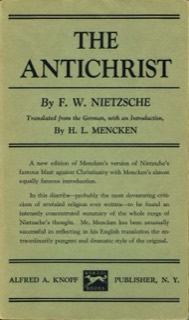
The Antichrist

by Friedrich Nietzsche

Length: 36,621 words, about 146 pages, about 3 hours to read

Philosophy

Read The Antichrist free, starting with its best pages and lines below. Listen to it free too, read aloud by your phone's own voice.

The best passages

Pages from the book itself, chosen to make you want to read on. Each opens in the reader at that exact spot.

Chapter 1

—Let us look each other in the face. We are Hyperboreans—we know well enough how remote our place is. “Neither by land nor by water will you find the road to the Hyperboreans”: even Pindar,[1] in his day, knew that much about us. Beyond the North, beyond the ice, beyond death—our life, our happiness.... We have discovered that happiness; we know the way; we got our knowledge of it from thousands of years in the labyrinth. Who else has found it?—The man of today?—“I don’t know either the way out or the way in; I am whatever doesn’t know either the way out or the way in”—so sighs the man of today.... This is the sort of modernity that made us ill,—we sickened on lazy peace, cowardly compromise, the whole virtuous dirtiness of the modern Yea and Nay. This tolerance and largeur of the heart that “forgives” everything because it “understands” everything is a sirocco to us. Rather live amid the ice than among modern virtues and other such south-winds!... We were brave enough; we spared neither ourselves nor others; but we were a long time finding out where to direct our courage. We grew dismal; they called us fatalists. Our fate—it was the fulness, the tension, the storing up of powers. We thirsted for the lightnings and great deeds; we kept as far as possible from the happiness of the weakling, from “resignation”... There was thunder in our air; nature, as we embodied it, became overcast—for we had not yet found the way. The formula of our happiness: a Yea, a Nay, a straight line, a goal....

Keep reading from here

Chapter 3

The problem that I set here is not what shall replace mankind in the order of living creatures (—man is an end—): but what type of man must be bred, must be willed, as being the most valuable, the most worthy of life, the most secure guarantee of the future.

This more valuable type has appeared often enough in the past: but always as a happy accident, as an exception, never as deliberately willed. Very often it has been precisely the most feared; hitherto it has been almost the terror of terrors;—and out of that terror the contrary type has been willed, cultivated and attained: the domestic animal, the herd animal, the sick brute-man—the Christian....

Keep reading from here

Chapter 6

It is a painful and tragic spectacle that rises before me: I have drawn back the curtain from the rottenness of man. This word, in my mouth, is at least free from one suspicion: that it involves a moral accusation against humanity. It is used—and I wish to emphasize the fact again—without any moral significance: and this is so far true that the rottenness I speak of is most apparent to me precisely in those quarters where there has been most aspiration, hitherto, toward “virtue” and “godliness.” As you probably surmise, I understand rottenness in the sense of décadence: my argument is that all the values on which mankind now fixes its highest aspirations are décadence-values.

I call an animal, a species, an individual corrupt, when it loses its instincts, when it chooses, when it prefers, what is injurious to it. A history of the “higher feelings,” the “ideals of humanity”—and it is possible that I’ll have to write it—would almost explain why man is so degenerate. Life itself appears to me as an instinct for growth, for survival, for the accumulation of forces, for power: whenever the will to power fails there is disaster. My contention is that all the highest values of humanity have been emptied of this will—that the values of décadence, of nihilism, now prevail under the holiest names.

Keep reading from here

Chapter 11

A word now against Kant as a moralist. A virtue must be our invention; it must spring out of our personal need and defence. In every other case it is a source of danger. That which does not belong to our life menaces it; a virtue which has its roots in mere respect for the concept of “virtue,” as Kant would have it, is pernicious. “Virtue,” “duty,” “good for its own sake,” goodness grounded upon impersonality or a notion of universal validity—these are all chimeras, and in them one finds only an expression of the decay, the last collapse of life, the Chinese spirit of Königsberg. Quite the contrary is demanded by the most profound laws of self-preservation and of growth: to wit, that every man find his own virtue, his own categorical imperative. A nation goes to pieces when it confounds its duty with the general concept of duty. Nothing works a more complete and penetrating disaster than every “impersonal” duty, every sacrifice before the Moloch of abstraction.—To think that no one has thought of Kant’s categorical imperative as dangerous to life!... The theological instinct alone took it under protection!—An action prompted by the life-instinct proves that it is a right action by the amount of pleasure that goes with it: and yet that Nihilist, with his bowels of Christian dogmatism, regarded pleasure as an objection.... What destroys a man more quickly than to work, think and feel without inner necessity, without any deep personal desire, without pleasure—as a mere automaton of duty? That is the recipe for décadence, and no less for idiocy.... Kant became an idiot.—And such a man was the contemporary of Goethe! This calamitous spinner of cobwebs passed for the German philosopher—still passes today!... I forbid myself to say what I think of the Germans....

Keep reading from here

Chapter 30

The instinctive hatred of reality: the consequence of an extreme susceptibility to pain and irritation—so great that merely to be “touched” becomes unendurable, for every sensation is too profound.

The instinctive exclusion of all aversion, all hostility, all bounds and distances in feeling: the consequence of an extreme susceptibility to pain and irritation—so great that it senses all resistance, all compulsion to resistance, as unbearable anguish (—that is to say, as harmful, as prohibited by the instinct of self-preservation), and regards blessedness (joy) as possible only when it is no longer necessary to offer resistance to anybody or anything, however evil or dangerous—love, as the only, as the ultimate possibility of life....

These are the two physiological realities upon and out of which the doctrine of salvation has sprung. I call them a sublime super-development of hedonism upon a thoroughly unsalubrious soil. What stands most closely related to them, though with a large admixture of Greek vitality and nerve-force, is epicureanism, the theory of salvation of paganism. Epicurus was a typical décadent: I was the first to recognize him.—The fear of pain, even of infinitely slight pain—the end of this can be nothing save a religion of love....

Keep reading from here

10 of the best lines

We thirsted for the lightnings and great deeds; we kept as far as possible from the happiness of the weakling, from “resignation”...

Chapter 1Keep reading from here

What is evil?—Whatever springs from weakness.

Chapter 2Keep reading from here

I call an animal, a species, an individual corrupt, when it loses its instincts, when it chooses, when it prefers, what is injurious to it.

Chapter 6Keep reading from here

A virtue must be our invention; it must spring out of our personal need and defence.

Chapter 11Keep reading from here

The truth is that there is no other alternative for gods: either they are the will to power—in which case they are national gods—or incapacity for power—in which case they have to be good....

Chapter 16Keep reading from here

It does not speak of a “struggle with sin,” but, yielding to reality, of the “struggle with suffering.”

Chapter 20Keep reading from here

This faith does not formulate itself—it simply lives, and so guards itself against formulae.

Chapter 32Keep reading from here

Greatness of soul is needed for this business: the service of truth is the hardest of all services.

Chapter 50Keep reading from here

Do not let yourself be deceived: great intellects are sceptical.

Chapter 54Keep reading from here

A religious man thinks only of himself.

Chapter 61Keep reading from here

All 54 The Antichrist quotes, with the words around each

Reviews

No reviews yet. Be the first, in the app.

Write a review in Doomreader

Contents

All 64 parts
  1. INTRODUCTION
  2. PREFACE
  3. Chapter 1
  4. Chapter 2
  5. Chapter 3
  6. Chapter 4
  7. Chapter 5
  8. Chapter 6
  9. Chapter 7
  10. Chapter 8
  11. Chapter 9
  12. Chapter 10
  13. Chapter 11
  14. Chapter 12
  15. Chapter 13
  16. Chapter 14
  17. Chapter 15
  18. Chapter 16
  19. Chapter 17
  20. Chapter 18
  21. Chapter 19
  22. Chapter 20
  23. Chapter 21
  24. Chapter 22
  25. Chapter 23
  26. Chapter 24
  27. Chapter 25
  28. Chapter 26
  29. Chapter 27
  30. Chapter 28
  31. Chapter 29
  32. Chapter 30
  33. Chapter 31
  34. Chapter 32
  35. Chapter 33
  36. Chapter 34
  37. Chapter 35
  38. Chapter 36
  39. Chapter 37
  40. Chapter 38
  41. Chapter 39
  42. Chapter 40
  43. Chapter 41
  44. Chapter 42
  45. Chapter 43
  46. Chapter 44
  47. Chapter 45
  48. Chapter 46
  49. Chapter 47
  50. Chapter 48
  51. Chapter 49
  52. Chapter 50
  53. Chapter 51
  54. Chapter 52
  55. Chapter 53
  56. Chapter 54
  57. Chapter 55
  58. Chapter 56
  59. Chapter 57
  60. Chapter 58
  61. Chapter 59
  62. Chapter 60
  63. Chapter 61
  64. Chapter 62

Listen to The Antichrist free

The Antichrist as a free audiobook: Doomreader reads any book aloud, free, in your phone's or computer's own voice. Open the book and tap listen, at the speed you like, hands free.

Want a more natural voice? The AI voices read with AI credits.

Listen free in Doomreader

Download The Antichrist free

The whole book as an EPUB file, free and legal, from Project Gutenberg. It opens in any ebook app, or read it here in Doomreader with nothing to install.

Download the EPUB (0.3 MB)

More by Friedrich Nietzsche

More like The Antichrist

About this edition

Text from Project Gutenberg. In the public domain in the USA. The Project Gutenberg License is kept inside the file. Every passage and line on this page is the book's own words, checked against the text.