Doomreader

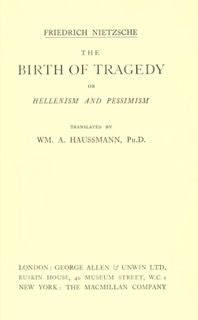
The Birth of Tragedy

by Friedrich Nietzsche

Length: 57,002 words, about 228 pages, about 4 hours to read

Philosophy

Read The Birth of Tragedy free, starting with its best pages and lines below. Listen to it free too, read aloud by your phone's own voice.

The best passages

Pages from the book itself, chosen to make you want to read on. Each opens in the reader at that exact spot.

Chapter 1

We shall have gained much for the science of æsthetics, when once we have perceived not only by logical inference, but by the immediate certainty of intuition, that the continuous development of art is bound up with the duplexity of the Apollonian and the Dionysian: in like manner as procreation is dependent on the duality of the sexes, involving perpetual conflicts with only periodically intervening reconciliations. These names we borrow from the Greeks, who disclose to the intelligent observer the profound mysteries of their view of art, not indeed in concepts, but in the impressively clear figures of their world of deities. It is in connection with Apollo and Dionysus, the two art-deities of the Greeks, that we learn that there existed in the Grecian world a wide antithesis, in origin and aims, between the art of the shaper, the Apollonian, and the non-plastic art of music, that of Dionysus: both these so heterogeneous tendencies run parallel to each other, for the most part openly at variance, and continually inciting each other to new and more powerful births, to perpetuate in them the strife of this antithesis, which is but seemingly bridged over by their mutual term "Art"; till at last, by a metaphysical miracle of the Hellenic will, they appear paired with each other, and through this pairing eventually generate the equally Dionysian and Apollonian art-work of Attic tragedy.
Keep reading from here

Chapter 3

Whosoever, with another religion in his heart, approaches these Olympians and seeks among them for moral elevation, even for sanctity, for incorporeal spiritualisation, for sympathetic looks of love, will soon be obliged to turn his back on them, discouraged and disappointed. Here nothing suggests asceticism, spirituality, or duty: here only an exuberant, even triumphant life speaks to us, in which everything existing is deified, whether good or bad. And so the spectator will perhaps stand quite bewildered before this fantastic exuberance of life, and ask himself what magic potion these madly merry men could have used for enjoying life, so that, wherever they turned their eyes, Helena, the ideal image of their own existence "floating in sweet sensuality," smiled upon them. But to this spectator, already turning backwards, we must call out: "depart not hence, but hear rather what Greek folk-wisdom says of this same life, which with such inexplicable cheerfulness spreads out before thee." There is an ancient story that king Midas hunted in the forest a long time for the wise Silenus, the companion of Dionysus, without capturing him. When at last he fell into his hands, the king asked what was best of all and most desirable for man. Fixed and immovable, the demon remained silent; till at last, forced by the king, he broke out with shrill laughter into these words: "Oh, wretched race of

Keep reading from here

Chapter 7

With this chorus the deep-minded Hellene, who is so singularly qualified for the most delicate and severe suffering, consoles himself:—he who has glanced with piercing eye into the very heart of the terrible destructive processes of so-called universal history, as also into the cruelty of nature, and is in danger of longing for a Buddhistic negation of the will. Art saves him, and through art life saves him—for herself.

For we must know that in the rapture of the Dionysian state, with its annihilation of the ordinary bounds and limits of existence, there is a lethargic element, wherein all personal experiences of the past are submerged. It is by this gulf of oblivion that the everyday world and the world of Dionysian reality are separated from each other. But as soon as this everyday reality rises again in consciousness, it is felt as such, and nauseates us; an ascetic will-paralysing mood is the fruit of these states. In this sense the Dionysian man may be said to resemble Hamlet: both have for once seen into the true nature of things, —they have perceived, but they are loath to act; for their action cannot change the eternal nature of things; they regard it as shameful or ridiculous that one should require of them to set aright the time which is out of joint. Knowledge kills action, action requires the veil of illusion—it is this lesson which Hamlet teaches, and not the cheap wisdom of John-a-Dreams who from too much reflection, as it were from a surplus of possibilities, does not arrive at action at all.

Keep reading from here

Chapter 14

For that despotic logician had now and then the feeling of a gap, or void, a sentiment of semi-reproach, as of a possibly neglected duty with respect to art. There often came to him, as he tells his friends in prison, one and the same dream-apparition, which kept constantly repeating to him: "Socrates, practise music." Up to his very last days he solaces himself with the opinion that his philosophising is the highest form of poetry, and finds it hard to believe that a deity will remind him of the "common, popular music." Finally, when in prison, he consents to practise also this despised music, in order thoroughly to unburden his conscience. And in this frame of mind he composes a poem on Apollo and turns a few Æsopian fables into verse. It was something similar to the demonian warning voice which urged him to these practices; it was because of his Apollonian insight that, like a barbaric king, he did not understand the noble image of a god and was in danger of sinning against a deity—through ignorance. The prompting voice of the Socratic dream-vision is the only sign of doubtfulness as to the limits of logical nature. "Perhaps "—thus he had to ask himself—"what is not intelligible to me is not therefore unreasonable? Perhaps there is a realm of wisdom from which the logician is banished? Perhaps art is even a necessary correlative of and supplement to science?"

Keep reading from here

Chapter 20

But how suddenly this gloomily depicted wilderness of our exhausted culture changes when the Dionysian magic touches it! A hurricane seizes everything decrepit, decaying, collapsed, and stunted; wraps it whirlingly into a red cloud of dust; and carries it like a vulture into the air. Confused thereby, our glances seek for what has vanished: for what they see is something risen to the golden light as from a depression, so full and green, so luxuriantly alive, so ardently infinite. Tragedy sits in the midst of this exuberance of life, sorrow and joy, in sublime ecstasy; she listens to a distant doleful song—it tells of the Mothers of Being, whose names are: Wahn, Wille, Wehe[21]—Yes, my friends, believe with me in Dionysian life and in the re-birth of tragedy. The time of the Socratic man is past: crown yourselves with ivy, take in your hands the thyrsus, and do not marvel if tigers and panthers lie down fawning at your feet. Dare now to be tragic men, for ye are to be redeemed! Ye are to accompany the Dionysian festive procession from India to Greece! Equip yourselves for severe conflict, but believe in the wonders of your god!

Keep reading from here

10 of the best lines

And perhaps many a one will, like myself, recollect having sometimes called out cheeringly and not without success amid the dangers and terrors of dream-life: "It is a dream! I will dream on!"

Chapter 1Keep reading from here

The true goal is veiled by a phantasm: we stretch out our hands for the latter, while Nature attains the former through our illusion.

Chapter 3Keep reading from here

Before him the cultured man shrank to a lying caricature.

Chapter 8Keep reading from here

Why should the artist be under obligations to accommodate himself to a power whose strength is merely in numbers?

Chapter 11Keep reading from here

Will it not one day rise again as art out of its mystic depth?

Chapter 17Keep reading from here

We understand why so feeble a culture hates true art; it fears destruction thereby.

Chapter 20Keep reading from here

Tragedy sits in the midst of this exuberance of life, sorrow and joy, in sublime ecstasy; she listens to a distant doleful song—it tells of the Mothers of Being, whose names are: Wahn, Wille, Wehe[21]—Yes, my friends, believe with me in Dionysian life and in the re-birth of tragedy.

Chapter 20Keep reading from here

One must not demand of what is most noble that it should possess the durable toughness of leather; the staunch durability, which, for instance, was inherent in the national character of the Romans, does not probably belong to the indispensable predicates of perfection.

Chapter 21Keep reading from here

And a people—for the rest, also a man—is worth just as much only as its ability to impress on its experiences the seal of eternity: for it is thus, as it were, desecularised, and reveals its unconscious inner conviction of the relativity of time and of the true, that is, the metaphysical significance of life.

Chapter 23Keep reading from here

If we could conceive an incarnation of dissonance—and what is man but that?—then, to be able to live this dissonance would require a glorious illusion which would spread a veil of beauty over its peculiar nature.

Chapter 25Keep reading from here

All 44 The Birth of Tragedy quotes, with the words around each

Reviews

No reviews yet. Be the first, in the app.

Write a review in Doomreader

Contents

All 47 parts
  1. THE
  2. BIRTH OF TRAGEDY
  3. OR
  4. HELLENISM AND PESSIMISM
  5. FRIEDRICH NIETZSCHE
  6. The Complete Works of Friedrich Nietzsche
  7. INTRODUCTION.[1]
  8. AN ATTEMPT AT SELF-CRITICISM. I.
  9. Chapter 2
  10. Chapter 3
  11. Chapter 4
  12. Chapter 5
  13. Chapter 6
  14. Chapter 7
  15. THE BIRTH OF TRAGEDY
  16. FROM THE SPIRIT OF MUSIC
  17. FOREWORD TO RICHARD WAGNER.
  18. THE BIRTH OF TRAGEDY.
  19. Chapter 1
  20. Chapter 2
  21. Chapter 3
  22. Chapter 4
  23. Chapter 5
  24. Chapter 6
  25. Chapter 7
  26. Chapter 8
  27. Chapter 9
  28. Chapter 11
  29. Chapter 12
  30. Chapter 13
  31. Chapter 14
  32. Chapter 15
  33. Chapter 16
  34. Chapter 17
  35. Chapter 18
  36. Chapter 19
  37. Chapter 20
  38. Chapter 21
  39. Chapter 22
  40. Chapter 23
  41. Chapter 24
  42. Chapter 25
  43. APPENDIX.
  44. Chapter 2
  45. Chapter 3
  46. Chapter 4
  47. TRANSLATOR'S NOTE.

Listen to The Birth of Tragedy free

The Birth of Tragedy as a free audiobook: Doomreader reads any book aloud, free, in your phone's or computer's own voice. Open the book and tap listen, at the speed you like, hands free.

Want a more natural voice? The AI voices read with AI credits.

Listen free in Doomreader

Download The Birth of Tragedy free

The whole book as an EPUB file, free and legal, from Project Gutenberg. It opens in any ebook app, or read it here in Doomreader with nothing to install.

Download the EPUB (0.2 MB)

More by Friedrich Nietzsche

More like The Birth of Tragedy

About this edition

Text from Project Gutenberg. In the public domain in the USA. The Project Gutenberg License is kept inside the file. Every passage and line on this page is the book's own words, checked against the text.