Doomreader

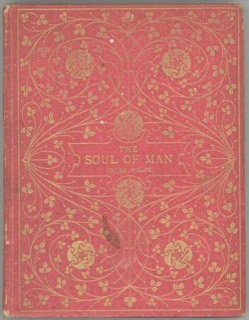
The Soul of Man under Socialism

by Oscar Wilde

Length: 17,426 words, about 70 pages, about 1 hour to read

Politics and society, Essays and ideas

Read The Soul of Man under Socialism free, starting with its best pages and lines below. Listen to it free too, read aloud by your phone's own voice.

The best passages

Pages from the book itself, chosen to make you want to read on. Each opens in the reader at that exact spot.

THE SOUL OF MAN

The chief advantage that would result from the establishment of Socialism is, undoubtedly, the fact that Socialism would relieve us from that sordid necessity of living for others which, in the present condition of things, presses so hardly upon almost everybody. In fact, scarcely anyone at all escapes.

Now and then, in the course of the century, a great man of science, like Darwin; a great poet, like Keats; a fine critical spirit, like M. Renan; a supreme artist, like Flaubert, has been able to isolate himself, to keep himself out of reach of the clamorous claims of others, to stand ‘under the shelter of the wall,’ as Plato puts it, and so to realise the perfection of what was in him, to his own incomparable gain, and to the incomparable and lasting gain of the whole world. These, however, are exceptions.  The majority of people spoil their lives by an unhealthy and exaggerated altruism—are forced, indeed, so to spoil them.  They find themselves surrounded by hideous poverty, by hideous ugliness, by hideous starvation. It is inevitable that they should be strongly moved by all this. The emotions of man are stirred more quickly than man’s intelligence; and, as I pointed out some time ago in an article on the function of criticism, it is much more easy to have sympathy with suffering than it is to have sympathy with thought. Accordingly, with admirable, though misdirected intentions, they very seriously and very sentimentally set themselves to the task of remedying the evils that they see.  But their remedies do not cure the disease: they merely prolong it.
Keep reading from here

THE SOUL OF MAN

Of course, it might be said that the Individualism generated under conditions of private property is not always, or even as a rule, of a fine or wonderful type, and that the poor, if they have not culture and charm, have still many virtues. Both these statements would be quite true.  The possession of private property is very often extremely demoralising, and that is, of course, one of the reasons why Socialism wants to get rid of the institution.  In fact, property is really a nuisance. Some years ago people went about the country saying that property has duties.  They said it so often and so tediously that, at last, the Church has begun to say it.  One hears it now from every pulpit.  It is perfectly true. Property not merely has duties, but has so many duties that its possession to any large extent is a bore.  It involves endless claims upon one, endless attention to business, endless bother. If property had simply pleasures, we could stand it; but its duties make it unbearable.  In the interest of the rich we must get rid of it.  The virtues of the poor may be readily admitted, and are much to be regretted. We are often told that the poor are grateful for charity.  Some of them are, no doubt, but the best amongst the poor are never grateful.  They are ungrateful, discontented, disobedient, and rebellious.  They are quite right to be so. Charity they feel to be a ridiculously inadequate mode of partial restitution, or a sentimental dole, usually accompanied by some impertinent attempt on the part of the sentimentalist to tyrannise over their private lives. Why should they be grateful for the crumbs that fall from the rich man’s table?  They should be seated at the board, and are beginning to know it.

Keep reading from here

THE SOUL OF MAN

With the abolition of private property, then, we shall have true, beautiful, healthy Individualism.  Nobody will waste his life in accumulating things, and the symbols for things.  One will live.  To live is the rarest thing in the world.  Most people exist, that is all.

It is a question whether we have ever seen the full expression of a personality, except on the imaginative plane of art.  In action, we never have.  Cæsar, says Mommsen, was the complete and perfect man.  But how tragically insecure was Cæsar! Wherever there is a man who exercises authority, there is a man who resists authority.  Cæsar was very perfect, but his perfection travelled by too dangerous a road.  Marcus Aurelius was the perfect man, says Renan.  Yes; the great emperor was a perfect man. But how intolerable were the endless claims upon him!  He staggered under the burden of the empire.  He was conscious how inadequate one man was to bear the weight of that Titan and too vast orb. What I mean by a perfect man is one who develops under perfect conditions; one who is not wounded, or worried or maimed, or in danger.  Most personalities have been obliged to be rebels.  Half their strength has been wasted in friction. Byron’s personality, for instance, was terribly wasted in its battle with the stupidity, and hypocrisy, and Philistinism of the English.  Such battles do not always intensify strength: they often exaggerate weakness.  Byron was never able to give us what he might have given us. Shelley escaped better.  Like Byron, he got out of England as soon as possible.  But he was not so well known. If the English had had any idea of what a great poet he really was, they would have fallen on him with tooth and nail, and made his life as unbearable to him as they possibly could.

Keep reading from here

THE SOUL OF MAN

To sweep it with joy would be appalling.  Man is made for something better than disturbing dirt.  All work of that kind should be done by a machine.

And I have no doubt that it will be so. Up to the present, man has been, to a certain extent, the slave of machinery, and there is something tragic in the fact that as soon as man had invented a machine to do his work he began to starve. This, however, is, of course, the result of our property system and our system of competition.  One man owns a machine which does the work of five hundred men. Five hundred men are, in consequence, thrown out of employment, and, having no work to do, become hungry and take to thieving. The one man secures the produce of the machine and keeps it, and has five hundred times as much as he should have, and probably, which is of much more importance, a great deal more than he really wants. Were that machine the property of all, every one would benefit by it.  It would be an immense advantage to the community.  All unintellectual labour, all monotonous, dull labour, all labour that deals with dreadful things, and involves unpleasant conditions, must be done by machinery. Machinery must work for us in coal mines, and do all sanitary services, and be the stoker of steamers, and clean the streets, and run messages on wet days, and do anything that is tedious or distressing.  At present machinery competes against man. Under proper conditions machinery will serve man.  There is no doubt at all that this is the future of machinery, and just as trees grow while the country gentleman is asleep, so while Humanity will be amusing itself, or enjoying cultivated leisure—which,

Keep reading from here

THE SOUL OF MAN

It will, of course, be said that such a scheme as is set forth here is quite unpractical, and goes against human nature.  This is perfectly true.  It is unpractical, and it goes against human nature. This is why it is worth carrying out, and that is why one proposes it.  For what is a practical scheme?  A practical scheme is either a scheme that is already in existence, or a scheme that could be carried out under existing conditions. But it is exactly the existing conditions that one objects to; and any scheme that could accept these conditions is wrong and foolish.  The conditions will be done away with, and human nature will change. The only thing that one really knows about human nature is that it changes.  Change is the one quality we can predicate of it.  The systems that fail are those that rely on the permanency of human nature, and not on its growth and development. The error of Louis XIV. was that he thought human nature would always be the same.  The result of his error was the French Revolution.  It was an admirable result.  All the results of the mistakes of governments are quite admirable.

Keep reading from here

10 of the best lines

Charity creates a multitude of sins.

THE SOUL OF MANKeep reading from here

In fact, property is really a nuisance.

THE SOUL OF MANKeep reading from here

It will love them because they will be different.

THE SOUL OF MANKeep reading from here

The State is to make what is useful. The individual is to make what is beautiful.

THE SOUL OF MANKeep reading from here

A work of art is the unique result of a unique temperament.

THE SOUL OF MANKeep reading from here

In centuries before ours the public nailed the ears of journalists to the pump. That was quite hideous. In this century journalists have nailed their own ears to the keyhole.

THE SOUL OF MANKeep reading from here

The form of government that is most suitable to the artist is no government at all.

THE SOUL OF MANKeep reading from here

All the results of the mistakes of governments are quite admirable.

THE SOUL OF MANKeep reading from here

It would be horribly selfish if it wanted all the other flowers in the garden to be both red and roses.

THE SOUL OF MANKeep reading from here

The new Individualism is the new Hellenism.

THE SOUL OF MANKeep reading from here

All 49 The Soul of Man under Socialism quotes, with the words around each

Reviews

No reviews yet. Be the first, in the app.

Write a review in Doomreader

Listen to The Soul of Man under Socialism free

The Soul of Man under Socialism as a free audiobook: Doomreader reads any book aloud, free, in your phone's or computer's own voice. Open the book and tap listen, at the speed you like, hands free.

Want a more natural voice? The AI voices read with AI credits.

Listen free in Doomreader

Download The Soul of Man under Socialism free

The whole book as an EPUB file, free and legal, from Project Gutenberg. It opens in any ebook app, or read it here in Doomreader with nothing to install.

Download the EPUB (0.3 MB)

More by Oscar Wilde

More like The Soul of Man under Socialism

About this edition

Text from Project Gutenberg. In the public domain in the USA. The Project Gutenberg License is kept inside the file. Every passage and line on this page is the book's own words, checked against the text.