Doomreader

The Man Who Was Thursday

by G. K. Chesterton

Length: 58,604 words, about 234 pages, about 4 hours to read

Novels, Mystery, Fantasy

Read The Man Who Was Thursday free, starting with its best pages and lines below. Listen to it free too, read aloud by your phone's own voice.

What it is

An undercover policeman infiltrates a mysterious Anarchist group.

The best passages

Pages from the book itself, chosen to make you want to read on. Each opens in the reader at that exact spot.

I: The Two Poets of Saffron Park

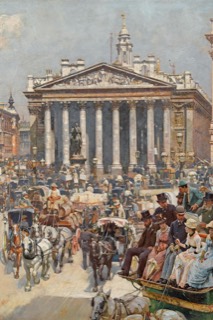
The suburb of Saffron Park lay on the sunset side of London, as red and ragged as a cloud of sunset. It was built of a bright brick throughout; its skyline was fantastic, and even its ground plan was wild. It had been the outburst of a speculative builder, faintly tinged with art, who called its architecture sometimes Elizabethan and sometimes Queen Anne, apparently under the impression that the two sovereigns were identical. It was described with some justice as an artistic colony, though it never in any definable way produced any art. But although its pretensions to be an intellectual centre were a little vague, its pretensions to be a pleasant place were quite indisputable. The stranger who looked for the first time at the quaint red houses could only think how very oddly shaped the people must be who could fit in to them. Nor when he met the people was he disappointed in this respect. The place was not only pleasant, but perfect, if once he could regard it not as a deception but rather as a dream. Even if the people were not “artists,” the whole was nevertheless artistic. That young man with the long, auburn hair and the impudent face⁠—that young man was not really a poet; but surely he was a poem. That old gentleman with the wild, white beard and the wild, white hat⁠—that venerable humbug was not really a philosopher; but at least he was the cause of philosophy in others. That scientific gentleman with the bald, egg-like head and the bare, birdlike neck had no real right to the airs of science that he assumed. He had not discovered anything new in biology; but what biological creature could he have discovered more singular than himself?
Keep reading from here

II: The Secret of Gabriel Syme

“Your secret?” asked the staring Gregory. “Have you got a secret?”

“Yes,” said Syme, “I have a secret.” Then after a pause, “Will you swear?”

Gregory glared at him gravely for a few moments, and then said abruptly⁠—

“You must have bewitched me, but I feel a furious curiosity about you. Yes, I will swear not to tell the anarchists anything you tell me. But look sharp, for they will be here in a couple of minutes.”

Syme rose slowly to his feet and thrust his long, white hands into his long, grey trousers’ pockets. Almost as he did so there came five knocks on the outer grating, proclaiming the arrival of the first of the conspirators.

“Well,” said Syme slowly, “I don’t know how to tell you the truth more shortly than by saying that your expedient of dressing up as an aimless poet is not confined to you or your President. We have known the dodge for some time at Scotland Yard.”

Gregory tried to spring up straight, but he swayed thrice.

“What do you say?” he asked in an inhuman voice.

“Yes,” said Syme simply, “I am a police detective. But I think I hear your friends coming.”

From the doorway there came a murmur of “Mr. Joseph Chamberlain.” It was repeated twice and thrice, and then thirty times, and the crowd of Joseph Chamberlains (a solemn thought) could be heard trampling down the corridor.

Keep reading from here

IV: The Tale of a Detective

Somewhat dazed and considerably excited, Syme allowed himself to be led to a side-door in the long row of buildings of Scotland Yard. Almost before he knew what he was doing, he had been passed through the hands of about four intermediate officials, and was suddenly shown into a room, the abrupt blackness of which startled him like a blaze of light. It was not the ordinary darkness, in which forms can be faintly traced; it was like going suddenly stone-blind.

“Are you the new recruit?” asked a heavy voice.

And in some strange way, though there was not the shadow of a shape in the gloom, Syme knew two things: first, that it came from a man of massive stature; and second, that the man had his back to him.

“Are you the new recruit?” said the invisible chief, who seemed to have heard all about it. “All right. You are engaged.”

Syme, quite swept off his feet, made a feeble fight against this irrevocable phrase.

“I really have no experience,” he began.

“No one has any experience,” said the other, “of the Battle of Armageddon.”

“But I am really unfit⁠—”

“You are willing, that is enough,” said the unknown.

“Well, really,” said Syme, “I don’t know any profession of which mere willingness is the final test.”

“I do,” said the other⁠—“martyrs. I am condemning you to death. Good day.”

Keep reading from here

VI: The Exposure

Sunday went on smoothly⁠—

“You will probably understand that there is only one possible motive for forbidding free speech at this festival of freedom. Strangers overhearing us matters nothing. They assume that we are joking. But what would matter, even unto death, is this, that there should be one actually among us who is not of us, who knows our grave purpose, but does not share it, who⁠—”

The Secretary screamed out suddenly like a woman.

“It can’t be!” he cried, leaping. “There can’t⁠—”

The President flapped his large flat hand on the table like the fin of some huge fish.

“Yes,” he said slowly, “there is a spy in this room. There is a traitor at this table. I will waste no more words. His name⁠—”

Syme half rose from his seat, his finger firm on the trigger.

“His name is Gogol,” said the President. “He is that hairy humbug over there who pretends to be a Pole.”

Gogol sprang to his feet, a pistol in each hand. With the same flash three men sprang at his throat. Even the Professor made an effort to rise. But Syme saw little of the scene, for he was blinded with a beneficent darkness; he had sunk down into his seat shuddering, in a palsy of passionate relief.

Keep reading from here

XII: The Earth in Anarchy

“Do you see this lantern?” cried Syme in a terrible voice. “Do you see the cross carved on it, and the flame inside? You did not make it. You did not light it. Better men than you, men who could believe and obey, twisted the entrails of iron and preserved the legend of fire. There is not a street you walk on, there is not a thread you wear, that was not made as this lantern was, by denying your philosophy of dirt and rats. You can make nothing. You can only destroy. You will destroy mankind; you will destroy the world. Let that suffice you. Yet this one old Christian lantern you shall not destroy. It shall go where your empire of apes will never have the wit to find it.”

He struck the Secretary once with the lantern so that he staggered; and then, whirling it twice round his head, sent it flying far out to sea, where it flared like a roaring rocket and fell.

“Swords!” shouted Syme, turning his flaming face to the three behind him. “Let us charge these dogs, for our time has come to die.”

Keep reading from here

10 of the best lines

He had not discovered anything new in biology; but what biological creature could he have discovered more singular than himself?
I: The Two Poets of Saffron ParkKeep reading from here

We know that the New Jerusalem will only be like Victoria.

I: The Two Poets of Saffron ParkKeep reading from here

You policemen are cruel to the poor, but I could forgive you even your cruelty if it were not for your calm.

IV: The Tale of a DetectiveKeep reading from here

The dragon without St. George would not even be grotesque.

IV: The Tale of a DetectiveKeep reading from here

For with any recovery from morbidity there must go a certain healthy humiliation.

VIII: The Professor ExplainsKeep reading from here

The first was the old fear that any miracle might happen, the second the more hopeless modern fear that no miracle can ever happen.

X: The DuelKeep reading from here

When duty and religion are really destroyed, it will be by the rich.

XII: The Earth in AnarchyKeep reading from here

The elephant is not made by God that could run away with him if he did not consent to the elopement.

XIII: The Pursuit of the PresidentKeep reading from here

Buddhism is not a creed, it is a doubt.

XIV: The Six PhilosophersKeep reading from here

No smell of ale or orchards could make the Secretary cease to ask a reasonable question.

XV: The AccuserKeep reading from here

All 76 The Man Who Was Thursday quotes, with the words around each

Reviews

No reviews yet. Be the first, in the app.

Write a review in Doomreader

Contents

  1. I: The Two Poets of Saffron Park
  2. II: The Secret of Gabriel Syme
  3. III: The Man Who Was Thursday
  4. IV: The Tale of a Detective
  5. V: The Feast of Fear
  6. VI: The Exposure
  7. VII: The Unaccountable Conduct of Professor de Worms
  8. VIII: The Professor Explains
  9. IX: The Man in Spectacles
  10. X: The Duel
  11. XI: The Criminals Chase the Police
  12. XII: The Earth in Anarchy
  13. XIII: The Pursuit of the President
  14. XIV: The Six Philosophers
  15. XV: The Accuser

Listen to The Man Who Was Thursday free

The Man Who Was Thursday as a free audiobook: Doomreader reads any book aloud, free, in your phone's or computer's own voice. Open the book and tap listen, at the speed you like, hands free.

Want a more natural voice? The AI voices read with AI credits.

Listen free in Doomreader

Download The Man Who Was Thursday free

The whole book as an EPUB file, free and legal, from Standard Ebooks. It opens in any ebook app, or read it here in Doomreader with nothing to install.

Download the EPUB (1.5 MB)

More by G. K. Chesterton

More like The Man Who Was Thursday

About this edition

Text from Standard Ebooks. Standard Ebooks dedicate their edition to the public domain (CC0 1.0). Every passage and line on this page is the book's own words, checked against the text.