Doomreader

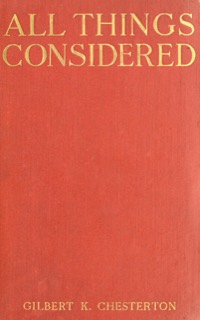
The Everlasting Man

by G. K. Chesterton

Length: 107,645 words, about 431 pages, about 8 hours to read

Philosophy, Essays and ideas, Spirituality and religion

Read The Everlasting Man free, starting with its best pages and lines below. Listen to it free too, read aloud by your phone's own voice.

What it is

G. K. Chesterton takes us through the history of man, rebuking common secular views and presenting the case for the Catholic Church.

The best passages

Pages from the book itself, chosen to make you want to read on. Each opens in the reader at that exact spot.

Introduction

Introduction The Plan of This Book

There are two ways of getting home; and one of them is to stay there. The other is to walk round the whole world till we come back to the same place; and I tried to trace such a journey in a story I once wrote. It is, however, a relief to turn from that topic to another story that I never wrote. Like every book I never wrote, it is by far the best book I have ever written. It is only too probable that I shall never write it, so I will use it symbolically here; for it was a symbol of the same truth. I conceived it as a romance of those vast valleys with sloping sides, like those along which the ancient White Horses of Wessex are scrawled along the flanks of the hills. It concerned some boy whose farm or cottage stood on such a slope, and who went on his travels to find something, such as the effigy and grave of some giant; and when he was far enough from home he looked back and saw that his own farm and kitchen-garden, shining flat on the hillside like the colours and quarterings of a shield, were but parts of some such gigantic figure, on which he had always lived, but which was too large and too close to be seen. That, I think, is a true picture of the progress of any real independent intelligence today; and that is the point of this book.
Keep reading from here

I: The Man in the Cave

Far away in some strange constellation in skies infinitely remote, there is a small star, which astronomers may some day discover. At least I could never observe in the faces or demeanour of most astronomers or men of science any evidence that they had discovered it; though as a matter of fact they were walking about on it all the time. It is a star that brings forth out of itself very strange plants and very strange animals; and none stranger than the men of science. That at least is the way in which I should begin a history of the world if I had to follow the scientific custom of beginning with an account of the astronomical universe. I should try to see even this earth from the outside, not by the hackneyed insistence of its relative position to the sun, but by some imaginative effort to conceive its remote position for the dehumanised spectator. Only I do not believe in being dehumanised in order to study humanity. I do not believe in dwelling upon the distances that are supposed to dwarf the world; I think there is even something a trifle vulgar about this idea of trying to rebuke spirit by size. And as the first idea is not feasible, that of making the earth a strange planet so as to make it significant, I will not stoop to the other trick of making it a small planet in order to make it insignificant.

Keep reading from here

III: The Antiquity of Civilisation

The modern man looking at the most ancient origins has been like a man watching for daybreak in a strange land; and expecting to see that dawn breaking behind bare uplands or solitary peaks. But that dawn is breaking behind the black bulk of great cities long builded and lost for us in the original night; colossal cities like the houses of giants, in which even the carved ornamental animals are taller than the palm-trees; in which the painted portrait can be twelve times the size of the man; with tombs like mountains of man set foursquare and pointing to the stars; with winged and bearded bulls standing and staring enormous at the gates of temples; standing still eternally as if a stamp would shake the world. The dawn of history reveals a humanity already civilised. Perhaps it reveals a civilisation already old. And among other more important things, it reveals the folly of most of the generalisations about the previous and unknown period when it was really young. The two first human societies of which we have any reliable and detailed record are Babylon and Egypt. It so happens that these two vast and splendid achievements of the genius of the ancients bear witness against two of the commonest and crudest assumptions of the culture of the moderns. If we want to get rid of half the nonsense about nomads and cavemen and the old man of the forest, we need only look steadily at the two solid and stupendous facts called Egypt and Babylon.

Keep reading from here

III: The Antiquity of Civilisation

Somewhere along the Ionian coast opposite Crete and the islands was a town of some sort, probably of the sort that we should call a village or hamlet with a wall. It was called Ilion but it came to be called Troy, and the name will never perish from the earth. A poet who may have been a beggar and a balladmonger, who may have been unable to read and write, and was described by tradition as blind, composed a poem about the Greeks going to war with this town to recover the most beautiful woman in the world. That the most beautiful woman in the world lived in that one little town sounds like a legend; that the most beautiful poem in the world was written by somebody who knew of nothing larger than such little towns is a historical fact. It is said that the poem came at the end of the period; that the primitive culture brought it forth in its decay; in which case one would like to have seen that culture in its prime. But anyhow it is true that this, which is our first poem, might very well be our last poem too. It might well be the last word as well as the first word spoken by man about his mortal lot, as seen by merely mortal vision. If the world becomes pagan and perishes, the last man left alive would do well to quote the Iliad and die.

Keep reading from here

VIII: The End of the World

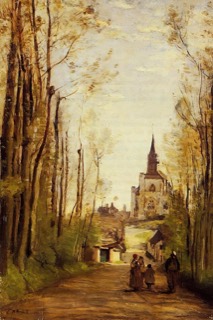
I was once sitting on a summer day in a meadow in Kent under the shadow of a little village church, with a rather curious companion with whom I had just been walking through the woods. He was one of a group of eccentrics I had come across in my wanderings who had a new religion called Higher Thought; in which I had been so far initiated as to realise a general atmosphere of loftiness or height, and was hoping at some later and more esoteric stage to discover the beginnings of thought. My companion was the most amusing of them, for however he may have stood towards thought, he was at least very much their superior in experience, having travelled beyond the tropics while they were meditating in the suburbs; though he had been charged with excess in telling travellers’ tales. In spite of anything said against him, I preferred him to his companions and willingly went with him through the wood; where I could not but feel that his sunburnt face and fierce tufted eyebrows and pointed beard gave him something of the look of Pan. Then we sat down in the meadow and gazed idly at the treetops and the spire of the village church; while the warm afternoon began to mellow into early evening and the song

Keep reading from here

10 of the best lines

There are two ways of getting home; and one of them is to stay there.

IntroductionKeep reading from here

In fact, people have been interested in everything about the caveman except what he did in the cave.

I: The Man in the CaveKeep reading from here

It was in the Darwinian age that the word first became known and the thing first became impossible.

II: Professors and Prehistoric MenKeep reading from here

But one of the strange marks of the strength of Christianity is that, since it came, no pagan in our civilisation has been able to be really human.

III: The Antiquity of CivilisationKeep reading from here

He was tribal enough to be universal. He was as narrow as the universe.

IV: God and Comparative ReligionKeep reading from here

The power even in the myths of savages is like the power in the metaphors of poets.

V: Man and MythologiesKeep reading from here

Despair does not lie in being weary of suffering, but in being weary of joy.

VIII: The End of the WorldKeep reading from here

He is cramped rather than cracked; there are not enough holes in his head to ventilate it.

III: The Strangest Story in the WorldKeep reading from here

Dogma gives even God too much freedom when it permits him to die.

V: The Escape from PaganismKeep reading from here

They will watch for it to stumble; they will watch for it to err; they will no longer watch for it to end.

VI: The Five Deaths of the FaithKeep reading from here

All 117 The Everlasting Man quotes, with the words around each

Reviews

No reviews yet. Be the first, in the app.

Write a review in Doomreader

Contents

  1. Prefatory Note
  2. Introduction
  3. Part I: On the Creature Called Man
  4. I: The Man in the Cave
  5. II: Professors and Prehistoric Men
  6. III: The Antiquity of Civilisation
  7. IV: God and Comparative Religion
  8. V: Man and Mythologies
  9. VI: The Demons and the Philosophers
  10. VII: The War of the Gods and Demons
  11. VIII: The End of the World
  12. Part II: On the Man Called Christ
  13. I: The God in the Cave
  14. II: The Riddles of the Gospel
  15. III: The Strangest Story in the World
  16. IV: The Witness of the Heretics
  17. V: The Escape from Paganism
  18. VI: The Five Deaths of the Faith
  19. Conclusion
  20. Appendix I: On Prehistoric Man
  21. Appendix II: On Authority and Accuracy

Listen to The Everlasting Man free

The Everlasting Man as a free audiobook: Doomreader reads any book aloud, free, in your phone's or computer's own voice. Open the book and tap listen, at the speed you like, hands free.

Want a more natural voice? The AI voices read with AI credits.

Listen free in Doomreader

Download The Everlasting Man free

The whole book as an EPUB file, free and legal, from Standard Ebooks. It opens in any ebook app, or read it here in Doomreader with nothing to install.

Download the EPUB (0.7 MB)

More by G. K. Chesterton

More like The Everlasting Man

About this edition

Text from Standard Ebooks. Standard Ebooks dedicate their edition to the public domain (CC0 1.0). Every passage and line on this page is the book's own words, checked against the text.