Doomreader

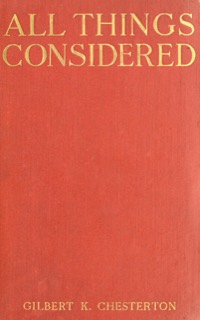
All Things Considered

by G. K. Chesterton

Length: 62,445 words, about 250 pages, about 4 hours to read

Essays and ideas

Read All Things Considered free, starting with its best pages and lines below. Listen to it free too, read aloud by your phone's own voice.

The best passages

Pages from the book itself, chosen to make you want to read on. Each opens in the reader at that exact spot.

COCKNEYS AND THEIR JOKES

I believe firmly in the value of all vulgar notions, especially of vulgar jokes. When once you have got hold of a vulgar joke, you may be certain that you have got hold of a subtle and spiritual idea. The men who made the joke saw something deep which they could not express except by something silly and emphatic. They saw something delicate which they could only express by something indelicate. I remember that Mr. Max Beerbohm (who has every merit except democracy) attempted to analyse the jokes at which the mob laughs. He divided them into three sections: jokes about bodily humiliation, jokes about things alien, such as foreigners, and jokes about bad cheese. Mr. Max Beerbohm thought he understood the first two forms; but I am not sure that he did. In order to understand vulgar humour it is not enough to be humorous. One must also be vulgar, as I am. And in the first case it is surely obvious that it is not merely at the fact of something being hurt that we laugh (as I trust we do) when a Prime Minister sits down on his hat. If that were so we should laugh whenever we saw a funeral. We do not laugh at the mere fact of something falling down; there is nothing humorous about leaves falling or the sun going down. When our house falls down we do not laugh. All the birds of the air might drop around us in a perpetual shower like a hailstorm without arousing a smile. If you really ask yourself why we laugh at a man sitting down suddenly in the street you will discover that the reason is not only recondite, but ultimately religious.

Keep reading from here

ON RUNNING AFTER ONE’S HAT

I feel an almost savage envy on hearing that London has been flooded in my absence, while I am in the mere country. My own Battersea has been, I understand, particularly favoured as a meeting of the waters. Battersea was already, as I need hardly say, the most beautiful of human localities. Now that it has the additional splendour of great sheets of water, there must be something quite incomparable in the landscape (or waterscape) of my own romantic town. Battersea must be a vision of Venice. The boat that brought the meat from the butcher’s must have shot along those lanes of rippling silver with the strange smoothness of the gondola. The greengrocer who brought cabbages to the corner of the Latchmere Road must have leant upon the oar with the unearthly grace of the gondolier. There is nothing so perfectly poetical as an island; and when a district is flooded it becomes an archipelago.

Keep reading from here

THE BOY

Sometimes I see small fragments of information in the newspapers which make my heart leap with an irrational patriotic sympathy. I have had the misfortune to be left comparatively cold by many of the enterprises and proclamations of my country in recent times. But the other day I found in the Tribune the following paragraph, which I may be permitted to set down as an example of the kind of international outrage with which I have by far the most instinctive sympathy. There is something attractive, too, in the austere simplicity with which the affair is set forth—

“Geneva, Oct. 31.

“The English schoolboy Allen, who was arrested at Lausanne railway station on Saturday, for having painted red the statue of General Jomini of Payerne, was liberated yesterday, after paying a fine of £24. Allen has proceeded to Germany, where he will continue his studies. The people of Payerne are indignant, and clamoured for his detention in prison.”

Keep reading from here

THE METHUSELAHITE

I Saw in a newspaper paragraph the other day the following entertaining and deeply philosophical incident. A man was enlisting as a soldier at Portsmouth, and some form was put before him to be filled up, common, I suppose, to all such cases, in which was, among other things, an inquiry about what was his religion. With an equal and ceremonial gravity the man wrote down the word “Methuselahite.” Whoever looks over such papers must, I should imagine, have seen some rum religions in his time; unless the Army is going to the dogs. But with all his specialist knowledge he could not “place” Methuselahism among what Bossuet called the variations of Protestantism. He felt a fervid curiosity about the tenets and tendencies of the sect; and he asked the soldier what it meant. The soldier replied that it was his religion “to live as long as he could.”

Keep reading from here

HUMANITARIANISM AND STRENGTH

Exactly in the same way the ruder or more sluggish races regard the civilisation of Christendom. If they have any respect for it, it is precisely because it does not use their own coarse and cruel expedients. According to some modern moralists whenever Zulus cut off the heads of dead Englishmen, Englishmen must cut off the heads of dead Zulus. Whenever Arabs or Egyptians constantly use the whip to their slaves, Englishmen must use the whip to their subjects. And on a similar principle (I suppose), whenever an English Admiral has to fight cannibals the English Admiral ought to eat them. However unattractive a menu consisting entirely of barbaric kings may appear to an English gentleman, he must try to sit down to it with an appetite. He must fight the Sandwich Islanders with their own weapons; and their own weapons are knives and forks. But the truth of the matter is, of course, that to do this kind of thing is to break the whole spell of our supremacy. All the mystery of the white man, all the fearful poetry of the white man, so far as it exists in the eyes of these savages, consists in the fact that we do not do such things. The Zulus point at us and say, “Observe the advent of these inexplicable demi-gods, these magicians, who do not cut off the noses of their enemies.” The Soudanese say to each other, “This hardy people never flogs its servants; it is superior to the simplest and most obvious human pleasures.”

Keep reading from here

10 of the best lines

It is so easy to be solemn; it is so hard to be frivolous.

THE CASE FOR THE EPHEMERALKeep reading from here

A man running after a hat is not half so ridiculous as a man running after a wife.

ON RUNNING AFTER ONE’S HATKeep reading from here

All good men are international. Nearly all bad men are cosmopolitan.

FRENCH AND ENGLISHKeep reading from here

It generally consists of a man chaining himself up and then complaining that he is not free.

THE MODERN MARTYRKeep reading from here

Every joke is a senseless joke. A joke is by its nature a protest against sense.

THE BOYKeep reading from here

“The plumber can find nothing wrong with our piano; so I suppose that my wife does love me.”

SCIENCE AND RELIGIONKeep reading from here

Whatever is cosmic is comic.

SPIRITUALISMKeep reading from here

For if you do not understand a man you cannot crush him. And if you do understand him, very probably you will not.

HUMANITARIANISM AND STRENGTHKeep reading from here

Not only can these fairy-tales be enjoyed because they are moral, but morality can be enjoyed because it puts us in fairyland, in a world at once of wonder and of war.

FAIRY TALESKeep reading from here

But God has never told us what a turkey means.

CHRISTMASKeep reading from here

All 105 All Things Considered quotes, with the words around each

Reviews

No reviews yet. Be the first, in the app.

Write a review in Doomreader

Contents

All 35 parts
  1. THE CASE FOR THE EPHEMERAL
  2. COCKNEYS AND THEIR JOKES
  3. THE FALLACY OF SUCCESS
  4. ON RUNNING AFTER ONE’S HAT
  5. THE VOTE AND THE HOUSE
  6. CONCEIT AND CARICATURE
  7. PATRIOTISM AND SPORT
  8. AN ESSAY ON TWO CITIES
  9. FRENCH AND ENGLISH
  10. THE ZOLA CONTROVERSY
  11. OXFORD FROM WITHOUT
  12. WOMAN
  13. THE MODERN MARTYR
  14. ON POLITICAL SECRECY
  15. EDWARD VII. AND SCOTLAND
  16. THOUGHTS AROUND KOEPENICK
  17. THE BOY
  18. LIMERICKS AND COUNSELS OF PERFECTION
  19. ANONYMITY AND FURTHER COUNSELS
  20. ON THE CRYPTIC AND THE ELLIPTIC
  21. THE WORSHIP OF THE WEALTHY
  22. SCIENCE AND RELIGION
  23. THE METHUSELAHITE
  24. SPIRITUALISM
  25. THE ERROR OF IMPARTIALITY
  26. PHONETIC SPELLING
  27. HUMANITARIANISM AND STRENGTH
  28. WINE WHEN IT IS RED
  29. DEMAGOGUES AND MYSTAGOGUES
  30. THE “EATANSWILL GAZETTE”
  31. FAIRY TALES
  32. TOM JONES AND MORALITY
  33. THE MAID OF ORLEANS
  34. A DEAD POET
  35. CHRISTMAS

Listen to All Things Considered free

All Things Considered as a free audiobook: Doomreader reads any book aloud, free, in your phone's or computer's own voice. Open the book and tap listen, at the speed you like, hands free.

Want a more natural voice? The AI voices read with AI credits.

Listen free in Doomreader

Download All Things Considered free

The whole book as an EPUB file, free and legal, from Project Gutenberg. It opens in any ebook app, or read it here in Doomreader with nothing to install.

Download the EPUB (0.4 MB)

More by G. K. Chesterton

More like All Things Considered

About this edition

Text from Project Gutenberg. In the public domain in the USA. The Project Gutenberg License is kept inside the file. Every passage and line on this page is the book's own words, checked against the text.