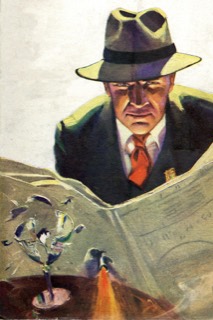
Doomreader

The Lerouge Case

by Émile Gaboriau

Length: 124,345 words, about 497 pages, about 9 hours to read

Mystery

Read The Lerouge Case free, starting with its best pages and lines below. Listen to it free too, read aloud by your phone's own voice.

What it is

A widow is found dead under mysterious circumstances, and Monsieur Lecoq of the police arranges to have his mentor brought in to help solve the crime.

The best passages

Pages from the book itself, chosen to make you want to read on. Each opens in the reader at that exact spot.

Chapter I

On Thursday, the 6th of March, 1862, two days after Shrove Tuesday, five women belonging to the village of La Jonchere presented themselves at the police station at Bougival. They stated that for two days past no one had seen the Widow Lerouge, one of their neighbours, who lived by herself in an isolated cottage. They had several times knocked at the door, but all in vain. The window-shutters as well as the door were closed; and it was impossible to obtain even a glimpse of the interior. This silence, this sudden disappearance alarmed them. Apprehensive of a crime, or at least of an accident, they requested the interference of the police to satisfy their doubts by forcing the door and entering the house.

Bougival is a pleasant riverside village, peopled on Sundays by crowds of boating parties. Trifling offences are frequently heard of in its neighbourhood, but crimes are rare. The commissary of police at first refused to listen to the women, but their importunities so fatigued him that he at length acceded to their request. He sent for the corporal of gendarmes, with two of his men, called into requisition the services of a locksmith, and, thus accompanied, followed the neighbours of the Widow Lerouge.

La Jonchere owes some celebrity to the inventor of the sliding railway, who for some years past has, with more enterprise than profit, made public trials of his system in the immediate neighbourhood.
Keep reading from here

Chapter II

As the old fellow spoke, his little gray eyes dilated, and became brilliant as carbuncles. His face reflected an internal satisfaction; even his wrinkles seemed to laugh. His figure became erect, and his step was almost elastic, as he darted into the inner chamber. He remained there about half an hour; then came out running, then reentered and then again came out; once more he disappeared and reappeared again almost immediately. The magistrate could not help comparing him to a pointer on the scent, his turned-up nose even moved about as if to discover some subtle odour left by the assassin. All the while he talked loudly and with much gesticulation, apostrophising himself, scolding himself, uttering little cries of triumph or self-encouragement. He did not allow Lecoq to have a moment’s rest. He wanted this or that or the other thing. He demanded paper and a pencil. Then he wanted a spade; and finally he cried out for plaster of Paris, some water and a bottle of oil. When more than an hour had elapsed, the investigating magistrate began to grow impatient, and asked what had become of the amateur detective.

“He is on the road,” replied the corporal, “lying flat in the mud, and mixing some plaster in a plate. He says he has nearly finished, and that he is coming back presently.”

He did in fact return almost instantly, joyous, triumphant, looking at least twenty years younger. Lecoq followed him, carrying with the utmost precaution a large basket.

Keep reading from here

Chapter IV

“Because, M. Tabaret, Madame Gerdy is not my mother!”

This sentence fell like a heavy blow on the head of the amateur detective.

“Oh!” he said, in the tone one assumes when rejecting an absurd proposition, “do you really know what you are saying, Noel? Is it credible? Is it probable?”

“It is improbable,” replied Noel with a peculiar emphasis which was habitual to him: “it is incredible, if you will; but yet it is true. That is to say, for thirty-three years, ever since my birth, this woman has played a most marvellous and unworthy comedy, to ennoble and enrich her son⁠—for she has a son⁠—at my expense!”

Keep reading from here

Chapter VI

M. Daburon had just gone to bed, but had given orders to his servant; so that M. Tabaret had but to give his name, to be at once conducted to the magistrate’s sleeping apartment. At sight of his amateur detective, M. Daburon raised himself in his bed, saying, “There is something extraordinary! What have you discovered? have you got a clue?”

“Better than that,” answered the old fellow, smiling with pleasure.

“Speak quickly!”

“I know the culprit!”

Old Tabaret ought to have been satisfied; he certainly produced an effect. The magistrate bounded in his bed. “Already!” said he. “Is it possible?”

“I have the honour to repeat to you, sir,” resumed the old fellow, “that I know the author of the crime of La Jonchere.”

“And I,” said M. Daburon, “I proclaim you the greatest of all detectives, past or future. I shall certainly never hereafter undertake an investigation without your assistance.”

“You are too kind, sir. I have had little or nothing to do in the matter. The discovery is due to chance alone.”

“You are modest, M. Tabaret. Chance assists only the clever, and it is that which annoys the stupid. But I beg you will be seated and proceed.”

Then with the lucidness and precision of which few would have believed him capable, the old fellow repeated to the magistrate all that he had learned from Noel. He quoted from memory the extracts from the letters, almost without changing a word.

Keep reading from here

Chapter VII

M. Daburon did not return home on leaving Mademoiselle d’Arlange. All through the night he wandered about at random, seeking to cool his heated brow, and to allay his excessive weariness.

“Fool that I was!” said he to himself, “thousand times fool to have hoped, to have believed, that she would ever love me. Madman! how could I have dared to dream of possessing so much grace, nobleness, and beauty! How charming she was this evening, when her face was bathed in tears! Could anything be more angelic? What a sublime expression her eyes had in speaking of him! How she must love him! And I? She loves me as a father, she told me so⁠—as a father! And could it be otherwise? Is it not justice? Could she see a lover in a sombre and severe-looking magistrate, always as sad as his black coat? Was it not a crime to dream of uniting that virginal simplicity to my detestable knowledge of the world? For her, the future is yet the land of smiling chimeras; and long since experience has dissipated all my illusions. She is as young as innocence, and I am as old as vice.”

The unfortunate magistrate felt thoroughly ashamed of himself. He understood Claire, and excused her. He reproached himself for having shown her how he suffered; for having cast a shadow upon her life. He could not forgive himself for having spoken of his love. Ought he not to have foreseen what had happened?⁠—that she would refuse him, that he would thus deprive himself of the happiness of seeing her, of hearing her, and of silently adoring her?

Keep reading from here

10 of the best lines

Of what avail to have the bread when one has no longer the teeth?

Chapter IIKeep reading from here

He is one of the fortunate ones who arrive without having to start, or who traverse life’s road on such soft cushions that they are never injured by the jolting of their carriage.

Chapter IVKeep reading from here

Crime engenders crime.

Chapter VIKeep reading from here

Only once again will Albert de Commarin be as near death.

Chapter VIIKeep reading from here

Always arrest a person early in the morning, when he’s hungry, and only half awake.

Chapter IXKeep reading from here

There is no greater punishment, remember, than anxiety; everything is preferable.

Chapter XIIKeep reading from here

A philosopher has plainly demonstrated that heroism is but an affair of the stomach.

Chapter XIVKeep reading from here

But the heart hardens by misfortune, like hands by labour.

Chapter XVIKeep reading from here

Justice is accused of slowness; but it is this very slowness that constitutes its strength and surety, its almost infallibility.

Chapter XVIIKeep reading from here

A man should always keep his will constantly with him, to be able to destroy it, if necessary.

Chapter XVIIIKeep reading from here

All 41 The Lerouge Case quotes, with the words around each

Reviews

No reviews yet. Be the first, in the app.

Write a review in Doomreader

Contents

  1. Chapter I
  2. Chapter II
  3. Chapter III
  4. Chapter IV
  5. Chapter V
  6. Chapter VI
  7. Chapter VII
  8. Chapter VIII
  9. Chapter IX
  10. Chapter X
  11. Chapter XI
  12. Chapter XII
  13. Chapter XIII
  14. Chapter XIV
  15. Chapter XV
  16. Chapter XVI
  17. Chapter XVII
  18. Chapter XVIII
  19. Chapter XIX
  20. Chapter XX

Listen to The Lerouge Case free

The Lerouge Case as a free audiobook: Doomreader reads any book aloud, free, in your phone's or computer's own voice. Open the book and tap listen, at the speed you like, hands free.

Want a more natural voice? The AI voices read with AI credits.

Listen free in Doomreader

Download The Lerouge Case free

The whole book as an EPUB file, free and legal, from Standard Ebooks. It opens in any ebook app, or read it here in Doomreader with nothing to install.

Download the EPUB (1.2 MB)

More by Émile Gaboriau

More like The Lerouge Case

About this edition

Text from Standard Ebooks. Standard Ebooks dedicate their edition to the public domain (CC0 1.0). Every passage and line on this page is the book's own words, checked against the text.