Doomreader

The Black Tulip

by Alexandre Dumas

Length: 73,945 words, about 296 pages, about 5 hours to read

Novels

Read The Black Tulip free, starting with its best pages and lines below. Listen to it free too, read aloud by your phone's own voice.

What it is

An unjustly imprisoned man longs after both his love and his tulips.

The best passages

Pages from the book itself, chosen to make you want to read on. Each opens in the reader at that exact spot.

I: A Grateful People

On the 20th of August, 1672, the city of the Hague, always so lively, so neat, and so trim that one might believe every day to be Sunday, with its shady park, with its tall trees, spreading over its Gothic houses, with its canals like large mirrors, in which its steeples and its almost Eastern cupolas are reflected⁠—the city of the Hague, the capital of the Seven United Provinces, was swelling in all its arteries with a black and red stream of hurried, panting, and restless citizens, who, with their knives in their girdles, muskets on their shoulders, or sticks in their hands, were pushing on to the Buytenhof, a terrible prison, the grated windows of which are still shown, where, on the charge of attempted murder preferred against him by the surgeon Tyckelaer, Cornelius de Witt, the brother of the Grand Pensionary of Holland was confined.
Keep reading from here

I: A Grateful People

Ten yards farther on, John de Witt met a lovely young girl, of about seventeen or eighteen, dressed in the national costume of the Frisian women, who, with pretty demureness, dropped a curtesy to him. Chucking her under the chin, he said to her⁠—

“Good morning, my good and fair Rosa; how is my brother?”

“Oh, Mynheer John!” the young girl replied, “I am not afraid of the harm which has been done to him. That’s all over now.”

“But what is it you are afraid of?”

“I am afraid of the harm which they are going to do to him.”

“Oh, yes,” said De Witt, “you mean to speak of the people down below, don’t you?”

“Do you hear them?”

“They are indeed in a state of great excitement; but when they see us perhaps they will grow calmer, as we have never done them anything but good.”

“That’s unfortunately no reason, except for the contrary,” muttered the girl, as, on an imperative sign from her father, she withdrew.

“Indeed, child, what you say is only too true.”

Then, in pursuing his way, he said to himself⁠—

“Here is a damsel who very likely does not know how to read, who consequently has never read anything, and yet with one word she has just told the whole history of the world.”

And with the same calm mien, but more melancholy than he had been on entering the prison, the Grand Pensionary proceeded towards the cell of his brother.

Keep reading from here

VI: The Hatred of a Tulip-Fancier

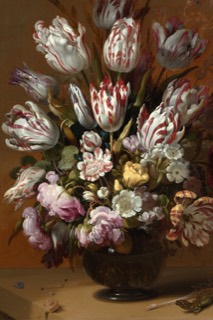
Just then the Tulip Society of Haarlem offered a prize for the discovery (we dare not say the manufacture) of a large black tulip without a spot of colour, a thing which had not yet been accomplished, and was considered impossible, as at that time there did not exist a flower of that species approaching even to a dark nut brown. It was, therefore, generally said that the founders of the prize might just as well have offered two millions as a hundred thousand guilders, since no one would be able to gain it.

The tulip-growing world, however, was thrown by it into a state of most active commotion. Some fanciers caught at the idea without believing it practicable, but such is the power of imagination among florists, that although considering the undertaking as certain to fail, all their thoughts were engrossed by that great black tulip, which was looked upon to be as chimerical as the black swan of Horace or the white raven of French tradition.

Van Baerle was one of the tulip-growers who were struck with the idea; Boxtel thought of it in the light of a speculation. Van Baerle, as soon as the idea had once taken root in his clear and ingenious mind, began slowly the necessary planting and crossbreeding to reduce the tulips which he had grown already from red to brown, and from brown to dark brown.

Keep reading from here

VIII: An Invasion

At midnight, with a beating heart, trembling hands, and a livid countenance, he descended from the tree, took a ladder, leaned it against the wall, mounted it to the last step but one, and listened.

All was perfectly quiet, not a sound broke the silence of the night; one solitary light, that of the housekeeper, was burning in the house.

This silence and this darkness emboldened Boxtel; he got astride the wall, stopped for an instant, and, after having ascertained that there was nothing to fear, he put his ladder from his own garden into that of Cornelius, and descended.

Then, knowing to an inch where the bulbs which were to produce the black tulip were planted, he ran towards the spot, following, however, the gravelled walks in order not to be betrayed by his footprints, and, on arriving at the precise spot, he proceeded, with the eagerness of a tiger, to plunge his hand into the soft ground.

He found nothing, and thought he was mistaken.

In the meanwhile, the cold sweat stood on his brow.

He felt about close by it⁠—nothing.

He felt about on the right, and on the left⁠—nothing.

He felt about in front and at the back⁠—nothing.

He was nearly mad, when at last he satisfied himself that on that very morning the earth had been disturbed.

Keep reading from here

XVII: The First Bulb

“Halloa!” said the jailer, furious, “here, you see, you are rebelling.”

“Leave me my tulip,” cried Van Baerle.

“Ah, yes, tulip,” replied the old man, “we know well the shifts of prisoners.”

“But I vow to you⁠—”

“Let go,” repeated Gryphus, stamping his foot, “let go, or I shall call the guard.”

“Call whoever you like, but you shall not have this flower except with my life.”

Gryphus, exasperated, plunged his finger a second time into the soil, and now he drew out the bulb, which certainly looked quite black; and whilst Van Baerle, quite happy to have saved the vessel, did not suspect that the adversary had possessed himself of its precious contents, Gryphus hurled the softened bulb with all his force on the flags, where almost immediately after it was crushed to atoms under his heavy shoe.

Van Baerle saw the work of destruction, got a glimpse of the juicy remains of his darling bulb, and, guessing the cause of the ferocious joy of Gryphus, uttered a cry of agony, which would have melted the heart even of that ruthless jailer who some years before killed Pelisson’s spider.

The idea of striking down this spiteful bully passed like lightning through the brain of the tulip-fancier. The blood rushed to his brow, and seemed like fire in his eyes, which blinded him, and he raised in his two hands the heavy jug with all the now useless earth which remained in it. One instant more, and he would have flung it on the bald head of old Gryphus.

Keep reading from here

10 of the best lines

The Athenians, who indeed have left behind them a pretty tolerable reputation for ingratitude, have in this respect to yield precedence to the Dutch.

I: A Grateful PeopleKeep reading from here

“To be sure,” he said. “These people are really implacable. It does no one good to offend them.”

IV: The MurderersKeep reading from here

“Yes, but I should fall on my tulips.”

VII: The Happy Man Makes Acquaintance with MisfortuneKeep reading from here

He thought of the beautiful tulips which he would see from heaven above, at Ceylon, or Bengal, or elsewhere, when he would be able to look with pity on this earth, where John and Cornelius de Witt had been murdered for having thought too much of politics, and where Cornelius van Baerle was about to be murdered for having thought too much of tulips.

XII: The ExecutionKeep reading from here

Did he do so because the hand kept one of the bulbs of the great black tulip, or because this hand was Rosa’s? We shall leave this point to the decision of wiser heads than ours.

XVI: Master and PupilKeep reading from here

Cornelius confessed to himself, sighing, that woman was not perfect.

XXI: The Second BulbKeep reading from here

To the President of the Horticultural Society the Tulipa nigra was a first-rate power, which, in its character as queen of the tulips, might send ambassadors.

XXV: The President Van SystensKeep reading from here

There is nothing more galling to angry people than the coolness of those on whom they wish to vent their spleen.

XXVIII: The Hymn of the FlowersKeep reading from here

This is the place for the multitude, which with true philosophic spirit, waits until the triumphal pageants have passed, to know what to say of them, and sometimes also to know what to do.

XXXI: HaarlemKeep reading from here

She would have been a spectre spoiling the joy of the festival for him, just as Banquo’s ghost did that of Macbeth.

XXXI: HaarlemKeep reading from here

All 37 The Black Tulip quotes, with the words around each

Reviews

No reviews yet. Be the first, in the app.

Write a review in Doomreader

Contents

All 33 parts
  1. I: A Grateful People
  2. II: The Two Brothers
  3. III: The Pupil of John de Witt
  4. IV: The Murderers
  5. V: The Tulip-Fancier and His Neighbour
  6. VI: The Hatred of a Tulip-Fancier
  7. VII: The Happy Man Makes Acquaintance with Misfortune
  8. VIII: An Invasion
  9. IX: The Family Cell
  10. X: The Jailer’s Daughter
  11. XI: Cornelius van Baerle’s Will
  12. XII: The Execution
  13. XIII: What Was Going on All This Time in the Mind of One of the Spectators
  14. XIV: The Pigeons of Dort
  15. XV: The Little Grated Window
  16. XVI: Master and Pupil
  17. XVII: The First Bulb
  18. XVIII: Rosa’s Lover
  19. XIX: The Maid and the Flower
  20. XX: The Events Which Took Place During Those Eight Days
  21. XXI: The Second Bulb
  22. XXII: The Opening of the Flower
  23. XXIII: The Rival
  24. XXIV: The Black Tulip Changes Masters
  25. XXV: The President Van Systens
  26. XXVI: A Member of the Horticultural Society
  27. XXVII: The Third Bulb
  28. XXVIII: The Hymn of the Flowers
  29. XXIX: In Which Van Baerle, Before Leaving Loewestein, Settles Accounts with Gryphus
  30. XXX: Wherein the Reader Begins to Guess the Kind of Execution That Was Awaiting Van Baerle
  31. XXXI: Haarlem
  32. XXXII: A Last Request
  33. XXXIII: Conclusion

Listen to The Black Tulip free

The Black Tulip as a free audiobook: Doomreader reads any book aloud, free, in your phone's or computer's own voice. Open the book and tap listen, at the speed you like, hands free.

Want a more natural voice? The AI voices read with AI credits.

Listen free in Doomreader

Download The Black Tulip free

The whole book as an EPUB file, free and legal, from Standard Ebooks. It opens in any ebook app, or read it here in Doomreader with nothing to install.

Download the EPUB (0.9 MB)

More by Alexandre Dumas

More like The Black Tulip

About this edition

Text from Standard Ebooks. Standard Ebooks dedicate their edition to the public domain (CC0 1.0). Every passage and line on this page is the book's own words, checked against the text.