Doomreader

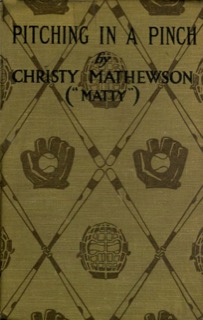
Pitching in a Pinch

by Christy Mathewson

Length: 66,077 words, about 264 pages, about 5 hours to read

Sport and games

Read Pitching in a Pinch free, starting with its best pages and lines below. Listen to it free too, read aloud by your phone's own voice.

The best passages

Pages from the book itself, chosen to make you want to read on. Each opens in the reader at that exact spot.

The Most Dangerous Batters I Have Met

be Fooled by a Change of Pace, and “Hans” Wagner’s Only “Groove” Is a Base on Balls—“Inside” Information on All the Great Batters.

I have often been asked to which batters I have found it hardest to pitch.

It is the general impression among baseball fans that Joseph Faversham Tinker, the short-stop of the Chicago Cubs, is the worst man that I have to face in the National League. Few realize that during his first two years in the big show Joe Tinker looked like a cripple at the plate when I was pitching. His “groove” was a slow curve over the outside corner, and I fed him slow curves over that very outside corner with great regularity. Then suddenly, overnight, he became from my point of view the most dangerous batter in the League.

Tinker is a clever ball-player, and one day I struck him out three times in succession with low curves over the outside corner. Instead of getting disgusted with himself, he began to think and reason. He knew that I was feeding him that low curve over the outside corner, and he started to look for an antidote. He had always taken a short, choppy swing at the ball. When he went to the clubhouse after the game in which he struck out three times, he was very quiet, so I have been told. He was just putting on his last sock when he clapped his hand to his leg and exclaimed:

“I’ve got it.”

“Got what?” asked Johnny Evers, who happened to be sitting next to Tinker.

“Got the way to hit Matty, who had me looking as if I came from the home for the blind out there to-day,” answered Joe.

Keep reading from here

Big League Pitchers and Their Peculiarities.

Just after the season closed, “Tacks” Ashenbach, the scout for the Cincinnati club, now dead, and formerly a manager in the league where Coveleski got his start, came to McGraw and laughed behind his hand.

“Mac,” he said, “I’m surprised you let that big Pole beat you out of a championship. I can give you the prescription to use every time that he starts working. All you have to do is to imitate a snare drum.”

“What are you trying to do—kid me?” asked McGraw, for he was still tolerably irritable over the outcome of the season.

“Try it,” was Ashenbach’s laconic reply.

The result was that the first game Coveleski started against the Giants the next season, there was a chorus of “rat-a-tat-tats” from the bench, with each of the coachers doing a “rat-a-tat-tat” solo, for we decided, after due consideration, this was the way to imitate a snare drum. We would have tried to imitate a calliope if we had thought that it would have done any good against this pitcher.

“I’ll hire a fife and drum corps if the tip is worth anything,” declared McGraw.

“Rat-a-tat-tat! Rat-a-tat-tat!” came the chorus as Coveleski wound up to pitch the first ball. It went wide of the plate.

Keep reading from here

Umpires and Close Decisions

“Larry” Doyle thought that he had received the raw end of a decision at second base one day. He ran down to first, where Klem had retreated after he passed his judgment.

“Say, ‘Bill,’” exploded “Larry,” “that man didn’t touch the bag—didn’t come within six feet of it.”

“Say, Doyle,” replied Klem, “when you talk to me call me ‘Mr. Klem.’”

“But, Mr. Klem—” amended “Larry.”

Klem hurriedly drew a line with his foot as Doyle approached him menacingly.

“But if you come over that line, you’re out of the game, Mr. Doyle,” he threatened.

“All right,” answered “Larry,” letting his pugilistic attitude evaporate before the abruptness of Klem as the mist does before the classic noonday sun, “but, Mr. Klem, I only wanted to ask you if that clock in centre field is right by your watch, because I know everything about you is right.”

“Larry” went back, grinning and considering that he had put one over on Klem—Mr. Klem.

Keep reading from here

Umpires and Close Decisions

That was a case of where a decision in my favor “made me sick.”

“Tim” Hurst, the old American League umpire, was one of the most picturesque judges that ever spun an indicator. He was the sort who would take a player at his word and fight him blow for blow. “Tim” was umpiring in Baltimore in the old days when there was a runner on first base.

“The man started to steal,” says “Tim.” He was telling the story only the other day in McGraw’s billiard room in New York, and it is better every time he does it. “As he left the bag he spiked the first baseman and that player attempted to trip him. The second baseman blocked the runner and, in sliding into the bag, the latter tried to spike ‘Hugh’ Jennings, who was playing shortstop and covering, while Jennings sat on him to knock the wind out. The batter hit Robinson, who was catching, on the hands with his bat so that he couldn’t throw, and ‘Robbie’ trod on my toes with his spikes and shoved his glove into my face so that I couldn’t see to give the decision. It was one of the hardest that I have ever been called upon to make.”

“What did you do?” I asked him.

“I punched ‘Robbie’ in the ribs, called it a foul and sent the runner back,” replied “Tim.”

Keep reading from here

Jinxes and What They Mean to a Ball-Player

Once more, the old confidence, hitched up with ability.

What manager would have carried a Kansas farmer around the circuit with him besides McGraw? I refer to Charles Victor Faust of Marion, Kansas, the most famous jinx killer of them all. Faust first met the Giants in St. Louis on the next to the last trip the club made West in the season of 1911, when he wandered into the Planter’s Hotel one day, asked for McGraw and announced that a fortune teller of Marion had informed him he would be a great pitcher and that for $5 he could have a full reading. This pitching announcement piqued Charles, and he reached down into his jeans, dug out his last five, and passed it over. The fortune teller informed Faust that all he had to do to get into the headlines of the newspapers and to be a great pitcher was to join the New York Giants. He joined, and, after he once joined, it would have taken the McNamaras in their best form to separate him from the said Giants.

“Charley” came out to the ball park and amused himself warming up. Incidentally, the Giants did not lose a game while he was in the neighborhood. The night the club left for Chicago on that trip, he was down at the Union Station ready to go along.

“Did you get your contract and transportation?” asked McGraw, as the lanky Kansan appeared.

Keep reading from here

10 of the best lines

“A base on balls,” replied Warner, without cracking a smile.

The Most Dangerous Batters I Have MetKeep reading from here

“Say,” replied “Josh,” “I’d hire out to let them pitch baseballs at me if none could throw harder than that guy.”

“Take Him Out”Keep reading from here

“He’s got a spine like a charlotte russe,” declared “Mac,” after his second peek, and he passed him back to the bushes.

Pitching in a PinchKeep reading from here

“Eagle Eye” was unconscious for two days after that and in the hospital several weeks.

Honest and Dishonest Sign StealingKeep reading from here

“Kill him! He hasn’t got any friends!” is an expression shouted from the stands time and again during a game.

Umpires and Close DecisionsKeep reading from here

“I would not have made that hit for my year’s salary if I could have helped it.”

The Game that Cost a PennantKeep reading from here

The spring training is just one darned drink after another and still the player is always thirsty.

When the Teams Are in Spring TrainingKeep reading from here

Luck is a combination of confidence and getting the breaks.

Jinxes and What They Mean to a Ball-PlayerKeep reading from here

Being a great ball-player is the gentle art of getting away with it.

Base Runners and How They Help a Pitcher to WinKeep reading from here

“Don’t fall for all the good lookers, Sam,” suggested McGraw, the philosopher.

Notable Instances Where the “Inside” Game Has FailedKeep reading from here

All 33 Pitching in a Pinch quotes, with the words around each

Reviews

No reviews yet. Be the first, in the app.

Write a review in Doomreader

Contents

All 30 parts
  1. PITCHING IN A PINCH
  2. OR BASEBALL FROM THE INSIDE
  3. INTRODUCTION
  4. Pitching in a Pinch
  5. Chapter I
  6. The Most Dangerous Batters I Have Met
  7. Chapter II
  8. “Take Him Out”
  9. Chapter III
  10. Pitching in a Pinch
  11. Chapter IV
  12. Big League Pitchers and Their Peculiarities.
  13. Chapter V
  14. Playing the Game from the Bench
  15. Chapter VI
  16. Coaching Good and Bad
  17. Chapter VII
  18. Honest and Dishonest Sign Stealing
  19. Chapter VIII
  20. Umpires and Close Decisions
  21. Chapter IX
  22. The Game that Cost a Pennant
  23. Chapter X
  24. When the Teams Are in Spring Training
  25. Chapter XI
  26. Jinxes and What They Mean to a Ball-Player
  27. Chapter XII
  28. Base Runners and How They Help a Pitcher to Win
  29. Chapter XIII
  30. Notable Instances Where the “Inside” Game Has Failed

Listen to Pitching in a Pinch free

Pitching in a Pinch as a free audiobook: Doomreader reads any book aloud, free, in your phone's or computer's own voice. Open the book and tap listen, at the speed you like, hands free.

Want a more natural voice? The AI voices read with AI credits.

Listen free in Doomreader

Download Pitching in a Pinch free

The whole book as an EPUB file, free and legal, from Project Gutenberg. It opens in any ebook app, or read it here in Doomreader with nothing to install.

Download the EPUB (0.4 MB)

More like Pitching in a Pinch

About this edition

Text from Project Gutenberg. In the public domain in the USA. The Project Gutenberg License is kept inside the file. Every passage and line on this page is the book's own words, checked against the text.