Doomreader

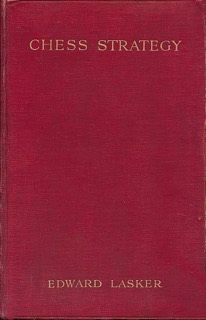
Chess Strategy

by Edward Lasker

Length: 64,859 words, about 259 pages, about 5 hours to read

Sport and games

Read Chess Strategy free, starting with its best pages and lines below. Listen to it free too, read aloud by your phone's own voice.

The best passages

Pages from the book itself, chosen to make you want to read on. Each opens in the reader at that exact spot.

CHAPTER II HINTS FOR BEGINNERS—ELEMENTARY COMBINATIONS

THE mental development of the chess player is a gradual struggle from a state of chaos to a clear conception of the game. The period required for such development largely depends upon the special gifts the learner may possess, but in the main the question of methods predominates. Most beginners do not trouble very much about any particular plan in their study of chess, but as soon as they have learnt the moves, rush into the turmoil of practical play. It is self-evident that their prospects under such conditions cannot be very bright. The play of a beginner is planless, because he has too many plans, and the capacity for subordinating all his combinations to one leading idea is non- existent. Yet it cannot be denied upon investigation that a certain kind of method is to be found in the play of all beginners, and seems to come to them quite naturally. At first the pawns are pushed forward frantically, because there is no appreciation of the power and value of the pieces. Conscious of the inferiority of the pawns, the beginner does not conclude that it must be advantageous to employ the greater power of the pieces, but is chiefly concerned with attacking the opposing pieces with his pawns in the hope of capturing them. His aim is not to develop his own forces, but to weaken those of his opponent. His combinations are made in the hope that his adversary may not see through them, nor does he trouble much about his opponent’s intentions.
Keep reading from here

CHAPTER IV THE OPENING

The only pieces available on the first move are the Knights. In order to develop other pieces as well, it is necessary to move pawns first, and such pawn moves will be best as give an outlet to as many pieces as possible. For quick development is of the utmost importance, and he who succeeds first in placing all his pieces, from their initial awkward positions, to such places as give them command of the greatest possible number of squares, has the better chance of concentrating a superior force on some important point.

It follows that White, having the first move, is, so to speak, always morally justified in attacking, whilst Black should assume the defensive. It is a step in the right direction, to appreciate the truth of this proposition. Unfortunately most beginners fail to realise it, and so pave the way, from the first, to the loss of the game.

There are not many developing pawn moves to choose from. Apparently from the point of view of quick development only P-K4 and P-Q4 need be considered, since they free both Bishop and Queen, whilst other pawn moves liberate one piece only. Generally speaking it is only required to move two or three pawns to allow all pieces to be developed, and it is good, on principle, to make only such pawn moves in the opening, which are necessary for the development of pieces. To play other pawns really means the loss of a move. To “lose a move” means to make a move which is not essential to the attainment of a desired position.

Keep reading from here

GENERAL REMARKS

HAVING now a fair knowledge of the end-game, we should be in a position to appreciate how the middle game should be conducted. We must throughout maintain a favourable pawn formation, in view of the end-game which might be forced on us by exchanges. On the other hand, as soon as we have gained an advantage sufficient to secure the victory in the end-game, we must ourselves, by the exchange of pieces, try to reduce the position to one of the typical elementary cases which we have discussed. Now it will invariably be found that beginners are unwilling to make these essential exchanges. This is explained by the attraction which combinations involving the action of many pieces have for them. They assume that exchanges, particularly of the Queens, make the games dull. Such ideas only prove that the beginner has not grasped the nature of chess, the essence of which is stern logic and uncompromising conclusions, and this demands the shortest and clearest way leading to a mate. To the strong player, able to play logically, logic will always be inseparable from beauty in chess.

To play logically means to subordinate all combinations to a leading plan of campaign, but there is difficulty in finding the latter. An unsound scheme, even if worked out to its logical conclusion, can of course be of no value. All the same it is better than no plan at all. And in time one gains by experience, and develops a sort of instinct for rejecting from the large number of possible operations all those which, properly countered, cannot bring any advantage.

Keep reading from here

10 of the best lines

The play of a beginner is planless, because he has too many plans, and the capacity for subordinating all his combinations to one leading idea is non- existent.

CHAPTER II HINTS FOR BEGINNERS—ELEMENTARY COMBINATIONSKeep reading from here

It is a good habit to look upon every pawn as a prospective Queen.

CHAPTER II HINTS FOR BEGINNERS—ELEMENTARY COMBINATIONSKeep reading from here

On the other hand, victory is often brought about by a timely sacrifice of material.

CHAPTER II HINTS FOR BEGINNERS—ELEMENTARY COMBINATIONSKeep reading from here

Pawn formation is of a more permanent character than that of the pieces, in consequence of the latter’s greater mobility.

CHAPTER IV THE OPENINGKeep reading from here

Once a pawn has moved it cannot turn back, and only after the greatest deliberation should we embark on changes in our pawn formation in order not to disturb the balance of this “static element” of the game.

CHAPTER IV THE OPENINGKeep reading from here

To the strong player, able to play logically, logic will always be inseparable from beauty in chess.

GENERAL REMARKSKeep reading from here

An unsound scheme, even if worked out to its logical conclusion, can of course be of no value. All the same it is better than no plan at all.

GENERAL REMARKSKeep reading from here

The game shows conclusively how important it is to maintain the centre.

GAME No. 21Keep reading from here

Both players have shown a deep positional insight, and the game shows in an interesting manner how a preponderance of material can be counterbalanced by the greater mobility of the pieces.

GAME No. 34Keep reading from here

Generally speaking it is wise, in R endings like the present one, to advance pawns on the side where there is an extra pawn, in order to get a passed pawn as soon as possible.

GAME No. 40Keep reading from here

All 12 Chess Strategy quotes, with the words around each

Reviews

No reviews yet. Be the first, in the app.

Write a review in Doomreader

Contents

All 76 parts
  1. TRANSLATOR’S PREFACE
  2. AUTHOR’S PREFACE
  3. PART I
  4. CHAPTER I. INTRODUCTORY
  5. I. RULES OF THE GAME
  6. II. NOTATION
  7. CHAPTER II HINTS FOR BEGINNERS—ELEMENTARY COMBINATIONS
  8. CHAPTER III GENERAL PRINCIPLES OF CHESS STRATEGY
  9. CHAPTER IV THE OPENING
  10. I. CENTRE GAMBIT
  11. II. KING’S BISHOP’S OPENING
  12. III. SCOTCH GAMBIT
  13. IV. SCOTCH GAME
  14. IRREGULAR OPENINGS
  15. CHAPTER V THE END-GAME
  16. END-GAMES FROM MASTER PLAY
  17. 1. FROM A GAME TEICHMANN-BLACKBURNE (BERLIN, 1897).
  18. II. FROM A GAME ED. LASKER-ROTLEVI (HAMBURG, 1910).
  19. IV. FROM A GAME BIRD-JANOWSKI.
  20. V. FROM A GAME STEINER-FORGACZ (SZEKESFEHERVAR, 1907).
  21. VI. FROM A GAME CHAROUSEK-HEINRICHSEN (COLOGNE, 1898).
  22. CHAPTER VI THE MIDDLE GAME
  23. GENERAL REMARKS
  24. PART II ILLUSTRATIVE GAMES FROM MASTER TOURNAMENTS
  25. GAME No. 1
  26. GAME No. 2
  27. GAME No. 3
  28. GAME No. 4
  29. GAME No. 5
  30. GAME No. 6
  31. GAME No. 7
  32. GAME No. 8
  33. GAME No. 9
  34. GAME No. 10
  35. GAME No. 11
  36. GAME No. 12
  37. GAME No. 13
  38. GAME No. 14
  39. GAME No. 15
  40. GAME No. 16
  41. GAME No. 17
  42. GAME No. 18
  43. GAME No. 19
  44. GAME No. 20
  45. GAME No. 21
  46. GAME No. 22
  47. GAME No. 23
  48. GAME No. 24
  49. GAME No. 25
  50. GAME No. 26
  51. GAME No. 27
  52. GAME No. 28
  53. GAME No. 29
  54. GAME No. 30
  55. GAME No. 31
  56. GAME No. 32
  57. GAME No. 33
  58. GAME No. 34
  59. GAME No. 35
  60. GAME No. 36
  61. GAME No. 37
  62. GAME No. 38
  63. GAME No. 39
  64. GAME No. 40
  65. GAME No. 41
  66. GAME No. 42
  67. GAME No. 43
  68. GAME No. 44
  69. GAME No. 45
  70. GAME No. 46
  71. GAME No. 47
  72. GAME No. 48
  73. TABLE OF OPENINGS
  74. A. KING’S PAWN GAMES
  75. B. QUEEN’S PAWN GAMES
  76. C. IRREGULAR OPENINGS 1. P-QB4 1. P-KB4 P-Q4 1. … P-K4 1. P-K3 P-Q3

Listen to Chess Strategy free

Chess Strategy as a free audiobook: Doomreader reads any book aloud, free, in your phone's or computer's own voice. Open the book and tap listen, at the speed you like, hands free.

Want a more natural voice? The AI voices read with AI credits.

Listen free in Doomreader

Download Chess Strategy free

The whole book as an EPUB file, free and legal, from Project Gutenberg. It opens in any ebook app, or read it here in Doomreader with nothing to install.

Download the EPUB (0.2 MB)

More like Chess Strategy

About this edition

Text from Project Gutenberg. In the public domain in the USA. The Project Gutenberg License is kept inside the file. Every passage and line on this page is the book's own words, checked against the text.