Doomreader

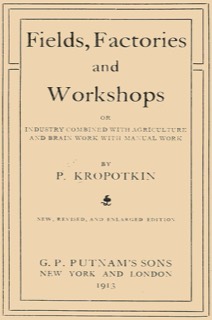
Fields, Factories and Workshops

by Peter Kropotkin

Length: 110,441 words, about 442 pages, about 8 hours to read

Economics, Politics and society

Read Fields, Factories and Workshops free, starting with its best pages and lines below. Listen to it free too, read aloud by your phone's own voice.

The best passages

Pages from the book itself, chosen to make you want to read on. Each opens in the reader at that exact spot.

CHAPTER I. THE DECENTRALISATION OF INDUSTRIES.

Division of labour and integration—The spread of industrial skill—Each nation its own producer of manufactured goods—The United Kingdom—France—Germany—Russia—“German competition.”

Who does not remember the remarkable chapter by which Adam Smith opens his inquiry into the nature and causes of the wealth of nations? Even those of our contemporary economists who seldom revert to the works of the father of political economy, and often forget the ideas which inspired them, know that chapter almost by heart, so often has it been copied and recopied since. It has become an article of faith; and the economical history of the century which has elapsed since Adam Smith wrote has been, so to speak, an actual commentary upon it.

“Division of labour” was its watchword. And the division and subdivision—the permanent subdivision—of functions has been pushed so far as to divide humanity into castes which are almost as firmly established as those of old India. We have, first, the broad division into producers and consumers: little-consuming producers on the one hand, little-producing consumers on the other hand. Then, amidst the former, a series of further subdivisions: the manual worker and the intellectual worker, sharply separated from one another to the detriment of both; the agricultural labourers and the workers in the manufacture; and, amidst the mass of the latter, numberless subdivisions again—so minute, indeed, that the modern ideal of a workman seems to be a man or a woman, or even a girl or a boy, without the knowledge of any handicraft, without any conception whatever of the industry he or she is employed in, who is only capable of making all day long and for a whole life the same infinitesimal part of something:


Keep reading from here

CHAPTER III. THE POSSIBILITIES OF AGRICULTURE.

I once took a knapsack and went on foot out of London, through Sussex. I had read Léonce de Lavergne’s work and expected to find a soil busily cultivated; but neither round London nor still less further south did I see men in the fields. In the Weald I could walk for twenty miles without crossing anything but heath or woodlands, rented as pheasant-shooting grounds to “London gentlemen,” as the labourers said. “Ungrateful soil” was my first thought; but then I would occasionally come to a farm at the crossing of two roads and see the same soil bearing a rich crop; and my next thought was tel seigneur, telle terre, as the French peasants say. Later on I saw the rich fields of the midland counties; but even there I was struck by not perceiving the same busy human labour which I was accustomed to admire on the Belgian and French fields. But I ceased to wonder when I learnt that only 1,383,000 men and women in England and Wales work in the fields, while more than 16,000,000 belong to the “professional, domestic, indefinite, and unproductive class,” as these pitiless statisticians say. One million human beings cannot productively cultivate an area of 33,000,000 acres, unless they can resort to the Bonanza farm’s methods of culture.

Keep reading from here

CHAPTER III. THE POSSIBILITIES OF AGRICULTURE.

The most striking fact is, however, that in some undoubtedly fertile parts of the country things are even in a worse condition. My heart simply ached when I saw the state in which land is kept in South Devon, and when I learned to know what “permanent pasture” means. Field after field is covered with nothing but grass, three inches high, and thistles in profusion. Twenty, thirty such fields can be seen at one glance from the top of every hill; and thousands of acres are in that state, notwithstanding that the grandfathers of the present generation have devoted a formidable amount of labour to the clearing of that land from the stones, to fencing it, roughly draining it and the like. In every direction I could see abandoned cottages and orchards going to ruin. A whole population has disappeared, and even its last vestiges must disappear if things continue to go on as they have gone. And this takes place in a part of the country endowed with a most fertile soil and possessed of a climate which is certainly more congenial than the climate of Jersey in spring and early summer—a land upon which even the poorest cottagers occasionally raise potatoes as early as the first half of May. But how can that land be cultivated when there is nobody to cultivate it? “We have fields; men go by, but never go in,” an old labourer said to me; and so it is in reality.[41]

Such were my impressions of British agriculture twenty years ago.

Keep reading from here

CHAPTER III. THE POSSIBILITIES OF AGRICULTURE.

French Gardening.—The above examples are striking enough, and yet those afforded by the market-gardening culture are still more striking. I mean the culture carried on in the neighbourhood of big cities, and more especially the culture maraîchère round Paris. In this culture each plant is treated according to its age. The seeds germinate and the seedlings develop their first four leaflets in especially favourable conditions of soil and temperature; then the best seedlings are picked out and transplanted into a bed of fine loam, under a frame or in the open air, where they freely develop their rootlets, and, gathered on a limited space, receive more than the usual care. Only after this preliminary training are they bedded in the open ground, where they grow till ripe. In such a culture the primitive condition of the soil is of little account, because loam is made out of the old forcing beds. The seeds are carefully tried, the seedlings receive proper attention, and there is no fear of drought, because of the variety of crops, the liberal watering with the help of a steam engine, and the stock of plants always kept ready to replace the weakest individuals. Almost each plant is treated individually.

There prevails, however, with regard to market-gardening, a misunderstanding which it would be well to remove. It is generally supposed that what chiefly attracts market-gardening to the great centres of population is the market. It must have been so; and so it may be still, but to some extent only.

Keep reading from here

CHAPTER VIII. BRAIN WORK AND MANUAL WORK.

In olden times men of science, and especially those who have done most to forward the growth of natural philosophy, did not despise manual work and handicraft. Galileo made his telescopes with his own hands. Newton learned in his boyhood the art of managing tools; he exercised his young mind in contriving most ingenious machines, and when he began his researches in optics he was able himself to grind the lenses for his instruments, and himself to make the well-known telescope, which, for its time, was a fine piece of workmanship. Leibnitz was fond of inventing machines: windmills and carriages to be moved without horses preoccupied his mind as much as mathematical and philosophical speculations. Linnæus became a botanist while helping his father—a practical gardener—in his daily work. In short, with our great geniuses handicraft was no obstacle to abstract researches—it rather favoured them. On the other hand, if the workers of old found but few opportunities for mastering science, many of them had, at least, their intelligences stimulated by the very variety of work which was performed in the then unspecialised workshops; and some of them had the benefit of familiar intercourse with men of science. Watt and Rennie were friends with Professor Robinson; Brindley, the road-maker, despite his fourteenpence-a-day wages, enjoyed intercourse with educated men, and thus developed his remarkable engineering faculties; the son of a well-to-do family could “idle” at a wheel-wright’s shop, so as to become later on a Smeaton or a Stephenson.

Keep reading from here

10 of the best lines

Knowledge ignores artificial political boundaries.

CHAPTER I. THE DECENTRALISATION OF INDUSTRIES.Keep reading from here

Woe to Europe, if on the day that the steam engine invades China she is still relying on foreign customers!

CHAPTER II. THE DECENTRALISATION OF INDUSTRIES—(continued).Keep reading from here

Man, not nature, has given to the Belgium soil its present productivity.

CHAPTER III. THE POSSIBILITIES OF AGRICULTURE.Keep reading from here

Few books have exercised so pernicious an influence upon the general development of economic thought as Malthus’s Essay on the Principle of Population exercised for three consecutive generations.

CHAPTER IV. THE POSSIBILITIES OF AGRICULTURE—(continued).Keep reading from here

The furniture palaces and bazaars are thus merely playing the part which the feudal castle formerly played in agriculture: they centralise the profits—not the production.

The Small Industries in the United Kingdom.Keep reading from here

Agriculture cannot be carried on without additional hands in the summer; but it still more needs temporary aids for improving the soil, for tenfolding its productive powers.

Conclusions.Keep reading from here

Waste of time is the leading feature of our present education.

CHAPTER VIII. BRAIN WORK AND MANUAL WORK.Keep reading from here

Men of science invent no more, or very little.

CHAPTER VIII. BRAIN WORK AND MANUAL WORK.Keep reading from here

And such a community would not know misery amidst wealth.

CHAPTER VIII. BRAIN WORK AND MANUAL WORK.Keep reading from here

Economists have been too hasty in celebrating their death.

W.—RESULTS OF THE CENSUS OF THE FRENCH INDUSTRIES IN 1896.Keep reading from here

All 36 Fields, Factories and Workshops quotes, with the words around each

Reviews

No reviews yet. Be the first, in the app.

Write a review in Doomreader

Contents

All 52 parts
  1. PREFACE.
  2. PREFACE TO FIRST EDITION.
  3. CHAPTER I. THE DECENTRALISATION OF INDUSTRIES.
  4. FOOTNOTES:
  5. CHAPTER II. THE DECENTRALISATION OF INDUSTRIES—(continued).
  6. FOOTNOTES:
  7. CHAPTER III. THE POSSIBILITIES OF AGRICULTURE.
  8. FOOTNOTES:
  9. CHAPTER IV. THE POSSIBILITIES OF AGRICULTURE—(continued).
  10. FOOTNOTES:
  11. CHAPTER V. THE POSSIBILITIES OF AGRICULTURE—(continued).
  12. FOOTNOTES:
  13. CHAPTER VI. SMALL INDUSTRIES AND INDUSTRIAL VILLAGES.
  14. The Small Industries in the United Kingdom.
  15. Petty Trades in France.
  16. FOOTNOTES:
  17. CHAPTER VII. SMALL INDUSTRIES AND INDUSTRIAL VILLAGES (continued).
  18. Petty Trades in Germany.
  19. Petty Trades in other Countries.
  20. Conclusions.
  21. FOOTNOTES:
  22. CHAPTER VIII. BRAIN WORK AND MANUAL WORK.
  23. FOOTNOTES:
  24. CHAPTER IX. CONCLUSION.
  25. FOOTNOTE:
  26. APPENDIX.
  27. A.—BRITISH INVESTMENTS ABROAD.
  28. B.—FRENCH IMPORTS.
  29. C.—GROWTH OF INDUSTRY IN RUSSIA.
  30. D.—IRON INDUSTRY IN GERMANY.
  31. E.—MACHINERY IN GERMANY.
  32. F.—COTTON INDUSTRY IN GERMANY.
  33. G.—MINING AND TEXTILES IN AUSTRIA.
  34. H.—COTTON MANUFACTURE IN INDIA.
  35. I.—THE COTTON INDUSTRY IN THE UNITED STATES.
  36. J.—MR. GIFFEN’S AND MR. FLUX’S FIGURES CONCERNING THE POSITION OF THE UNITED KINGDOM IN INTERNATIONAL TRADE.
  37. K.—MARKET-GARDENING IN BELGIUM.
  38. L.—THE CHANNEL ISLANDS—THE SCILLY ISLANDS.
  39. M.—IRRIGATED MEADOWS IN ITALY.
  40. N.—PLANTED WHEAT.
  41. O.—REPLANTED WHEAT.
  42. P.—IMPORTS OF VEGETABLES TO THE UNITED KINGDOM.
  43. Q.—FRUIT-CULTURE IN BELGIUM.
  44. R.—CULTURE UNDER GLASS IN HOLLAND.
  45. S.—PRICES OBTAINED IN LONDON FOR DESSERT GRAPES CULTIVATED UNDER GLASS.
  46. T.—THE USE OF ELECTRICITY IN AGRICULTURE.
  47. U.—PETTY TRADES IN THE LYONS REGION.
  48. V.—SMALL INDUSTRIES AT PARIS.
  49. W.—RESULTS OF THE CENSUS OF THE FRENCH INDUSTRIES IN 1896.
  50. X.—THE SMALL INDUSTRIES IN GERMANY.
  51. Y.—THE DOMESTIC INDUSTRIES IN SWITZERLAND.
  52. FOOTNOTES:

Listen to Fields, Factories and Workshops free

Fields, Factories and Workshops as a free audiobook: Doomreader reads any book aloud, free, in your phone's or computer's own voice. Open the book and tap listen, at the speed you like, hands free.

Want a more natural voice? The AI voices read with AI credits.

Listen free in Doomreader

Download Fields, Factories and Workshops free

The whole book as an EPUB file, free and legal, from Project Gutenberg. It opens in any ebook app, or read it here in Doomreader with nothing to install.

Download the EPUB (1.4 MB)

More by Peter Kropotkin

More like Fields, Factories and Workshops

About this edition

Text from Project Gutenberg. In the public domain in the USA. The Project Gutenberg License is kept inside the file. Every passage and line on this page is the book's own words, checked against the text.