Chapter I
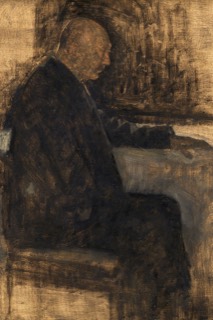
On this 26th day of April, 1794, which in the newly constituted calendar is the 7th Floreal, year II of the Republic, three women and one man were assembled in a small, closely curtained room on the top floor of a house in the Rue de la Planchette, which is situated in a remote and dreary quarter of Paris. The man sat upon a chair which was raised on a dais. He was neatly, indeed immaculately, dressed, in dark cloth coat and tan breeches, with clean linen at throats and wrists, white stockings and buckled shoes. His own hair was concealed under a mouse-coloured wig. He sat quite still, with one leg crossed over the other, and his thin, bony hands were clasped in front of him.
Behind the dais there was a heavy curtain which stretched right across the room, and in front of it, at opposite corners, two young girls, clad in grey, clinging draperies, sat upon their heels, with the palms of their hands resting flat upon their thighs. Their hair hung loose down their backs, their chins were uplifted, their eyes fixed, their bodies rigid in an attitude of contemplation. In the centre of the room a woman stood, gazing upwards at the ceiling, her arms folded across her breast. Her grey hair, lank and unruly, was partially hidden by an ample floating veil of an indefinite shade of grey, and from her meagre shoulders and arms, her garment—it was hardly a gown—descended in straight, heavy, shapeless folds. In front of her was a small table, on it a large crystal globe, which rested on a stand of black wood, exquisitely carved and inlaid with mother-of-pearl, and beside it a small metal box.