Doomreader

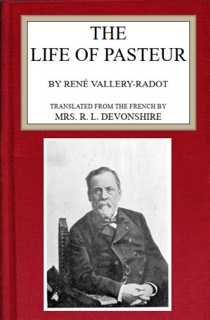
The Life of Pasteur

by René Vallery-Radot

Length: 189,910 words, about 760 pages, about 13 hours to read

Lives and letters, Science and nature

Read The Life of Pasteur free, starting with its best pages and lines below. Listen to it free too, read aloud by your phone's own voice.

The best passages

Pages from the book itself, chosen to make you want to read on. Each opens in the reader at that exact spot.

CHAPTER I 1822—1843

When Louis Pasteur reached Paris he did not feel like Balzac’s student hero, confidently defying the great city. In spite of the strong will already visible in his pensive features, his grief was too deep to be reasoned away. No one at first suspected this; he was a reserved youth, with none of the desire to talk which leads weak natures to ease their sorrows by pouring them out; but, when all was quiet in the Impasse des Feuillantines and his sleeping comrades could not break in upon his regrets, he would lie awake for hours thinking of his home and repeating the mournful line—

How endless unto watchful anguish Night doth seem.

The students of the Barbet school attended the classes of the Lycée St. Louis. In spite of his willingness and his passionate love of study, Louis was overcome with despair at being away from home. Never was homesickness more acute. “If I could only get a whiff of the tannery yard,” he would say to Jules Vercel, “I feel I should be cured.” M. Barbet endeavoured in vain to amuse and turn the thoughts of this lad of fifteen so absorbed in his sorrow. At last he thought it his duty to warn the parents of this state of mind, which threatened to become morbid.

One morning in November Louis Pasteur was told with an air of mystery that he was wanted. “They are waiting for you close by,” said the messenger, indicating a small café at the corner of the street. Louis entered and found a man sitting at a small table at the back of the shop, his face in his hands. It was his father. “I have come to fetch you,” he said simply.
Keep reading from here

CHAPTER II 1844—1849

With anxious and beating heart he proceeded to this experiment with the polarizing apparatus and exclaimed, “I have it!” His excitement was such that he could not look at the apparatus again; he rushed out of the laboratory, not unlike Archimedes. He met a curator in the passage, embraced him as he would have embraced Chappuis, and dragged him out with him into the Luxembourg garden to explain his discovery. Many confidences have been whispered under the shade of the tall trees of those avenues, but never was there greater or more exuberant joy on a young man’s lips. He foresaw all the consequences of his discovery. The hitherto incomprehensible constitution of paratartaric or racemic acid was explained; he differentiated it into righthand tartaric acid, similar in every way to the natural tartaric acid of grapes, and lefthand tartaric acid. These two distinct acids possess equal and opposite rotatory powers which neutralize each other when these two substances, reduced to an aqueous solution, combine spontaneously in equal quantities.

“How often,” he wrote to Chappuis (May 5), whom he longed to have with him, “how often have I regretted that we did not both take up the same study, that of physical science. We who so often talked of the future, we did not understand. What splendid work we could have undertaken and would be undertaking now; and what could we not have done united by the same ideas, the same love of science, the same ambition! I would we were twenty and with the three years of the Ecole before us!” Always fancying that he could have done more, he often had such retrospective regrets.

Keep reading from here

CHAPTER II 1844—1849

In Paris, in the scientific world perhaps even more than in any other, everything gets known, repeated, discussed. Pasteur’s researches were becoming a subject of conversation. Balard, with his strident voice, spoke of them in the library at the Institute, which is a sort of drawing-room for talkative old Academicians. J. B. Dumas listened gravely; Biot, old Biot, then seventy-four years old, questioned the story with some scepticism. “Are you quite sure?” he would ask, his head a little on one side, his words slow and slightly ironical. He could hardly believe, on first hearing Balard, that a new doctor, fresh from the Ecole Normale, should have overcome a difficulty which had proved too much for Mitscherlich. He did not care for long conversations with Balard, and as the latter continued to extol Pasteur, Biot said, “I should like to investigate that young man’s results.”

Besides Pasteur’s deference for all those whom he looked upon as his teachers, he also felt a sort of general gratitude for their services to Science. Partly from an infinite respect and partly from an ardent desire to convince the old scientist, he wrote on his return to Paris to Biot, whom he did not know personally, asking him for an interview. Biot answered: “I shall be pleased to verify your results if you will communicate them confidentially to me. Please believe in the feelings of interest inspired in me by all young men who work with accuracy and perseverance.”

Keep reading from here

CHAPTER V 1860—1864

When Biot heard that Pasteur wished to tackle this study of spontaneous generation, he interposed, as he had done seven years before, to arrest him on the verge of his audacious experiments on the part played by dissymmetrical forces in the development of life. Vainly Pasteur, grieved at Biot’s disapprobation, explained that this question, in the course of such researches, had become an imperious necessity; Biot would not be convinced. But Pasteur, in spite of his quasi-filial attachment to Biot, could not stop where he was; he had to go through to the end.

“You will never find your way out,” cried Biot.

“I shall try,” said Pasteur modestly.

Angry and anxious, Biot wished Pasteur to promise that he would relinquish these apparently hopeless researches. J. B. Dumas, to whom Pasteur related the more than discouraging remonstrances of Biot, entrenched himself behind this cautious phrase—

Keep reading from here

CHAPTER V 1860—1864

“Here,” he said, “is an infusion of organic matter, as limpid as distilled water, and extremely alterable. It has been prepared to-day. To-morrow it will contain animalculæ, little infusories, or flakes of mouldiness.

“I place a portion of that infusion into a flask with a long neck, like this one. Suppose I boil the liquid and leave it to cool. After a few days, mouldiness or animalculæ will develop in the liquid. By boiling, I destroyed any germs contained in the liquid or against the glass; but that infusion being again in contact with air, it becomes altered, as all infusions do. Now suppose I repeat this experiment, but that, before boiling the liquid, I draw (by means of an enameller’s lamp) the neck of the flask into a point, leaving, however, its extremity open. This being done, I boil the liquid in the flask, and leave it to cool. Now the liquid of this second flask will remain pure not only two days, a month, a year, but three or four years—for the experiment I am telling you about is already four years old, and the liquid remains as limpid as distilled water. What difference is there, then, between those two vases? They contain the same liquid, they both contain air, both are open! Why does one decay and the other remain pure? The only difference between them is this: in the first case, the dusts suspended in air and their germs can fall into the neck of the flask and arrive into contact with the liquid, where they find appropriate food and develop; thence microscopic beings.

Keep reading from here

10 of the best lines

“Blessed is he who carries within himself a God, an ideal, and who obeys it: ideal of art, ideal of science, ideal of the gospel virtues, therein lie the springs of great thoughts and great actions; they all reflect light from the Infinite.”

Chapter IIIKeep reading from here

“He throws light upon everything he touches,”

CHAPTER III 1850—1854Keep reading from here

“Gases, fluids, electricity, magnetism, ozone, things known or things occult, there is nothing in the air that is conditional to life, except the germs that it carries.”

CHAPTER V 1860—1864Keep reading from here

Laboratories and discoveries are correlative terms; if you suppress laboratories, Physical Science will become stricken with barrenness and death;

CHAPTER VI 1865—1870Keep reading from here

“Might goes before Right,” Bismarck said.

CHAPTER VII 1870—1872Keep reading from here

Let us strive, for strife is effort, strife is life when progress is the goal.

CHAPTER VIII 1873—1877Keep reading from here

How many such futile incidents, such vain quarrels, traverse the life of a great man!

CHAPTER X 1880—1882.Keep reading from here

“You aim at the microbe and you bring down the patient!”

CHAPTER XI 1882—1884Keep reading from here

“Is this all we have come such a long journey for?”

CHAPTER XIII 1885—1888Keep reading from here

“When I see a child,” he used to say, “he inspires me with two feelings: tenderness for what he is now, respect for what he may become hereafter.”

CHAPTER XIV 1889—1895Keep reading from here

All 61 The Life of Pasteur quotes, with the words around each

Reviews

No reviews yet. Be the first, in the app.

Write a review in Doomreader

Contents

  1. INTRODUCTION
  2. Chapter I
  3. Chapter II
  4. Chapter III
  5. CHAPTER I 1822—1843
  6. CHAPTER II 1844—1849
  7. CHAPTER III 1850—1854
  8. CHAPTER IV 1855—1859
  9. CHAPTER V 1860—1864
  10. CHAPTER VI 1865—1870
  11. CHAPTER VII 1870—1872
  12. CHAPTER VIII 1873—1877
  13. CHAPTER IX 1877—1879
  14. CHAPTER X 1880—1882.
  15. CHAPTER XI 1882—1884
  16. CHAPTER XII 1884—1885
  17. CHAPTER XIII 1885—1888
  18. CHAPTER XIV 1889—1895

Listen to The Life of Pasteur free

The Life of Pasteur as a free audiobook: Doomreader reads any book aloud, free, in your phone's or computer's own voice. Open the book and tap listen, at the speed you like, hands free.

Want a more natural voice? The AI voices read with AI credits.

Listen free in Doomreader

Download The Life of Pasteur free

The whole book as an EPUB file, free and legal, from Project Gutenberg. It opens in any ebook app, or read it here in Doomreader with nothing to install.

Download the EPUB (0.7 MB)

More like The Life of Pasteur

About this edition

Text from Project Gutenberg. In the public domain in the USA. The Project Gutenberg License is kept inside the file. Every passage and line on this page is the book's own words, checked against the text.