Doomreader

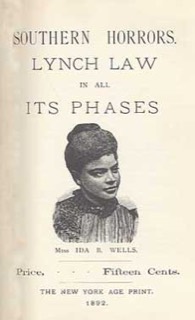
Southern Horrors: Lynch Law in All Its Phases

by Ida B. Wells

Length: 12,707 words, about 51 pages, about 53 minutes to read

Politics and society, History and travel

Read Southern Horrors: Lynch Law in All Its Phases free, starting with its best pages and lines below. Listen to it free too, read aloud by your phone's own voice.

The best passages

Pages from the book itself, chosen to make you want to read on. Each opens in the reader at that exact spot.

THE OFFENSE

Wednesday evening May 24, 1892, the city of Memphis was filled with excitement. Editorials in the daily papers of that date caused a meeting to be held in the Cotton Exchange Building; a committee was sent for the editors of the Free Speech an Afro-American journal published in that city, and the only reason the open threats of lynching that were made were not carried out was because they could not be found. The cause of all this commotion was the following editorial published in the Free Speech May 21, 1892, the Saturday previous.

Eight negroes lynched since last issue of the Free Speech one at Little Rock, Ark., last Saturday morning where the citizens broke(?) into the penitentiary and got their man; three near Anniston, Ala., one near New Orleans; and three at Clarksville, Ga., the last three for killing a white man, and five on the same old racket—the new alarm about raping white women. The same programme of hanging, then shooting bullets into the lifeless bodies was carried out to the letter.

Nobody in this section of the country believes the old thread-bare lie that Negro men rape white women. If Southern white men are not careful, they will overreach themselves and public sentiment will have a reaction; a conclusion will then be reached which will be very damaging to the moral reputation of their women.
Keep reading from here

THE BLACK AND WHITE OF IT

The Cleveland Gazette of January 16, 1892, publishes a case in point. Mrs. J.S. Underwood, the wife of a minister of Elyria, Ohio, accused an Afro-American of rape. She told her husband that during his absence in 1888, stumping the State for the Prohibition Party, the man came to the kitchen door, forced his way in the house and insulted her. She tried to drive him out with a heavy poker, but he overpowered and chloroformed her, and when she revived her clothing was torn and she was in a horrible condition. She did not know the man but could identify him. She pointed out William Offett, a married man, who was arrested and, being in Ohio, was granted a trial.

The prisoner vehemently denied the charge of rape, but confessed he went to Mrs. Underwood's residence at her invitation and was criminally intimate with her at her request. This availed him nothing against the sworn testimony of a ministers wife, a lady of the highest respectability. He was found guilty, and entered the penitentiary, December 14, 1888, for fifteen years. Some time afterwards the woman's remorse led her to confess to her husband that the man was innocent.

These are her words:

Keep reading from here

THE BLACK AND WHITE OF IT

In Natchez, Miss., Mrs. Marshall, one of the creme de la creme of the city, created a tremendous sensation several years ago. She has a black coachman who was married, and had been in her employ several years. During this time she gave birth to a child whose color was remarked, but traced to some brunette ancestor, and one of the fashionable dames of the city was its godmother. Mrs. Marshall's social position was unquestioned, and wealth showered every dainty on this child which was idolized with its brothers and sisters by its white papa. In course of time another child appeared on the scene, but it was unmistakably dark. All were alarmed, and "rush of blood, strangulation" were the conjectures, but the doctor, when asked the cause, grimly told them it was a Negro child. There was a family conclave, the coachman heard of it and leaving his own family went West, and has never returned. As soon as Mrs. Marshall was able to travel she was sent away in deep disgrace. Her husband died within the year of a broken heart.

Keep reading from here

THE BLACK AND WHITE OF IT

In Nashville, Tenn., there is a white man, Pat Hanifan, who outraged a little Afro-American girl, and, from the physical injuries received, she has been ruined for life. He was jailed for six months, discharged, and is now a detective in that city. In the same city, last May, a white man outraged an Afro-American girl in a drug store. He was arrested, and released on bail at the trial. It was rumored that five hundred Afro-Americans had organized to lynch him. Two hundred and fifty white citizens armed themselves with Winchesters and guarded him. A cannon was placed in front of his home, and the Buchanan Rifles (State Militia) ordered to the scene for his protection. The Afro-American mob did not materialize. Only two weeks before Eph. Grizzard, who had only been charged with rape upon a white woman, had been taken from the jail, with Governor Buchanan and the police and militia standing by, dragged through the streets in broad daylight, knives plunged into him at every step, and with every fiendish cruelty a frenzied mob could devise, he was at last swung out on the bridge with hands cut to pieces as he tried to climb up the stanchions. A naked, bloody example of the blood-thirstiness of the nineteenth-century civilization of the Athens of the South! No cannon or military was called out in his defense. He dared to visit a white woman.

Keep reading from here

THE MALICIOUS AND UNTRUTHFUL WHITE PRESS

On March 9, 1892, there were lynched in this same city three of the best specimens of young since-the-war Afro-American manhood. They were peaceful, law-abiding citizens and energetic business men.

They believed the problem was to be solved by eschewing politics and putting money in the purse. They owned a flourishing grocery business in a thickly populated suburb of Memphis, and a white man named Barrett had one on the opposite corner. After a personal difficulty which Barrett sought by going into the "People's Grocery" drawing a pistol and was thrashed by Calvin McDowell, he (Barrett) threatened to "clean them out." These men were a mile beyond the city limits and police protection; hearing that Barrett's crowd was coming to attack them Saturday night, they mustered forces, and prepared to defend themselves against the attack.

When Barrett came he led a posse of officers, twelve in number, who afterward claimed to be hunting a man for whom they had a warrant. That twelve men in citizen's clothes should think it necessary to go in the night to hunt one man who had never before been arrested, or made any record as a criminal has never been explained. When they entered the back door the young men thought the threatened attack was on, and fired into them. Three of the officers were wounded, and when the defending party found it was officers of the law upon whom they had fired, they ceased and got away.

Keep reading from here

10 of the best lines

It is a contribution to truth, an array of facts, the perusal of which it is hoped will stimulate this great American Republic to demand that justice be done though the heavens fall.

PREFACEKeep reading from here

You have dealt with the facts with cool, painstaking fidelity and left those naked and uncontradicted facts to speak for themselves.

HON. FRED. DOUGLASS'S LETTERKeep reading from here

Nobody in this section of the country believes the old thread-bare lie that Negro men rape white women.

THE OFFENSEKeep reading from here

The utterances of the leading white men show that with them it is not the crime but the class.

THE BLACK AND WHITE OF ITKeep reading from here

The outrage upon helpless childhood needed no avenging in this case; she was black.

THE BLACK AND WHITE OF ITKeep reading from here

There was no law on the statute books which would execute an Afro-American for wounding a white man, but the "unwritten law" did.

THE MALICIOUS AND UNTRUTHFUL WHITE PRESSKeep reading from here

The South is brutalized to a degree not realized by its own inhabitants, and the very foundation of government, law and order, are imperilled.

THE SOUTH'S POSITIONKeep reading from here

The appeal to the white man's pocket has ever been more effectual than all the appeals ever made to his conscience.

SELF-HELPKeep reading from here

The lesson this teaches and which every Afro-American should ponder well, is that a Winchester rifle should have a place of honor in every black home, and it should be used for that protection which the law refuses to give.

SELF-HELPKeep reading from here

Nothing is more definitely settled than he must act for himself.

SELF-HELPKeep reading from here

All 28 Southern Horrors: Lynch Law in All Its Phases quotes, with the words around each

Reviews

No reviews yet. Be the first, in the app.

Write a review in Doomreader

Contents

  1. PREFACE
  2. HON. FRED. DOUGLASS'S LETTER
  3. THE OFFENSE
  4. THE BLACK AND WHITE OF IT
  5. THE NEW CRY
  6. THE MALICIOUS AND UNTRUTHFUL WHITE PRESS
  7. THE SOUTH'S POSITION
  8. SELF-HELP

Listen to Southern Horrors: Lynch Law in All Its Phases free

Southern Horrors: Lynch Law in All Its Phases as a free audiobook: Doomreader reads any book aloud, free, in your phone's or computer's own voice. Open the book and tap listen, at the speed you like, hands free.

Want a more natural voice? The AI voices read with AI credits.

Listen free in Doomreader

Download Southern Horrors: Lynch Law in All Its Phases free

The whole book as an EPUB file, free and legal, from Project Gutenberg. It opens in any ebook app, or read it here in Doomreader with nothing to install.

Download the EPUB (0.1 MB)

More like Southern Horrors: Lynch Law in All Its Phases

About this edition

Text from Project Gutenberg. In the public domain in the USA. The Project Gutenberg License is kept inside the file. Every passage and line on this page is the book's own words, checked against the text.