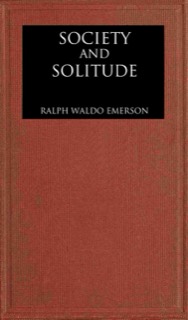
SOCIETY AND SOLITUDE.
These conversations led me somewhat later to the knowledge of similar cases, and to the discovery that they are not of very infrequent occurrence. Few substances are found pure in nature. Those constitutions which can bear in open day the rough dealing of the world must be of that mean and average structure,—such as iron and salt, atmospheric air, and water. But there are metals, like potassium and sodium, which, to be kept pure, must be kept under naphtha. Such are the talents determined on some specialty, which a culminating civilization fosters in the heart of great cities and in royal chambers. Nature protects her own work. To the culture of the world, an Archimedes, a Newton is indispensable; so she guards them by a certain aridity. If these had been good fellows, fond of dancing, port, and clubs, we should have had no “Theory of the Sphere,” and no “Principia.” They had that necessity of isolation which genius feels. Each must stand on his glass tripod, if he would keep his electricity. Even Swedenborg, whose theory of the universe is based on affection, and who reprobates to weariness the danger and vice of pure intellect, is constrained to make an extraordinary exception: “There are also angels who do not live consociated, but separate, house and house; these dwell in the midst of heaven, because they are the best of angels.”