Doomreader

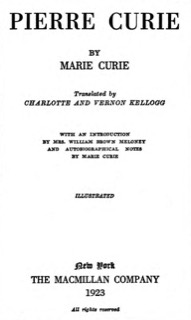
Pierre Curie

by Marie Curie

Length: 51,724 words, about 207 pages, about 4 hours to read

Lives and letters, Science and nature

Read Pierre Curie free, starting with its best pages and lines below. Listen to it free too, read aloud by your phone's own voice.

The best passages

Pages from the book itself, chosen to make you want to read on. Each opens in the reader at that exact spot.

CHAPTER I THE CURIE FAMILY. INFANCY AND FIRST STUDIES OF PIERRE CURIE

Pierre Curie's parents, who were educated and intelligent, formed a part of the petite bourgeoisie of small means. They did not frequent fashionable society, but confined themselves entirely to the companionship of their relatives and a few intimate friends.

Eugène Curie, Pierre's father, was a physician and the son of a physician. He knew very few kinsmen of his name, and very little about the Curie family, which was of Alsatian (Eugène Curie was born at Mulhouse in 1827) and Protestant origin. Even though his father was established in London, Eugène had been brought up in Paris, where he pursued his studies in the natural sciences and medicine, and worked as preparator under Gratiollet in the laboratories of the Museum.

Doctor Eugène Curie's remarkable personality impressed all who approached him. He was a tall man, who in youth must have been blonde, with beautiful blue eyes of a clearness and brilliancy that were striking even in an advanced old age. These eyes, which had retained a child-like expression, reflected goodness and intelligence. He had indeed unusual intellectual capacities, a very live aptitude for the natural sciences, and the temperament of a scholar.
Keep reading from here

CHAPTER IV MARRIAGE AND ORGANIZATION OF THE FAMILY LIFE. PERSONALITY AND CHARACTER

I met Pierre Curie for the first time in the spring of the year 1894. I was then living in Paris where for three years I[6] had been studying at the Sorbonne. I had passed the examinations for the licentiate in physics, and was preparing for those in mathematics. At the same time I had begun to work in the research laboratory of Professor Lippmann. A Polish physicist whom I knew, and who was a great admirer of Pierre Curie, one day invited us together to spend the evening with himself and his wife.

As I entered the room, Pierre Curie was standing in the recess of a French window opening on a balcony. He seemed to me very young, though he was at that time thirty-five years old. I was struck by the open expression of his face and by the slight suggestion of detachment in his whole attitude. His speech, rather slow and deliberate, his simplicity, and his smile, at once grave and youthful, inspired confidence. We began a conversation which soon became friendly. It first concerned certain scientific matters about which I was very glad to be able to ask his opinion. Then we discussed certain social and humanitarian subjects which interested us both. There was, between his conceptions and mine, despite the difference between our native countries, a surprising kinship, no doubt attributable to a certain likeness in the moral atmosphere in which we were both raised by our families.

Keep reading from here

CHAPTER V THE DREAM BECOME A REALITY. THE DISCOVERY OF RADIUM

During the course of my research, I had had occasion to examine not only simple compounds, salts and oxides, but also a great number of minerals. Certain ones proved radioactive; these were those containing uranium and thorium; but their radioactivity seemed abnormal, for it was much greater than the amount I had found in uranium and thorium had led me to expect.

This abnormality greatly surprised us. When I had assured myself that it was not due to an error in the experiment, it became necessary to find an explanation. I then made the hypothesis that the ores uranium and thorium contain in small quantity a substance much more strongly radioactive than either uranium or thorium. This substance could not be one of the known elements, because these had already been examined; it must, therefore, be a new chemical element.

I had a passionate desire to verify this hypothesis as rapidly as possible. And Pierre Curie, keenly interested in the question, abandoned his work on crystals (provisionally, he thought) to join me in the search for this unknown substance.

Keep reading from here

CHAPTER II

Yet it was in this miserable old shed that we passed the best and happiest years of our life, devoting our entire days to our work. Often I had to prepare our lunch in the shed, so as not to interrupt some particularly important operation. Sometimes I had to spend a whole day mixing a boiling mass with a heavy iron rod nearly as large as myself. I would be broken with fatigue at the day's end. Other days, on the contrary, the work would be a most minute and delicate fractional crystallization, in the effort to concentrate the radium. I was then annoyed by the floating dust of iron and coal from which I could not protect my precious products. But I shall never be able to express the joy of the untroubled quietness of this atmosphere of research and the excitement of actual progress with the confident hope of still better results. The feeling of discouragement that sometimes came after some unsuccessful toil did not last long and gave way to renewed activity. We had happy moments devoted to a quiet discussion of our work, walking around our shed.

One of our joys was to go into our workroom at night; we then perceived on all sides the feebly luminous silhouettes of the bottles or capsules containing our products. It was really a lovely sight and one always new to us. The glowing tubes looked like faint, fairy lights.

Keep reading from here

10 of the best lines

His dreamer's spirit would not submit itself to the ordering of the intellectual effort imposed by the school.

CHAPTER I THE CURIE FAMILY. INFANCY AND FIRST STUDIES OF PIERRE CURIEKeep reading from here

He never published any of these investigations, for he had the habit of thus engaging in the pursuit of phenomena, often with little hope of success, solely for the love of the unforeseen, and without ever thinking of publication.

CHAPTER III LIFE AS THE DIRECTOR OF LABORATORY WORK IN THE SCHOOL OF PHYSICS AND CHEMISTRY. GENERALIZATION OF THE PRINCIPLE OF SYMMETRY. INVESTIGATIONS OF MAGNETISMKeep reading from here

Whatever happens, even if one should become like a body without a soul, still one must always work.

CHAPTER IV MARRIAGE AND ORGANIZATION OF THE FAMILY LIFE. PERSONALITY AND CHARACTERKeep reading from here

This defied all contemporary scientific experience.

CHAPTER VI THE STRUGGLE FOR MEANS TO WORK. THE BURDEN OF CELEBRITY. THE FIRST ASSISTANCE FROM THE STATE. IT COMES TOO LATEKeep reading from here

Between the days of fecund productivity are inserted days of uncertainty when nothing seems to succeed, and when even matter itself seems hostile; and it is then that one must hold out against discouragement.

CHAPTER VII THE NATION'S SORROW. THE LABORATORIES: "SACRED PLACES"Keep reading from here

But there may be in a life some general direction, some continuous thread, due to a few dominant ideas and a few strong feelings, that explain the life and are characteristic of a human personality.

CHAPTER IKeep reading from here

This life, painful from certain points of view, had, for all that, a real charm for me.

CHAPTER IKeep reading from here

It was like creating something out of nothing, and if my earlier studying years had once been called by my brother-in-law the heroic period of my life, I can say without exaggeration that the period on which my husband and I now entered was truly the heroic one of our common life.

CHAPTER IIKeep reading from here

I have been frequently questioned, especially by women, how I could reconcile family life with a scientific career.

CHAPTER IIKeep reading from here

Humanity, surely, needs practical men who make the best of their work for the sake of their own interests, without forgetting the general interest. But it also needs dreamers, for whom the unselfish following of a purpose is so imperative that it becomes impossible for them to devote much attention to their own material benefit.

CHAPTER IIIKeep reading from here

All 36 Pierre Curie quotes, with the words around each

Reviews

No reviews yet. Be the first, in the app.

Write a review in Doomreader

Contents

  1. CHARLOTTE AND VERNON KELLOGG
  2. ILLUSTRATED
  3. NEW YORK THE MACMILLAN COMPANY 1923
  4. TRANSLATORS' NOTE
  5. PREFACE
  6. THE LIFE STORY OF PIERRE CURIE
  7. INTRODUCTION
  8. CHAPTER I THE CURIE FAMILY. INFANCY AND FIRST STUDIES OF PIERRE CURIE
  9. CHAPTER II DREAMS OF YOUTH. FIRST SCIENTIFIC WORK. DISCOVERY OF PIEZO-ELECTRICITY
  10. CHAPTER III LIFE AS THE DIRECTOR OF LABORATORY WORK IN THE SCHOOL OF PHYSICS AND CHEMISTRY. GENERALIZATION OF THE PRINCIPLE OF SYMMETRY. INVESTIGATIONS OF MAGNETISM
  11. CHAPTER IV MARRIAGE AND ORGANIZATION OF THE FAMILY LIFE. PERSONALITY AND CHARACTER
  12. CHAPTER V THE DREAM BECOME A REALITY. THE DISCOVERY OF RADIUM
  13. CHAPTER VI THE STRUGGLE FOR MEANS TO WORK. THE BURDEN OF CELEBRITY. THE FIRST ASSISTANCE FROM THE STATE. IT COMES TOO LATE
  14. CHAPTER VII THE NATION'S SORROW. THE LABORATORIES: "SACRED PLACES"
  15. AUTOBIOGRAPHICAL NOTES—MARIE CURIE
  16. CHAPTER I
  17. CHAPTER II
  18. CHAPTER III
  19. CHAPTER IV A VISIT TO AMERICA

Listen to Pierre Curie free

Pierre Curie as a free audiobook: Doomreader reads any book aloud, free, in your phone's or computer's own voice. Open the book and tap listen, at the speed you like, hands free.

Want a more natural voice? The AI voices read with AI credits.

Listen free in Doomreader

Download Pierre Curie free

The whole book as an EPUB file, free and legal, from Project Gutenberg. It opens in any ebook app, or read it here in Doomreader with nothing to install.

Download the EPUB (1.7 MB)

More like Pierre Curie

About this edition

Text from Project Gutenberg. In the public domain in the USA. The Project Gutenberg License is kept inside the file. Every passage and line on this page is the book's own words, checked against the text.