Doomreader

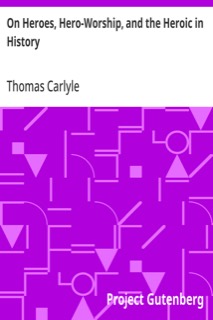
On Heroes, Hero-Worship, and the Heroic in History

by Thomas Carlyle

Length: 91,432 words, about 366 pages, about 6 hours to read

Essays and ideas, History and travel

Read On Heroes, Hero-Worship, and the Heroic in History free, starting with its best pages and lines below. Listen to it free too, read aloud by your phone's own voice.

The best passages

Pages from the book itself, chosen to make you want to read on. Each opens in the reader at that exact spot.

[May 5, 1840.]

We have undertaken to discourse here for a little on Great Men, their manner of appearance in our world's business, how they have shaped themselves in the world's history, what ideas men formed of them, what work they did;—on Heroes, namely, and on their reception and performance; what I call Hero-worship and the Heroic in human affairs. Too evidently this is a large topic; deserving quite other treatment than we can expect to give it at present. A large topic; indeed, an illimitable one; wide as Universal History itself. For, as I take it, Universal History, the history of what man has accomplished in this world, is at bottom the History of the Great Men who have worked here. They were the leaders of men, these great ones; the modellers, patterns, and in a wide sense creators, of whatsoever the general mass of men contrived to do or to attain; all things that we see standing accomplished in the world are properly the outer material result, the practical realization and embodiment, of Thoughts that dwelt in the Great Men sent into the world: the soul of the whole world's history, it may justly be considered, were the history of these. Too clearly it is a topic we shall do no justice to in this place!
Keep reading from here

[May 5, 1840.]

One of Thor's expeditions, to Utgard (the Outer Garden, central seat of Jotun-land), is remarkable in this respect. Thialfi was with him, and Loke. After various adventures, they entered upon Giant-land; wandered over plains, wild uncultivated places, among stones and trees. At nightfall they noticed a house; and as the door, which indeed formed one whole side of the house, was open, they entered. It was a simple habitation; one large hall, altogether empty. They stayed there. Suddenly in the dead of the night loud noises alarmed them. Thor grasped his hammer; stood in the door, prepared for fight. His companions within ran hither and thither in their terror, seeking some outlet in that rude hall; they found a little closet at last, and took refuge there. Neither had Thor any battle: for, lo, in the morning it turned out that the noise had been only the snoring of a certain enormous but peaceable Giant, the Giant Skrymir, who lay peaceably sleeping near by; and this that they took for a house was merely his Glove, thrown aside there; the door was the Glove-wrist; the little closet they had fled into was the Thumb! Such a glove;—I remark too that it had not fingers as ours have, but only a thumb, and the rest undivided: a most ancient, rustic glove!

Keep reading from here

[May 8, 1840.]

Ah no: this deep-hearted Son of the Wilderness, with his beaming black eyes and open social deep soul, had other thoughts in him than ambition. A silent great soul; he was one of those who cannot but be in earnest; whom Nature herself has appointed to be sincere. While others walk in formulas and hearsays, contented enough to dwell there, this man could not screen himself in formulas; he was alone with his own soul and the reality of things. The great Mystery of Existence, as I said, glared in upon him, with its terrors, with its splendors; no hearsays could hide that unspeakable fact, "Here am I!" Such sincerity, as we named it, has in very truth something of divine. The word of such a man is a Voice direct from Nature's own Heart. Men do and must listen to that as to nothing else;—all else is wind in comparison. From of old, a thousand thoughts, in his pilgrimings and wanderings, had been in this man: What am I? What is this unfathomable Thing I live in, which men name Universe? What is Life; what is Death? What am I to believe? What am I to do? The grim rocks of Mount Hara, of Mount Sinai, the stern sandy solitudes answered not. The great Heaven rolling silent overhead, with its blue-glancing stars, answered not. There was no answer. The man's own soul, and what of God's inspiration dwelt there, had to answer!

Keep reading from here

[May 12, 1840.]

In Dante's Priorship, the Guelf-Ghibelline, Bianchi-Neri, or some other confused disturbances rose to such a height, that Dante, whose party had seemed the stronger, was with his friends cast unexpectedly forth into banishment; doomed thenceforth to a life of woe and wandering. His property was all confiscated and more; he had the fiercest feeling that it was entirely unjust, nefarious in the sight of God and man. He tried what was in him to get reinstated; tried even by warlike surprisal, with arms in his hand: but it would not do; bad only had become worse. There is a record, I believe, still extant in the Florence Archives, dooming this Dante, wheresoever caught, to be burnt alive. Burnt alive; so it stands, they say: a very curious civic document. Another curious document, some considerable number of years later, is a Letter of Dante's to the Florentine Magistrates, written in answer to a milder proposal of theirs, that he should return on condition of apologizing and paying a fine. He answers, with fixed stern pride: "If I cannot return without calling myself guilty, I will never return, nunquam revertar."

Keep reading from here

[May 15, 1840.]

Luther's birthplace was Eisleben in Saxony; he came into the world there on the 10th of November, 1483. It was an accident that gave this honor to Eisleben. His parents, poor mine-laborers in a village of that region, named Mohra, had gone to the Eisleben Winter-Fair: in the tumult of this scene the Frau Luther was taken with travail, found refuge in some poor house there, and the boy she bore was named MARTIN LUTHER. Strange enough to reflect upon it. This poor Frau Luther, she had gone with her husband to make her small merchandisings; perhaps to sell the lock of yarn she had been spinning, to buy the small winter-necessaries for her narrow hut or household; in the whole world, that day, there was not a more entirely unimportant-looking pair of people than this Miner and his Wife. And yet what were all Emperors, Popes and Potentates, in comparison? There was born here, once more, a Mighty Man; whose light was to flame as the beacon over long centuries and epochs of the world; the whole world and its history was waiting for this man. It is strange, it is great. It leads us back to another Birth-hour, in a still meaner environment, Eighteen Hundred years ago,—of which it is fit that we say nothing, that we think only in silence; for what words are there! The Age of Miracles past? The Age of Miracles is forever here—!

Keep reading from here

10 of the best lines

It is well said, in every sense, that a man's religion is the chief fact with regard to him.

[May 5, 1840.]Keep reading from here

Sincerity, I think, is better than grace.

[May 5, 1840.]Keep reading from here

Thought, true labor of any kind, highest virtue itself, is it not the daughter of Pain?

[May 12, 1840.]Keep reading from here

The merit of originality is not novelty; it is sincerity.

[May 15, 1840.]Keep reading from here

She is fitter for swimming, I think, than for being worshipped, added Knox; and flung the thing into the river.

[May 15, 1840.]Keep reading from here

Burke said there were Three Estates in Parliament; but, in the Reporters' Gallery yonder, there sat a Fourth Estate more important far than they all.

[May 19, 1840.]Keep reading from here

The contortions of a dying gladiator: the crowded amphitheatre looks on with entertainment; but the gladiator is in agonies and dying.

[May 19, 1840.]Keep reading from here

The sincere alone can recognize sincerity.

[May 22, 1840.]Keep reading from here

The Sun was dimmed many a time; but the Sun had not himself grown a Dimness.

[May 22, 1840.]Keep reading from here

The Atheistic logic runs off from him like water; the great Fact stares him in the face: "Who made all that?"

[May 22, 1840.]Keep reading from here

All 131 On Heroes, Hero-Worship, and the Heroic in History quotes, with the words around each

Reviews

No reviews yet. Be the first, in the app.

Write a review in Doomreader

Contents

  1. LECTURES ON HEROES.
  2. LECTURE I. THE HERO AS DIVINITY. ODIN. PAGANISM: SCANDINAVIAN MYTHOLOGY.
  3. [May 5, 1840.]
  4. LECTURE II. THE HERO AS PROPHET. MAHOMET: ISLAM.
  5. [May 8, 1840.]
  6. LECTURE III. THE HERO AS POET. DANTE: SHAKSPEARE.
  7. [May 12, 1840.]
  8. LECTURE IV. THE HERO AS PRIEST. LUTHER; REFORMATION: KNOX; PURITANISM.
  9. [May 15, 1840.]
  10. LECTURE V. THE HERO AS MAN OF LETTERS. JOHNSON, ROUSSEAU, BURNS.
  11. [May 19, 1840.]
  12. LECTURE VI. THE HERO AS KING. CROMWELL, NAPOLEON: MODERN REVOLUTIONISM.
  13. [May 22, 1840.]

Listen to On Heroes, Hero-Worship, and the Heroic in History free

On Heroes, Hero-Worship, and the Heroic in History as a free audiobook: Doomreader reads any book aloud, free, in your phone's or computer's own voice. Open the book and tap listen, at the speed you like, hands free.

Want a more natural voice? The AI voices read with AI credits.

Listen free in Doomreader

Download On Heroes, Hero-Worship, and the Heroic in History free

The whole book as an EPUB file, free and legal, from Project Gutenberg. It opens in any ebook app, or read it here in Doomreader with nothing to install.

Download the EPUB (0.3 MB)

More by Thomas Carlyle

More like On Heroes, Hero-Worship, and the Heroic in History

About this edition

Text from Project Gutenberg. In the public domain in the USA. The Project Gutenberg License is kept inside the file. Every passage and line on this page is the book's own words, checked against the text.