Doomreader

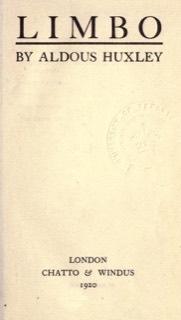
Limbo

by Aldous Huxley

Length: 52,372 words, about 209 pages, about 4 hours to read

Short stories, Satire and humour

Read Limbo free, starting with its best pages and lines below. Listen to it free too, read aloud by your phone's own voice.

The best passages

Pages from the book itself, chosen to make you want to read on. Each opens in the reader at that exact spot.

Chapter I

THE most sumptuous present that Millicent received on her seventh birthday was a doll’s house. “With love to darling little Mill from Aunty Loo.” Aunt Loo was immensely rich, and the doll’s house was almost as grandiose and massive as herself.

It was divided into four rooms, each papered in a different colour and each furnished as was fitting: beds and washstands and wardrobes in the upstair rooms, arm-chairs and artificial plants below. “Replete with every modern convenience; sumptuous appointments.” There was even a cold collation ready spread on the dining-room table—two scarlet lobsters on a dish, and a ham that had been sliced into just enough to reveal an internal complexion of the loveliest pink and white. One might go on talking about the doll’s house for ever, it was so beautiful. Such, at any rate, was the opinion of Millicent’s brother Dick. He would spend hours opening and shutting the front door, peeping through the windows, arranging and rearranging the furniture. As for Millicent, the gorgeous present left her cold. She had been hoping—and, what is more, praying, fervently, every night for a month—that Aunty Loo would give her a toy sewing-machine (one of the kind that works, though) for her birthday.

She was bitterly disappointed when the doll’s house came instead. But she bore it all stoically and managed to be wonderfully polite to Aunty Loo about the whole affair. She never looked at the doll’s house: it simply didn’t interest her.
Keep reading from here

Chapter VI

He decided that he would begin writing his articles at once. He collected pens, paper, and ink and sat down in a business-like way at his bureau. He remembered distinctly biting the tip of his pen-holder; it tasted rather bitter.

And then he realized he was standing in Regent Street, looking in at one of the windows of Liberty’s.

For a long time he stood there quite still, absorbed to all appearance in the contemplation of a piece of peacock-blue fabric. But all his attention was concentrated within himself, not on anything outside. He was wondering—wondering how it came about that he was sitting at his writing-table at one moment, and standing, at the next, in Regent Street. He hadn’t—the thought flashed upon him—he hadn’t been drinking any more of that brandy, had he? No, he felt himself to be perfectly sober. He moved slowly away and continued to speculate as he walked.

At Oxford Circus he bought an evening paper. He almost screamed aloud when he saw that the date printed at the head of the page was August 12th. It was on August 7th that he had sat down at his writing-table to compose those articles. Five days ago, and he had not the faintest recollection of what had happened in those five days.

Keep reading from here

EUPOMPUS GAVE SPLENDOUR TO ART BY NUMBERS

“Zuylerius’ narrative,” he said, “is very bald, but on the whole lucid; and I think it gives one the main points of the story. I will give it you in my own words; that is preferable to reading his Dutch Latin. Eupompus, then, was one of the most fashionable portrait-painters of Alexandria. His clientele was large, his business immensely profitable. For a half-length in oils the great courtesans would pay him a month’s earnings. He would paint likenesses of the merchant princes in exchange for the costliest of their outlandish treasures. Coal-black potentates would come a thousand miles out of Ethiopia to have a miniature limned on some specially choice panel of ivory; and for payment there would be camel-loads of gold and spices. Fame, riches, and honour came to him while he was yet young; an unparalleled career seemed to lie before him. And then, quite suddenly, he gave it all up—refused to paint another portrait. The doors of his studio were closed. It was in vain that clients, however rich, however distinguished, demanded admission; the slaves had their order; Eupompus would see no one but his own intimates.”

Emberlin made a pause in his narrative.

Keep reading from here

HAPPY FAMILIES

THE scene is a conservatory. Luxuriant tropical plants are seen looming through a greenish aquarium twilight, punctuated here and there by the surprising pink of several Chinese lanterns hanging from the roof or on the branches of trees, while a warm yellow radiance streams out from the ball-room by a door on the left of the scene. Through the glass of the conservatory, at the back of the stage, one perceives a black-and-white landscape under the moon—expanses of snow, lined and dotted with coal-black hedges and trees. Outside is frost and death: but within the conservatory all is palpitating and steaming with tropical life and heat. Enormous fantastic plants encumber it; trees, creepers that writhe with serpentine life, orchids of every kind. Everywhere dense vegetation; horrible flowers that look like bottled spiders, like suppurating wounds; flowers with eyes and tongues, with moving, sensitive tentacles, with breasts and teeth and spotted skins.

The strains of a waltz float in through the ball-room door, and to that slow, soft music there enter, in parallel processions, the two families which are respectively Mr. Aston J. Tyrrell and Miss Topsy Garrick.

The doyen of the Tyrrell family is a young and perhaps too cultured literary man with rather long, dark brown hair, a face well cut and sensitive, if a trifle weak about the lower jaw, and a voice whose exquisite modulations could only be the product of education at one of the two Great Universities. We will call him plain Aston.

Keep reading from here

CYNTHIA

I entered the room with my hands over my ears. “For God’s sake——” I implored. Through the open window Tom was shouting a deep E flat, with a spread chord of under- and over-tones, while the guitar gibbered shrilly and hysterically in D natural. Lykeham laughed, banged down his guitar on to the sofa with such violence that it gave forth a trembling groan from all its strings, and ran forward to meet me. He slapped me on the shoulder with painful heartiness; his whole face radiated joy and excitement.

I can sympathize with people’s pains, but not with their pleasures. There is something curiously boring about somebody else’s happiness.

“You are perspiring,” I said coldly.

Lykeham mopped himself, but went grinning.

“Well, what is it this time?” I asked. “Are you engaged to be married again?”

Lykeham burst forth with the triumphant pleasure of one who has at last found an opportunity of disburdening himself of an oppressive secret. “Far better than that,” he cried.

Keep reading from here

10 of the best lines

The discontent rankled under the surface, like a suppressed measles.

Chapter IKeep reading from here

His nerves were twittering and jumping within him; he felt like a walking aviary.

Chapter VIKeep reading from here

How clear and splendid were the ideas of right and justice! If only one could filter away the contaminating human element. . . .

Chapter IXKeep reading from here

She wished she could write about her feelings in an accurate, complicated way, like people in novels; but when she came to think about it, she didn’t seem to have any feelings to describe.

Chapter IKeep reading from here

He took the weak-willed man’s delight in the irrevocability of action.

Chapter IIIKeep reading from here

That is the way of commentators—the obvious points fulsomely explained and discussed, the hard passages, about which one might want to know something passed over in the silence of sheer ignorance.

EUPOMPUS GAVE SPLENDOUR TO ART BY NUMBERSKeep reading from here

Now it’s over, I wonder whether it ever existed.

HAPPY FAMILIESKeep reading from here

He opened the lid, and the yellow keys grinned at me in the darkness like the teeth of an ancient horse.

THE BOOKSHOPKeep reading from here

Love should come unsought on such a night as this, among these black waters and the stars that sleep so peacefully on their bosom.

THE DEATH OF LULLYKeep reading from here

It was already dawn; the candles were hardly visible now in the light, faded to nothing, like souls in prosperity.

THE DEATH OF LULLYKeep reading from here

All 49 Limbo quotes, with the words around each

Reviews

No reviews yet. Be the first, in the app.

Write a review in Doomreader

Contents

  1. FARCICAL HISTORY OF RICHARD GREENOW
  2. Chapter I
  3. Chapter II
  4. Chapter III
  5. Chapter IV
  6. Chapter V
  7. Chapter VI
  8. Chapter VII
  9. Chapter VIII
  10. Chapter IX
  11. Chapter X
  12. HAPPILY EVER AFTER
  13. Chapter I
  14. Chapter II
  15. Chapter III
  16. Chapter IV
  17. EUPOMPUS GAVE SPLENDOUR TO ART BY NUMBERS
  18. HAPPY FAMILIES
  19. CYNTHIA
  20. THE BOOKSHOP
  21. THE DEATH OF LULLY

Listen to Limbo free

Limbo as a free audiobook: Doomreader reads any book aloud, free, in your phone's or computer's own voice. Open the book and tap listen, at the speed you like, hands free.

Want a more natural voice? The AI voices read with AI credits.

Listen free in Doomreader

Download Limbo free

The whole book as an EPUB file, free and legal, from Project Gutenberg. It opens in any ebook app, or read it here in Doomreader with nothing to install.

Download the EPUB (0.2 MB)

More by Aldous Huxley

More like Limbo

About this edition

Text from Project Gutenberg. In the public domain in the USA. The Project Gutenberg License is kept inside the file. Every passage and line on this page is the book's own words, checked against the text.