Doomreader

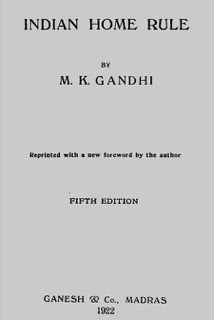
Indian Home Rule

by Mahatma Gandhi

Also known as Hind Swaraj

Length: 32,324 words, about 129 pages, about 2 hours to read

Politics and society

Read Indian Home Rule free, starting with its best pages and lines below. Listen to it free too, read aloud by your phone's own voice.

The best passages

Pages from the book itself, chosen to make you want to read on. Each opens in the reader at that exact spot.

CHAPTER I

The Congress and Its Officials

Reader: Just at present there is a Home Rule wave passing over India. All our countrymen appear to be pining for National Independence. A similar spirit pervades them even in South Africa. Indians seem to be eager after acquiring rights. Will you explain your views in this matter?

Editor: You have well put the question, but the answer is not easy. One of the objects of a newspaper is to understand the popular feeling and to give expression to it; another is to arouse among the people certain desirable sentiments; and the third is fearlessly to expose popular defects. The exercise of all these three functions is involved in answering your question. To a certain extent the people's will has to be expressed; certain sentiments will need to be fostered, and defects will have to be brought to light. But, as you have asked the question, it is my duty to answer it.

Reader: Do you then consider that a desire for Home Rule has been created among us?
Keep reading from here

CHAPTER II

Reader: Considering the matter as you put it, it seems proper to say that the foundation of Home Rule was laid by the Congress. But you will admit that it cannot be considered a real awakening. When and how did the awakening take place?

Editor: The seed is never seen. It works underneath the ground, is itself destroyed, and the tree which rises above the ground is alone seen. Such is the case with the Congress. Yet, what you call the real awakening took place after the Partition of Bengal. For this we have to be thankful to Lord Curzon. At the time of the Partition, the people of Bengal reasoned with Lord Curzon, but, in the pride of power, he disregarded all their prayers—he took it for granted that Indians could only prattle, that they could never take any effective steps. He used insulting language, and, in the teeth of all opposition, partitioned Bengal. That day may be considered to be the day of the partition of the British Empire. The shock that the British power received through the Partition has never been equalled by any other act. This does not mean that the other injustices done to India are less glaring than that done by the Partition. The salt-tax is not a small injustice. We shall see many such things later on. But the people were ready to resist the Partition. At that time, the feeling ran high. Many leading Bengalis were ready to lose their all. They knew their power; hence the conflagration. It is now well nigh unquenchable; it is not necessary to quench it either. Partition will go, Bengal will be re-united, but the rift in the English barque will remain: it must daily widen. India awakened is not likely to fall asleep.

Keep reading from here

CHAPTER IV

Editor: Supposing we get self-government similar to what the Canadians and the South Africans have, will it be good enough?

Reader: That question also is useless. We may get it when we have the same powers; we shall then hoist our own flag. As is Japan, so must India be. We must own our navy, our army, and we must have our own splendour, and then will India's voice ring through the world.

Editor: You have well drawn the picture. In effect it means this: that we want English rule without the Englishman. You want the tiger's nature, but not the tiger; that is to say, you would make India English, and when it becomes English, it will be called not Hindustan but Englistan. This is not the Swaraj that I want.

Reader: I have placed before you my idea of Swaraj as I think it should be. If the education we have received be of any use, if the works of Spencer, Mill and others be of any importance and if the English Parliament be the mother of Parliaments, I certainly think that we should copy the English people and this to such an extent that, just as they do not allow others to obtain a footing in their country, so we should not allow them or others to obtain it in ours. What they have done in their own country has not been done in any other country. It is, therefore, proper for us to import their institutions. But now I want to know your views.

Keep reading from here

CHAPTER VII

Why was India Lost?

Reader: You have said much about civilization—enough to make me ponder over it. I do not now know what I should adopt and what I should avoid from the nations of Europe, but one question comes to my lips immediately. If civilization is a disease, and if it has attacked England why has she been able to take India, and why is she able to retain it?

Editor: Your question is not very difficult to answer, and we shall presently be able to examine the true nature of Swaraj; for I am aware that I have still to answer that question. I will, however, take up your previous question. The English have not taken India; we have given it to them. They are not in India because of their strength, but because we keep them. Let us now see whether these propositions can be sustained. They came to our country originally for purposes of trade. Recall the Company Bahadur. Who made it Bahadur? They had not the slightest intention at the time of establishing a kingdom. Who assisted the Company's officers? Who was tempted at the sight of their silver? Who bought their goods? History testifies that we did all this. In order to become rich all at once, we welcomed the Company's officers with open arms. We assisted them. If I am in the habit of drinking Bhang and a seller thereof sells it to me, am I to blame him or myself? By blaming the seller shall I be able to avoid the habit? And, if a particular retailer is driven away, will not another take his place? A true servant of India will have to go to the root of the matter.

Keep reading from here

CHAPTER XVII

Reader: According to what you say, it is plain that instances of the kind of passive resistance are not to be found in history. It is necessary to understand this passive resistance more fully. It will be better, therefore, if you enlarge upon it.

Editor: Passive resistance is a method of securing rights by personal suffering; it is the reverse of resistance by arms. When I refuse to do a thing that is repugnant to my conscience, I use soul-force. For instance, the government of the day has passed a law which is applicable to me: I do not like it, if, by using violence, I force the government to repeal the law, I am employing what may be termed body-force. If I do not obey the law and accept the penalty for its breach, I use soul-force. It involves sacrifice of self.

Everybody admits that sacrifice of self is infinitely superior to sacrifice of others. Moreover, if this kind of force is used in a cause that is unjust only the person using it suffers. He does not make others suffer for his mistakes. Men have before now done many things which were subsequently found to have been wrong. No man can claim to be absolutely in the right, or that a particular thing is wrong, because he thinks so, but it is wrong for him so long as that is his deliberate judgment. It is, therefore, meet that he should not do that which he knows to be wrong, and suffer the consequence whatever it may be. This is the key to the use of soul-force.

Keep reading from here

10 of the best lines

It is a bad habit to say that another man's thoughts are bad and ours only are good, and that those holding different views from ours are the enemies of the country.

CHAPTER IKeep reading from here

When a man rises from sleep, he twists his limbs and is restless.

CHAPTER IIIKeep reading from here

A man, whilst he is dreaming, believes in his dream; he is undeceived only when he is awakened from his sleep.

CHAPTER VIKeep reading from here

They are not in India because of their strength, but because we keep them.

CHAPTER VIIKeep reading from here

Good travels at a snail's pace—it can, therefore, have little to do with the railways.

CHAPTER IXKeep reading from here

That man who has inspired confidence in another has never lost anything in this world.

CHAPTER XKeep reading from here

One drowning man will never save another.

CHAPTER XIVKeep reading from here

Your reasoning is the same as saying that we can get a rose through planting a noxious weed.

CHAPTER XVIKeep reading from here

When I refuse to do a thing that is repugnant to my conscience, I use soul-force.

CHAPTER XVIIKeep reading from here

One who is free from hatred requires no sword.

CHAPTER XVIIKeep reading from here

All 49 Indian Home Rule quotes, with the words around each

Reviews

No reviews yet. Be the first, in the app.

Write a review in Doomreader

Contents

  1. CHAPTER I
  2. CHAPTER II
  3. CHAPTER III
  4. CHAPTER IV
  5. CHAPTER V
  6. CHAPTER VI
  7. CHAPTER VII
  8. CHAPTER VIII
  9. CHAPTER IX
  10. CHAPTER X
  11. CHAPTER XI
  12. CHAPTER XII
  13. CHAPTER XIII
  14. CHAPTER XIV
  15. CHAPTER XV
  16. CHAPTER XVI
  17. CHAPTER XVII
  18. CHAPTER XVIII
  19. CHAPTER XIX
  20. CHAPTER XX
  21. APPENDICES:

Listen to Indian Home Rule free

Indian Home Rule as a free audiobook: Doomreader reads any book aloud, free, in your phone's or computer's own voice. Open the book and tap listen, at the speed you like, hands free.

Want a more natural voice? The AI voices read with AI credits.

Listen free in Doomreader

Download Indian Home Rule free

The whole book as an EPUB file, free and legal, from Project Gutenberg. It opens in any ebook app, or read it here in Doomreader with nothing to install.

Download the EPUB (0.1 MB)

More by Mahatma Gandhi

More like Indian Home Rule

About this edition

Text from Project Gutenberg. In the public domain in the USA. The Project Gutenberg License is kept inside the file. Every passage and line on this page is the book's own words, checked against the text.