Doomreader

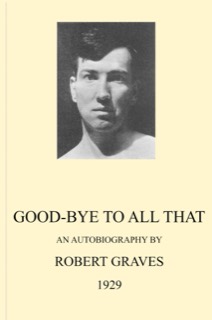
Good-Bye to All That

by Robert Graves

Length: 135,389 words, about 542 pages, about 9 hours to read

Lives and letters, History and travel

Read Good-Bye to All That free, starting with its best pages and lines below. Listen to it free too, read aloud by your phone's own voice.

The best passages

Pages from the book itself, chosen to make you want to read on. Each opens in the reader at that exact spot.

Chapter I

As a proof of my readiness to accept biographical convention, let me at once record my two earliest recollections. The first is being held up to the window to watch a carnival procession for the Diamond Jubilee in 1897 (this was at Wimbledon, where I had been born on 24th July 1895). The second, an earlier recollection still, is looking up with a sort of despondent terror at a cupboard in the nursery, which stood accidentally open and which was filled to the ceiling with octavo volumes of Shakespeare. My father was organiser of a Shakespeare reading circle. I did not know until long afterwards that it was the Shakespeare cupboard, but I, apparently, had then a strong instinct against drawing-room activities. It is only recently that I have overcome my education and gone back to this early intuitional spontaneousness.

When distinguished visitors came to the house, like Sir Sidney Lee with his Shakespearean scholarship, and Lord Ashbourne, not yet a peer, with his loud talk of
Keep reading from here

Chapter IV

They also gave us jam, made of wild roseberries, which they called ‘Hetchi-Petch.’

The most remarkable thing in the castle was an iron chest in a small thick-walled white-washed room at the top of the keep. It was a huge chest, twice the size of the door, and had obviously been made inside the room—there were no windows but arrow-slits. It had two keys. I could not say what its date was, but I recall it as twelfth or thirteenth century work. There was a tradition that it should never be opened unless the castle were in the most extreme danger. One key was held by the baron and one by the steward; I believe the stewardship was a hereditary office. The chest could only be opened by using both keys, and nobody knew what was inside; it was even considered unlucky to speculate. Of course we speculated. It might be gold, more likely it was a store of corn in sealed jars, or even some sort of weapon—Greek fire, perhaps. From what I know of the Aufsesses and their stewards, it is inconceivable that the chest ever got the better of their curiosity. The castle ghost was that of a former baron known as the Red Knight; his terrifying portrait hung half-way up the turret staircase that took us to our bedrooms. We slept for the first time in our lives on feather beds.

Keep reading from here

Chapter VII

While the First Eleven were wondering what on earth to do their three opponents decided to take the war into the enemy’s country.

The social code of Charterhouse was based on a very strict caste system; the caste-marks were slight distinctions in dress. A new boy had no privileges at all; a boy in his second term might wear a knitted tie instead of a plain one; a boy in his second year might wear coloured socks; third year gave most of the privileges—turned down collars, coloured handkerchiefs, a coat with a long roll, and so on; fourth year, a few more, such as the right to get up raffles; but very peculiar and unique distinctions were reserved for the bloods. These included light grey flannel trousers, butterfly collars, coats slit up the back, and the privilege of walking arm-in-arm. So the next Sunday Mansfield, Waller and Taylor did the bravest thing that was ever done at Charterhouse. The school chapel service was at eleven in the morning, but the custom was for the school to be in its seats by five minutes to eleven and to sit waiting there. At two minutes to eleven the bloods used to stalk in; at one and a half minutes to came the masters; at one minute to came the choir in its surplices; then the headmaster arrived and the service started. If any boy was accidentally late and sneaked in between five minutes to and two minutes to the hour, he was followed by six hundred pairs of eyes; there was nudging and giggling and he would not hear the last of it for a long time; it was as though he were pretending to be a blood.

Keep reading from here

Chapter XII

I jumped up on the fire-step beside the sentry and cautiously raising my head stared over the parapet. I could see nothing except the wooden pickets supporting our protecting barbed-wire entanglement and a dark patch or two of bushes beyond. The darkness seemed to move and shake about as I looked at it; the bushes started travelling, singly at first, then both together. The pickets were doing the same. I was glad of the sentry beside me; his name, he told me, was Beaumont. ‘They’re quiet to-night, sir,’ he said, ‘a relief going on; I think so, surely.’ I said: ‘It’s funny how those bushes seem to move.’ ‘Aye, they do play queer tricks. Is this your first spell in trenches, sir?’ A German flare shot up, broke into bright flame, dropped slowly and went hissing into the grass just behind our trench, showing up the bushes and pickets. Instinctively I moved. ‘It’s bad to do that, sir,’ he said, as a rifle bullet cracked and seemed to pass right between us. ‘Keep still, sir, and they can’t spot you. Not but what a flare is a bad thing to have fall on you. I’ve seen them burn a hole in a man.’

Keep reading from here

Chapter XIV

There was constant mining going on in this Cambrin-Cuinchy sector. We had the prospect of being blown up at any moment. An officer of the R.E. tunnelling company was awarded the Victoria Cross while we were here. A duel of mining and counter-mining was going on. The Germans began to undermine his original boring, so he rapidly tunnelled underneath them. It was touch and go who would get the mine ready first. He won. But when he detonated it from the trench by an electric lead, nothing happened. He ran down again into the mine, retamped the charge, and was just back in time to set it off before the Germans. I had been into the upper boring on the previous day. It was about twenty feet under the German lines. At the end of the gallery I found a Welsh miner, one of our own men who had transferred to the Royal Engineers, on listening duty. He cautioned me to silence. I could distinctly hear the Germans working somewhere underneath. He whispered: ‘So long as they work, I don’t mind; it’s when they stop.’ He did his two-hour spell by candle-light. It was very stuffy. He was reading a book. The mining officer had told me that they were allowed to read; it didn’t interfere with their listening. It was a paper-backed novelette called From Mill Girl to Duchess. The men of the tunnelling companies were notorious thieves, by the way. They would snatch things up from the trench and scurry off with them into their borings; just like mice.

Keep reading from here

10 of the best lines

Clear spectacle: where is the eye?

WORLD’S ENDKeep reading from here

The value of coins seemed less fictitious to me than stamp values.

Chapter IIIKeep reading from here

Crime, of course, meant any breach of army regulations; and there was plenty of it.

Chapter XKeep reading from here

Those who are killed can’t complain, the wounded would have given far more than that to escape as they have, and the unwounded regard the money as a consolation prize for still being here.

Chapter XIIIKeep reading from here

Festubert was nightmare, and had been so since the first fighting there in 1914, when the inmates of its lunatic asylum had been caught between two fires and broken out and run all over the countryside.

Chapter XVIKeep reading from here

It often happened when both sides were busy putting up proper defences that they turned a blind eye to each other’s work.

Chapter XVIIIKeep reading from here

Every one was mad; we were hardly sane ourselves.

Chapter XXIKeep reading from here

At this stage of the war, sugar was practically unobtainable; the wedding cake was in three tiers, but all the sugar icing was plaster.

Chapter XXVKeep reading from here

‘If we could find the exact house, surely to goodness we can find a mere lump sum of money.’

Chapter XXVIIIKeep reading from here

The audience talked all the time and ate peanuts, oranges, sunflower-seeds and heads of lettuces.

Chapter XXXIIKeep reading from here

All 68 Good-Bye to All That quotes, with the words around each

Reviews

No reviews yet. Be the first, in the app.

Write a review in Doomreader

Contents

All 37 parts
  1. WORLD’S END
  2. Chapter I
  3. Chapter II
  4. Chapter III
  5. Chapter IV
  6. Chapter V
  7. Chapter VI
  8. Chapter VII
  9. Chapter VIII
  10. Chapter IX
  11. Chapter X
  12. Chapter XI
  13. Chapter XII
  14. Chapter XIII
  15. Chapter XIV
  16. Chapter XV
  17. Chapter XVI
  18. Chapter XVII
  19. Chapter XVIII
  20. Chapter XIX
  21. Chapter XX
  22. Chapter XXI
  23. Chapter XXII
  24. Chapter XXIII
  25. Chapter XXIV
  26. Chapter XXV
  27. Chapter XXVI
  28. Chapter XXVII
  29. Chapter XXVIII
  30. Chapter XXIX
  31. Chapter XXX
  32. Chapter XXXI
  33. Chapter XXXII
  34. Dedicatory Epilogue To Laura Riding
  35. Footnotes
  36. ERRATUM
  37. Corrections:

Listen to Good-Bye to All That free

Good-Bye to All That as a free audiobook: Doomreader reads any book aloud, free, in your phone's or computer's own voice. Open the book and tap listen, at the speed you like, hands free.

Want a more natural voice? The AI voices read with AI credits.

Listen free in Doomreader

Download Good-Bye to All That free

The whole book as an EPUB file, free and legal, from Project Gutenberg. It opens in any ebook app, or read it here in Doomreader with nothing to install.

Download the EPUB (2.5 MB)

More like Good-Bye to All That

About this edition

Text from Project Gutenberg. In the public domain in the USA. The Project Gutenberg License is kept inside the file. Every passage and line on this page is the book's own words, checked against the text.