CHAPTER III THE INVENTION OF THE REAPER
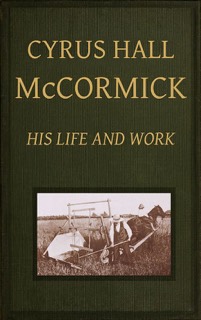
The young inventor toiled "laboriously," he says, to complete his Reaper in time for the harvest of 1831. He was very nearly too late, but a small patch of wheat was left standing at his request; and one day in July, with no spectators except his parents and his excited brothers and sisters, Cyrus put a horse between the shafts of his Reaper, and drove against the yellow grain. The reel revolved and swept the gentle wheat downwards upon the knife. Click! Click! Click! The white steel blade shot back and forth. The grain was cut. It fell upon the platform in a shimmering golden swath. From here it was raked off by a young laborer named John Cash. It was a roughly done specimen of reaping, no doubt. The reel and the divider worked poorly. But for a preliminary test it was a magnificent success. Here, at last, was a Reaper that reaped, the first that had ever been made in any country.
The scene of this first "reaping by horse-power" was then, and is to-day, one of unusual beauty. The field is near by the farm-house, rolling in several undulations to the rim of a winding little rivulet. In the centre of the field is a single tree, a wide-branched white oak, which was probably born before the first colonists arrived at Jamestown. And in the background, not more than two miles distant, rise the tall and jagged crags of the Blue Ridge, twelve sharp peaks flung high from deep ravines, on which the lights and shades are incessantly changing,—a most impressive staging for the first act of the drama of the Reaper.